
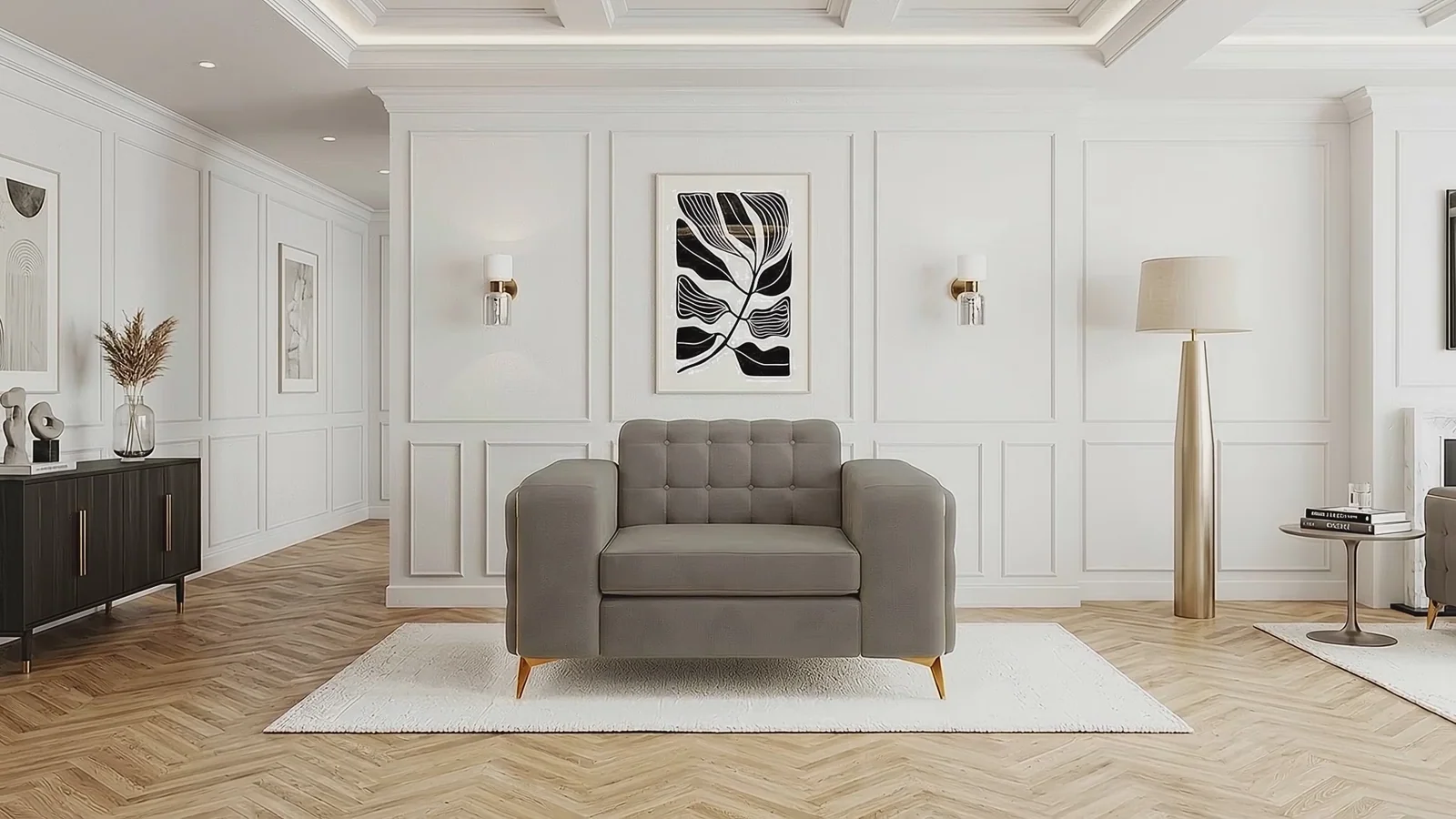
The right sofa for a small living room is the largest one that suits the floor plan and still fits through every gap between the street and the room. In a London flat, the second test is usually the harder one. A Victorian terrace split into flats, a mansion block with a cramped lift, or a conversion reached by a winding stair can each stop a sofa that would have looked fine inside.
Measure twice, then shop.
What is the best sofa for a very small living room?
The best sofa for a very small living room is usually a compact 2 seater or a wide 1 seater sofa, kept shallow and lifted on legs. Visible floor beneath the frame lets light travel under it, so the room reads as larger. One generous sofa also tends to work better than a smaller sofa paired with an armchair, because the gap between two separate pieces becomes dead floor.
Slim arms help too. They keep the overall width down, so the sofa slips into a narrow alcove more easily.
Measure the room and the route into the flat
A sofa’s footprint is its width multiplied by its depth, and masking tape on the floor is the simplest way to test it. Mark the outline and leave it down for a few days while you live around it. If you keep stepping on the tape, the sofa is too big. Sofas also look smaller in a showroom than at home, because a showroom gives each piece far more space than a living room can.
The route matters just as much in London. Walk it from the pavement to the living room with a tape measure and note the narrowest point of every doorway and stair, with each door fully open. Radiators in communal hallways and low light fittings on landings both steal space.
Doorways
The most common internal door in England and Wales is 762 mm wide, and the clear gap is narrower still once the frame and open door are allowed for. The arithmetic is simple. A compact 2 seater 80 cm deep is already wider than a 762 mm door, so it cannot be carried straight through the door as it stands. It has to be tilted or angled through instead.
Diagonal depth
Diagonal depth is the measurement that shows whether a sofa can be tilted through a gap narrower than its depth. Take the seat cushions off and lay a straight edge from the top of the back to the front of the arm. Then measure from the bottom rear corner of the sofa up to that line. If the figure is smaller than the clear width of the door, the sofa can usually be angled through.
Stairs, landings and lifts
A staircase is measured at its narrowest point, which in most stairwells is the gap between the handrail and the opposite wall. Where a sofa has to be lifted over a bannister on a turn, the height between the bannister and the ceiling must be greater than the sofa’s depth. Half landings in converted houses are a common sticking point.
In a lift, check the open door width and the internal depth against the sofa, and ask the managing agent for the weight limit. Some sofas have feet that unscrew, which helps on every one of these checks.
Which type of sofa is best for a small living room?
A slimline 2 seater or a single seat with square arms suits most small living rooms. The right size depends on how many people sit on it and how much clear wall the room has. Square, tight arms give more sitting room per centimetre than rolled arms, which add bulk at each end.
Single seats and reference sizes
M&H Living, a Yorkshire maker of handmade fabric sofas, publishes useful reference sizes. Its 2 seaters run from 152 to 170 cm wide and 80 to 90 cm deep. Its single seats are listed at 105 to 120 cm long, so one can fill a wide alcove beside a chimney breast where a 2 seater would not fit. Free standard delivery goes to the front door, and placement in the room of your choice needs the paid Expert Assembly add-on, which is worth pricing in for an upper-floor flat.
Corner sofas in a small living room
A corner sofa can work in a small living room when it sits tight into a corner and the floor in front stays clear. A compact corner sofa with a short chaise suits a small room better than a long L shape. Choose the chaise side against the door swing before ordering, because on many designs it cannot be swapped after delivery. A corner sofa that arrives in separate sections is far easier to carry up a London stairwell than a one-piece sofa of the same size.
Colour and fabric for a small living room
Light neutrals such as cream or pale grey make a small living room feel more open, which matters in flats with limited daylight. Dark colours still have a place. A navy sofa tucked into a corner with low lamps makes a snug evening room.
Fabric matters more when one sofa takes all the daily wear. A Martindale rub count between 15,000 and 25,000 is the usual band for general domestic use. Any upholstered sofa sold new in the UK must also meet the Furniture and Furnishings (Fire) (Safety) Regulations 1988. In a flat with a cat, a velvet pile tends to snag less easily than a loose weave, and samples are worth judging by the window and again under evening lamps.
How do I know if my sofa is too big for my living room?
A sofa is too big for a living room if you have to turn sideways to pass it or if it runs the full length of a wall. A London flat adds a second test. If the sofa cannot clear the narrowest door or stair turn on its way in, it is too big however well it would suit the room.
Before paying, send the retailer your narrowest door width and stair measurements, and ask for written confirmation that the sofa will get through. Ten minutes with a tape measure costs far less than a sofa stuck on a half landing.