
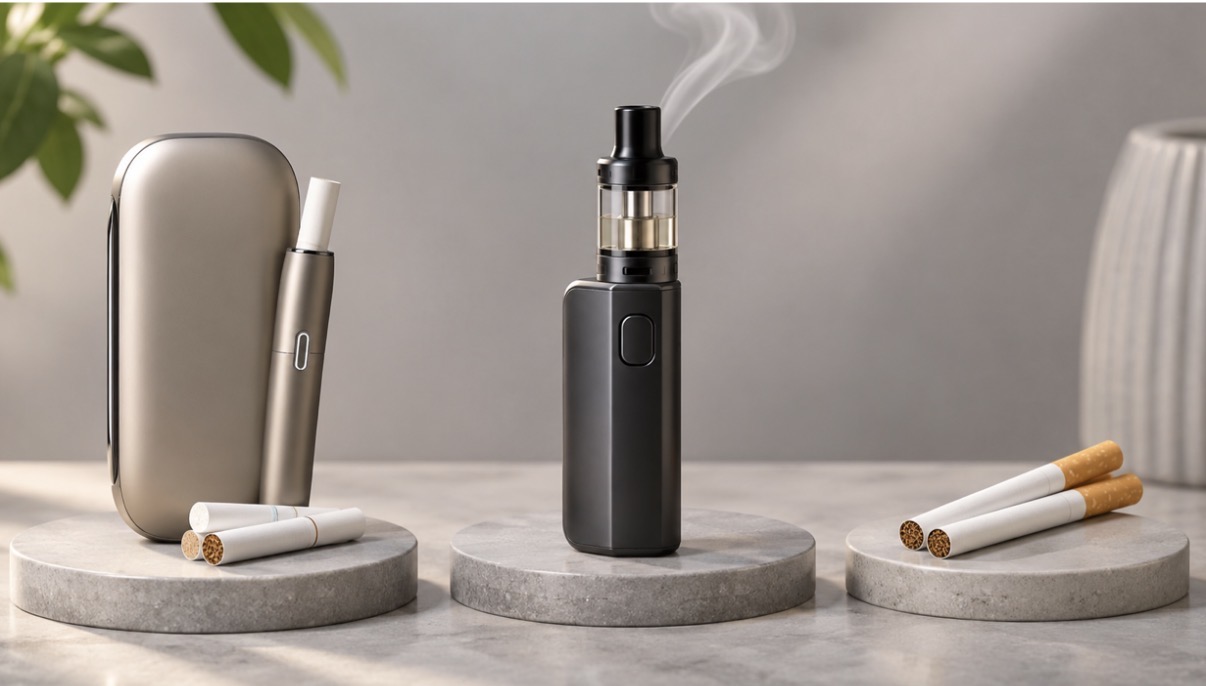
People talk about cigarettes, vapes and heated tobacco as if they were three versions of the same product. Underneath, they run on three different technologies.
The quickest way to tell them apart is to ask what gets heated and how hot. A cigarette burns tobacco leaf, with the tip reaching as high as about 950°C (1,740°F). A heated tobacco device warms processed tobacco to about 250-350°C (480-660°F), low enough that it never catches fire. A vape heats a nicotine liquid and contains no tobacco leaf at all.
Heated tobacco, vaping and cigarettes at a glance
| Cigarettes | Heated tobacco | Vapes | |
| Main ingredient | Tobacco leaf | Processed tobacco leaf | Liquid with nicotine, propylene glycol and glycerin |
| Heat source | A flame, then the burn itself | Battery-powered heater | Battery-powered coil |
| Typical temperature | About 700-950°C at the burning tip | About 250-350°C | Varies by device and power setting |
| Produces | Smoke | Aerosol | Aerosol |
| What gets used up | The whole cigarette | One tobacco stick per session | Liquid from a pod or tank |
| Left behind | Ash and a stub | The used stick | An empty pod or tank |
| Contains nicotine | Yes | Yes | Usually |
Two rows tend to surprise people. Vapes have no tobacco leaf in them, and a heated tobacco stick comes out of the device whole, with no ash.
Where did heated tobacco technology come from?
It’s older than most people assume. The first products appeared in the late 1980s, though the category only took off once electronic devices with precise temperature control arrived in the mid-2010s.
- 1988: R.J. Reynolds launched Premier, which heated the tobacco with a carbon tip. It was off the market within about a year.
- 1998: Philip Morris launched Accord, an early electrically heated system that stayed on sale for eight years.
- 2014: modern electronic heated tobacco devices launched in Japan, Italy and Switzerland.
- 2016: Japan Tobacco launched Ploom TECH and BAT launched glo in Japan, which became the main test market for the category.
| By the numbers
In Great Britain, 28% of adults had heard of heated tobacco in 2025, compared with 9% in 2017, according to ASH and YouGov. |
What is the difference between heated tobacco and cigarettes?
Both use tobacco. A cigarette burns it, though, while heated tobacco is warmed electronically and kept below the point where combustion starts. Combustion is a reaction with oxygen that keeps going on its own once lit, which is why a cigarette has a glowing ember and a heated tobacco stick doesn’t.
The other big difference is who controls the heat. Every draw on a cigarette pulls in oxygen and makes the tip hotter. In a heated device, sensors and software set the temperature and the person holding it has no say.
Both still contain tobacco and nicotine, though, and both are regulated as tobacco products.
Is heated tobacco the same as vaping?
No, even though both run on batteries. A vape heats a liquid and a heated tobacco device heats real tobacco, and the law treats them differently too: in the UK and the EU, vapes fall under e-cigarette rules, while heated tobacco is classed as a novel tobacco product.
Inside a vape there’s a coil, a wick and a liquid made mostly of propylene glycol and glycerin, usually with nicotine. A heated tobacco device has a heater and a chamber for a single-use stick. That changes how each one gets used. A vape works whenever it’s picked up, until the liquid or the battery runs out, while heated tobacco runs in timed sessions of one stick each.
How do heated tobacco devices compare with vapes on design?
Both are small and rechargeable, but they’re built around different jobs. A heated tobacco device has to hold one exact temperature for a fixed session. A vape has to get liquid onto a hot coil whenever someone inhales.
Heated tobacco devices use one of four heating designs: a blade inside the tobacco, induction heating a metal strip in the stick, an external chamber wrapped around the stick, or heated air passing through it. Their batteries work differently from a vape’s as well, drawing a burst of power to pre-heat and then just enough to hold the temperature, where a vape draws power each time it’s used.
The PLOOM AURA from Ploom is an example of the airflow design. Its HEATFLOW technology pre-heats in about 25 seconds (30 in its intensive mode) and runs a five-minute session, and a full charge covers about 20 sessions.
What do heated tobacco, vapes and cigarettes have in common?
All three usually contain nicotine, which is addictive. They’re all age-restricted, at 18 in the UK and the EU and 21 in the US, and most countries limit how they can be advertised. None of them is risk-free.