
Jim Murphy speaks with entrepreneur Viktor Snakin about the future of energy, the limits of electrification, Europe’s difficult transition towards a circular economy, and why oil regeneration and battery recycling may ultimately belong to the same industrial transformation.
There is something slightly paradoxical about discussing the future of energy with Viktor Snakin in the Gulf, a region whose modern prosperity was built in large part on hydrocarbons, while our conversation ranges from electric vehicles and batteries to resource security, European industry and the question of whether an economy can ever become genuinely circular.
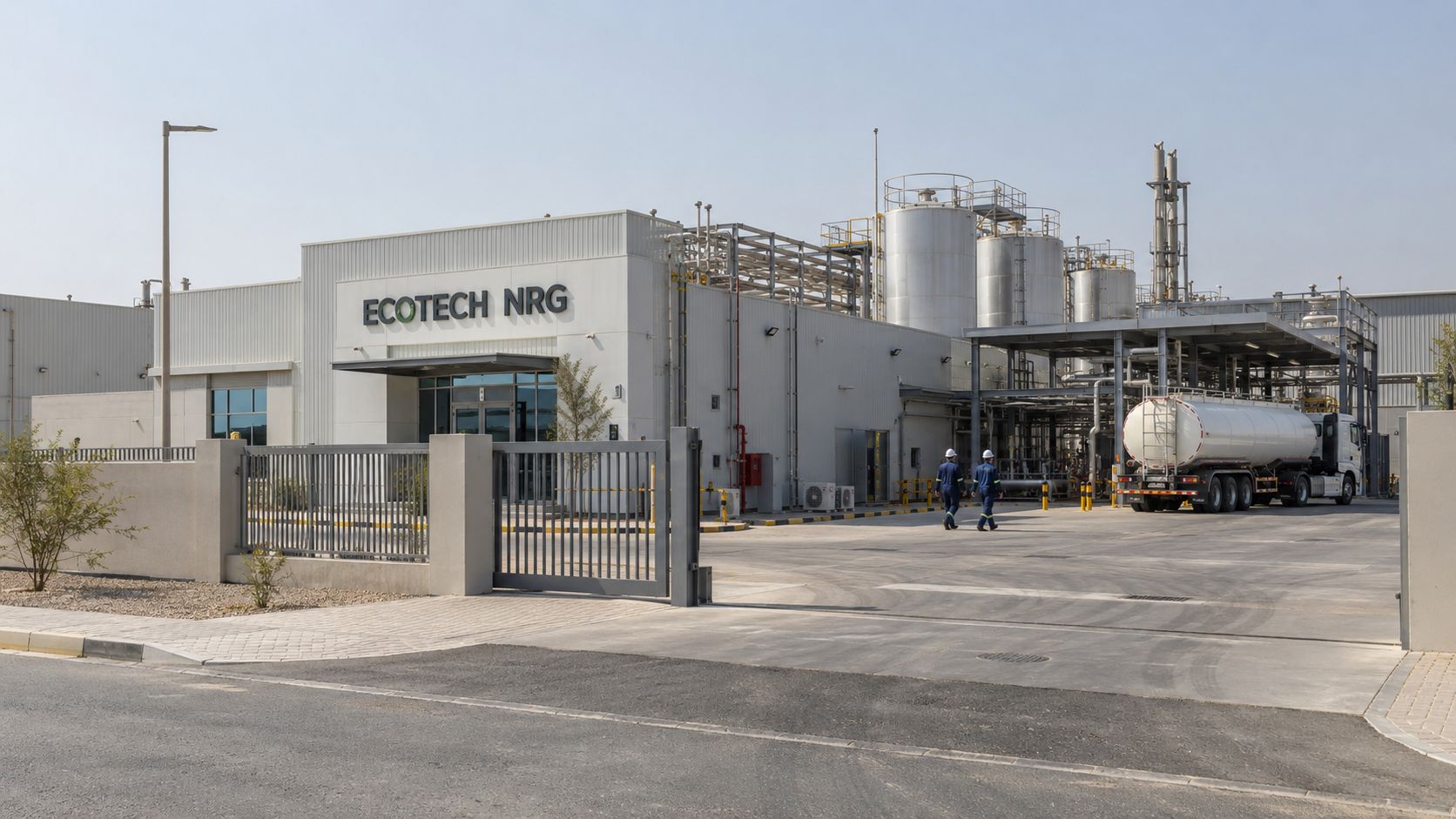
Snakin is developing ECOTECH NRG, whose first industrial facility in Sharjah’s Hamriyah Free Zone is designed to regenerate used automotive and industrial oils, recovering material that would otherwise be treated as waste or burned as low-grade fuel and returning it to the industrial cycle.
For him, however, the larger question is not whether electricity will eventually defeat oil, but how different technologies will coexist during a transition that may take decades.
Jim Murphy: We have spent the past decade hearing that transport is going electric, so isn’t there something contradictory about building a business around used oil at precisely the moment when much of the world appears to be moving away from it?
Viktor Snakin: I do not see those trends as contradictory, because that assumes that the passenger car and the industrial economy are effectively the same technological system, when they are not. Electric vehicles are clearly going to take an increasingly important share of passenger transport, and in many applications that makes perfect economic and environmental sense, but the moment you move beyond the private car you encounter trucks, construction machinery, mining equipment, aircraft, ships, agricultural machinery, generators, hydraulic systems, gearboxes and industrial installations, all of which operate under completely different technical constraints. Even an electric car sits at the end of a vast industrial chain involving mining, manufacturing, transport and machinery, so saying that petrol and diesel will become less important in passenger cars is not the same as saying that lubricants and petroleum-derived industrial products disappear from the economy. My view is therefore pragmatic: electrify what can be electrified efficiently, improve what cannot yet be electrified, and stop wasting resources in both systems.
Jim Murphy: So the energy transition is not really a transition from one technology to another?
Viktor Snakin: Not in the clean, linear way in which it is sometimes presented. Different technologies will win in different applications and at different speeds, because a car travelling twenty kilometres through Paris presents a completely different energy problem from a container ship crossing an ocean, an excavator operating at a mine or a military vehicle that may have to function for days without dependable infrastructure. Environmental policy becomes less useful when we begin with a preferred technology and then try to make every industrial problem fit it; what should matter is the result — lower emissions, greater efficiency, lower consumption of resources and a system that remains economically and operationally resilient.
Jim Murphy: Military vehicles are an interesting extreme. Are we eventually going to see electric tanks?
Viktor Snakin: Militaries are already experimenting with hybrid and electric systems, which is interesting precisely because they are not choosing them for environmental symbolism but for practical advantages such as torque, quiet operation and the ability to power sophisticated electronic equipment. At the same time, the military thinks obsessively about resilience, and a sixty-tonne vehicle cannot be dependent on finding a functioning charging point in a remote or hostile environment. That is a very good illustration of what I think the wider transition will look like: not one technology eliminating everything else, but different systems being combined according to what the application actually requires.
Jim Murphy: Yet electrification creates another resource problem, because batteries require lithium, nickel, copper and other strategic materials. Are we simply replacing one dependency with another?
Viktor Snakin: We could be, if we repeat the same industrial behaviour with a different set of materials, which is why I think the deeper transformation is not from petroleum to electricity but from a linear economy to a more circular one. For most of the industrial era, we extracted a resource, processed it, manufactured something, used it and eventually discarded it; in a world of more than eight billion people and increasingly competitive supply chains, that model becomes harder to justify. Whether the material is petroleum, lithium, nickel or copper, the more important question is how many times we can use it before we have to extract more. If we replace millions of combustion vehicles with electric cars and then simply discard the batteries after their first useful life, we have changed the technology without really changing the philosophy.
Jim Murphy: So battery recycling and oil regeneration belong to the same industrial idea?
Viktor Snakin: Philosophically, yes, even though technically they are completely different industries, because in both cases you are dealing with something society has already paid to extract, process, transport and turn into a useful product. Used oil illustrates the problem particularly well: because it is dark and contaminated, we instinctively classify it as waste, whereas chemically there is still considerable value inside it. Depending on the quality of the feedstock, the process we are developing can potentially recover around 70% as usable base oil, with other fractions also becoming commercial products, so the question is not whether the material looks used but whether there is enough value left inside it to justify recovering it.
Jim Murphy: What is different about the model you are developing? Oil regeneration itself is obviously not a new idea.
Viktor Snakin: Of course not, and I would never claim that we invented molecular distillation or the idea of regenerating lubricants. What we are trying to develop is an industrial model that combines established processing stages — including thin-film evaporation, molecular distillation and extraction — in a facility that can be commercially scaled while producing a consistent product from a feedstock that is inherently variable. The first line is designed for around 500 litres an hour, but the surrounding infrastructure is being built with expansion towards 2,000 litres an hour in mind, so from the beginning we are treating the plant not as a laboratory demonstration but as a model that, if the economics and yields are confirmed, can be reproduced in other markets. That distinction matters to me because there are many environmental technologies that work beautifully in presentations; the real question is whether they can operate continuously, satisfy regulators, produce something customers will buy and make financial sense without permanently depending on environmental goodwill.
Jim Murphy: That sounds almost brutally commercial for an environmental project.
Viktor Snakin: I actually think commercial viability is one of the best things that can happen to an environmental technology, because if you tell a company that it should adopt a process simply because it is morally desirable, you are asking management to accept an additional cost for ethical reasons, whereas if the same process reduces waste, recovers value from a material that was previously discarded and reduces exposure to raw-material costs, you have aligned the environmental objective with the economic one. At that point you no longer need every chief executive to be an environmental activist, because the incentive begins to operate by itself, and that is when a technology has the possibility of scaling.
Jim Murphy: Your first facility is in the UAE, but you have spoken about Europe as a future market. Why Europe?
Viktor Snakin: Because Europe presents almost the perfect case for this kind of transitional technology: it has very ambitious environmental objectives and is moving rapidly towards electrification, but it also has an enormous existing vehicle and industrial base that cannot simply be replaced overnight. New electric-car sales can grow very quickly while the overall fleet changes much more slowly, and for many years Europe will therefore operate a mixed system in which electric vehicles, combustion vehicles, hybrids and an enormous range of industrial machinery coexist. For me, that makes resource efficiency particularly relevant, because the fact that you are building the next energy system does not remove the environmental responsibility for the system you already have.
Europe also has something that is extremely important for a regeneration business: a regulatory culture that increasingly treats waste as a resource and expects materials to be collected, traced and processed properly. That makes the market more demanding, certainly, but a demanding market can also be a very good market if your technology and operating model are designed to meet those requirements.
Jim Murphy: Are you therefore designing the project with eventual European deployment in mind?
Viktor Snakin: Yes, although the first responsibility is to prove the economics and operating performance in the UAE. What interests me about Europe is that a technology introduced there has to do more than simply work mechanically; it needs predictable quality, traceability, controlled feedstock, credible environmental accounting and the ability to operate within a sophisticated regulatory framework, so those considerations are relevant to the way we are thinking about the project now. I do not believe the right approach is to build something for one market and later assume that you can simply copy and paste it somewhere else; if Europe is one of the markets you ultimately want to enter, you need to understand its requirements before you arrive.
Jim Murphy: There is also an argument that circular technologies could become part of European strategic autonomy.
Viktor Snakin: Absolutely, because resource security and environmental policy are increasingly difficult to separate. Europe has learned very clearly that dependence on concentrated external supply chains creates economic and political vulnerability, and the same principle applies whether we are talking about energy, lithium, nickel, copper or petroleum products. Every tonne of useful material that you recover within your own economy is material that you do not necessarily have to extract, refine, purchase and transport again from somewhere else, so circularity has an environmental value, but it increasingly has an industrial and strategic value as well.
Jim Murphy: You have calculated significant potential CO₂ savings from the plant. How much confidence do you have in those numbers before it is operating at full scale?
Viktor Snakin: Our calculations suggest more than 10,000 tonnes of CO₂ for the first installation and potentially around 45,000 tonnes after expansion, but I always add the same qualification: Excel is an optimistic creature. You can produce a very convincing model, and then the machinery starts operating and reality tells you what the energy consumption, maintenance requirements, feedstock variations and actual yields look like, so I would rather run the facility, measure the results and then make strong environmental claims on the basis of operating data rather than presentation slides.
Jim Murphy: If we came back in 2040, what do you think the global energy system would actually look like?
Viktor Snakin: Much less tidy than people imagine today. There will be hundreds of millions of electric vehicles, enormous battery-storage systems, much more renewable generation and far more sophisticated grids, but there will also still be aircraft, ships, industrial machinery and probably military equipment using liquid fuels and lubricants; hydrogen will be important in some applications and irrelevant in others, battery chemistry will continue to evolve, and technologies that are currently experimental may become commercially normal. What I do not believe is that we wake up one morning and discover that one energy system has been switched off and another switched on, because different industries will change at different speeds and for different reasons. The energy transition will be a system of transitions.
Jim Murphy: And where do you want ECOTECH NRG to be within that system?
Viktor Snakin: First, I want the UAE plant to operate properly and prove that the model works outside a spreadsheet, and then the Gulf is the obvious place to expand because the feedstock, infrastructure and market are already here. Europe would be the next logical step for me, not because I expect it to resist electrification, but precisely because it is trying to manage one of the most complex industrial transitions in the world while still having to deal responsibly with the enormous physical economy that already exists. Our proposition is quite modest: something has already been extracted from the earth, energy has already been spent processing it and money has already been spent moving it around the world, so if after one use most of its value is still physically there, why would you throw it away? For me, that is the circular economy stripped of all the fashionable language: not consuming nothing, but becoming much better at using what we consume more than once.