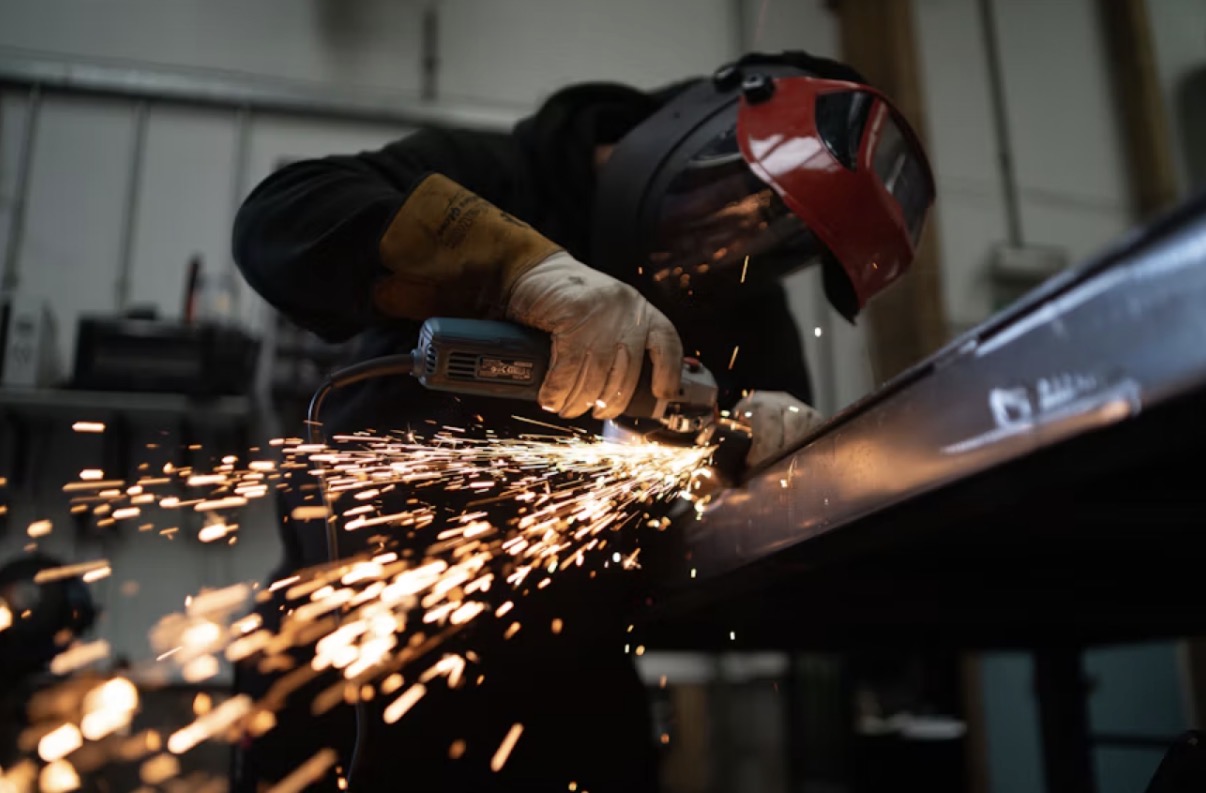
In the past, a welding machine was like a piece of stationary furniture, sitting in the corner of a workshop and left alone. Today’s MIG welders for sale are a completely different matter. They are compact, have digital control panels, and have a tonne of settings to play with.
But the difference between those old, heavy “cabinets” and modern inverters is much more than just weight. It is a fundamental change in the approach to welding. How has the industry progressed, and what has really changed for the welder on the job?
The Era of Transformers: When Power Was Measured in Kilograms
Early industrial welding machines were huge pieces of equipment, constructed with steel casings, thick copper windings, and massive cores. Transformers like these might weigh tens, or even hundreds, of kilograms. They weren’t meant to be moved. Once they were installed, they stayed there.
The operating principle was simple: the transformer stepped down the mains voltage to provide the high current needed to create an electric arc. At the time, it was a revolution, which enabled welding to spread from small specialist shops into large factories, construction sites and repair depots.
However, this reliability came at a cost. Welders often had to adapt their technique to the machine, rather than the other way around. Those who worked with such equipment frequently faced several drawbacks:
- immense weight and difficult transport;
- significant voltage drops during operation;
- high power consumption coupled with low efficiency;
- coarse, stepped current adjustment;
- excessive metal spatter;
- tendency for the windings to overheat quickly under load.
Each issue took time and tested the welder’s patience. Workshop lights would flicker whenever a machine started, and weld quality depended far more on the operator’s skill than on the machine’s settings. A beginner had to study for years to achieve consistent results. So the industry needed something fundamentally new.
Semi-Automatic Welding Transforms the Process
Shielded-gas welding fundamentally changed the rhythm of the work. Instead of short, individual electrodes, a continuous wire is now fed directly into the arc zone. Welders can now work for much longer without stopping every few minutes to replace an electrode or chip away slag, dramatically boosting productivity. A stream of shielding gas protects the metal from oxygen so the weld is cleaner.
The MIG (Metal Inert Gas) method was quickly accepted, mainly because of its flexibility. It works well with steel, stainless steel, and aluminium and is suitable for everything from thin sheet metal to thick structural profiles.
However, early semi-automatic machines still used transformer technology and inherited problems such as excessive weight, bulkiness, and stepped (fixed-increment) adjustment. The hardware’s imperfections often limited the welding process’s potential.
Inverters: Replacing Bulk with Electronics
One major turning point was the development of power electronics. The principle behind an inverter is simple. It converts the mains voltage to a high-frequency current and then steps it down. The higher the frequency, the smaller the transformer core can be, so a machine that used to take a cart to move it now can be lifted with one hand.
The benefits extend beyond just weight reduction. Inverters are more energy-efficient and generate less heat, while the welding arc becomes smoother and more responsive. Such equipment can be taken anywhere, to a job site, a garage, or even for work at heights. Welding has finally moved beyond the factory floor and into the real world.
PATON builds its product line precisely at the intersection of power and compactness. These machines are developed and manufactured in Ukraine, offering high performance while remaining remarkably lightweight and portable. They come with a warranty of up to 5 years, one of the longest in the industry.
Brain of the Device: Microprocessor and Synergetics
The next step made the device smarter. The microprocessor now handles what previously required the welder’s experience. It measures arc parameters hundreds of times per second and adjusts them on the fly. A person just has to choose the material, wire diameter, and metal thickness.
This is how synergetic control appeared: one knob instead of a dozen settings. For a beginner, this is a tangible help. For a professional, this saves time on selecting modes. This is what intelligent control brings to your daily work:
- smooth adjustment of current and voltage;
- ready-made programmes for different materials;
- stable arc during network drawdowns;
- protection against overheating and overload;
- memory for saving your modes;
- less splashing and a neat seam.
Many of these features address old transformer pain points. Net subsidence no longer destroys the seam.
Now overheating does not damage the device without warning. Mode memory turns routine into a repeatable process. For production, this means consistent quality from shift to shift.
How to Choose a Device Today
The market offers a lot, and it can be dizzying. Big numbers in the catalogue don’t guarantee anything. Declared characteristics must match real performance, and components must come from trusted global manufacturers.
PATON emphasises this: the parameters match the declared ones, and production processes are strictly controlled. To this are added loyal terms of warranty and post-warranty service. For the welder, this means peace of mind: the machine is needed for work, not for service. It is also worth looking at functionality. The wider the set of modes, the more tasks one device can handle. This saves both space in the workshop and budget.
Conclusion
The path from transformer “cabinets” to smart inverters took several decades, but the result is obvious. Welding has become more mobile, more accurate, and more accessible. Weight is no longer a price to pay for power. Electronics now support the craftsman’s experience rather than replace it.
The main takeaway is simple: technology has grown, and expectations have grown along with it. Today, they expect a stable arc, thoughtful functions, and honest characteristics from the device. Anyone who chooses equipment with this set gets a tool for years. And those who keep working the old-fashioned way waste time on tasks the microprocessor has long solved.