
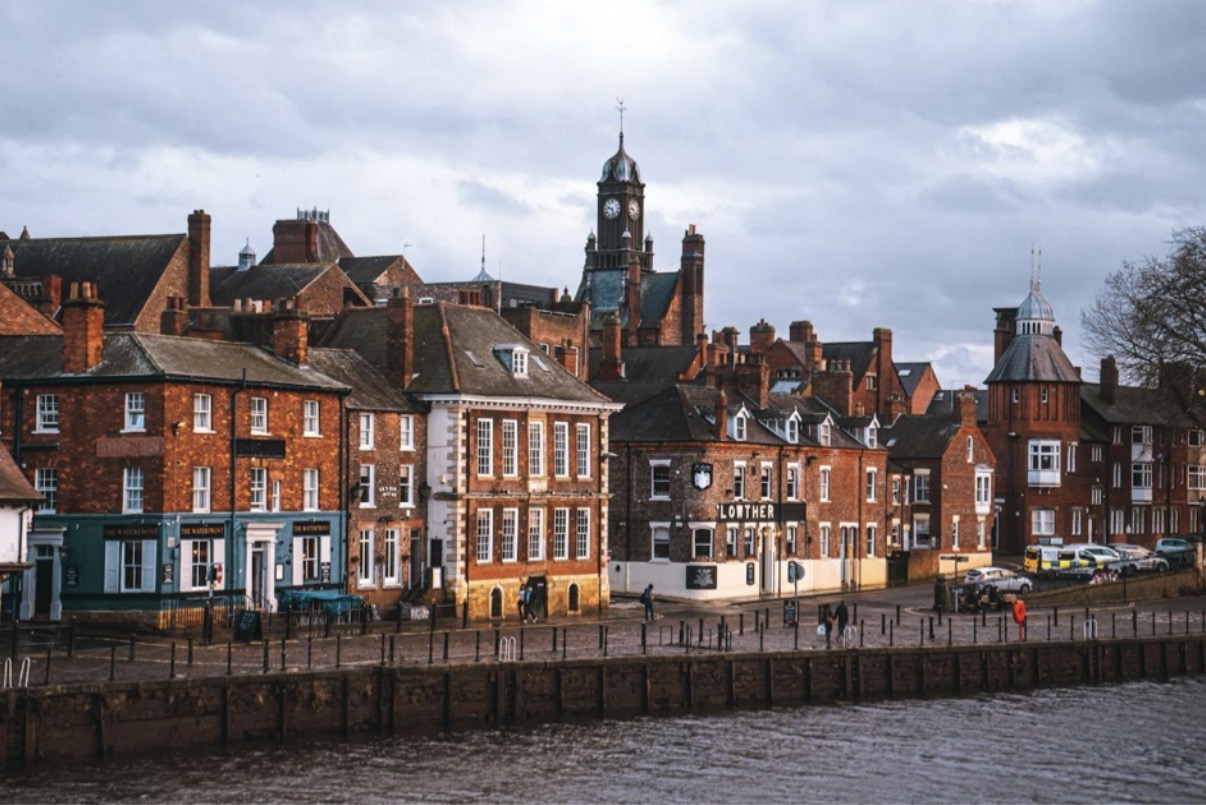
A weekend among medieval streets, Roman remains and historic landmarks does not have to begin with a motorway journey. Several of England’s most rewarding heritage destinations are only a direct train ride from London.
Travelling by train can be one of the easiest ways to explore historic England. Many older cities were built long before the motor car, and their most interesting streets are often better appreciated on foot.
For a historic weekend without a car, York, Winchester, Bath and Canterbury are four particularly strong choices. All have direct rail connections from London, walkable historic centres and enough cultural attractions to justify an overnight stay.
York offers the broadest mix of Roman, Viking and medieval history. Winchester is ideal for a quieter weekend exploring England’s royal and religious past. Bath combines Roman remains with Georgian architecture, while Canterbury offers a compact introduction to centuries of pilgrimage.
The right choice depends on how far you want to travel, what period of history interests you and how much walking you enjoy.
York: The best all-round historic weekend by train
Direct train: London King’s Cross to York, approximately two hours.
York is an excellent choice for travellers who want to see several chapters of English history in one weekend. Roman foundations, Viking archaeology and medieval architecture are concentrated within a relatively compact city centre.
Direct trains from London King’s Cross take as little as around one hour and 45 minutes, although journey times vary. From York station, it is a short walk towards the River Ouse and the medieval city walls.
The walls provide an excellent introduction to the city. Their surviving medieval sections offer views across historic streets and towards York Minster, one of England’s great Gothic cathedrals.
At street level, the Shambles preserves the narrow proportions and overhanging timber-framed buildings associated with medieval York. Nearby, the JORVIK Viking Centre explores the city’s Scandinavian past through archaeology recovered from Coppergate.
Why Clifford’s Tower deserves a place on your York itinerary
A visit to Clifford’s Tower adds another dimension to York’s history.
Standing on a steep mound above the former York Castle, the surviving 13th-century stone tower provides panoramic views across the city. The English Heritage attraction also explains the castle’s changing roles in royal government, defence and imprisonment.
The site carries a particularly important and tragic connection to medieval Jewish history. In March 1190, approximately 150 members of York’s Jewish community sought refuge in the castle’s earlier wooden tower during an antisemitic attack.
Many died by suicide rather than face murder or forced conversion, while others were killed by the attackers. The present stone structure was built decades later, but the site remains an important place of remembrance.
Visitors can see memorial features at the mound and learn about events that form part of York’s wider history.
Allow a full day for the Minster, walls, Shambles and Clifford’s Tower. The following morning is better spent exploring the Yorkshire Museum or the National Railway Museum rather than trying to fit everything into Saturday.
York works especially well for a two-night stay, when its busier streets can be explored outside peak visiting hours.
Winchester: An easy weekend exploring England’s ancient capital
Direct train: London Waterloo to Winchester, approximately one hour.
Winchester is one of the most rewarding historic cities within easy reach of London. Direct trains from Waterloo take around an hour, making it especially practical for a one-night break.
The former capital of Anglo-Saxon England has an attractive combination of cathedral architecture, medieval streets and riverside walks.
Start at Winchester Cathedral, renowned for its long medieval nave and associations with English kings and writers, including Jane Austen.
From there, follow the High Street towards the Great Hall, one of the principal surviving structures of Winchester Castle. Inside hangs the famous Round Table associated with King Arthur, although the object itself dates from the Middle Ages rather than Arthurian times.
The surrounding streets reward unhurried exploration. Winchester’s history is not confined to royal buildings and religious institutions.
The Statue of Licoricia of Winchester: An overlooked historical landmark
On Jewry Street, outside The Arc cultural centre, stands the Statue of Licoricia of Winchester.
Unveiled in February 2022, the bronze sculpture depicts Licoricia, a prominent 13th-century Jewish businesswoman, with her young son Asher.
Licoricia was an influential financier who conducted business with King Henry III and other important figures. Her achievements are particularly notable given the legal restrictions, heavy taxation and prejudice faced by England’s medieval Jewish communities.
The statue, created by sculptor Ian Rank-Broadley, celebrates her contribution while encouraging visitors to discover a less familiar part of Winchester’s history.
The city’s Medieval Jewish Trail provides additional context around Jewry Street, where members of the medieval community lived and worked.
This makes Winchester particularly interesting for travellers who want to understand the lives of people beyond England’s monarchs and clergy.
For Sunday, walk beside the River Itchen through the water meadows towards St Cross. This is a pleasant way to combine local history with the surrounding Hampshire landscape.
Winchester is especially suitable for couples, solo travellers and anyone seeking a manageable weekend without a crowded sightseeing schedule.
Bath: Roman history and Georgian streets within easy walking distance
Direct train: London Paddington to Bath Spa, approximately 80 minutes.
Bath feels different from York or Winchester. Its grand terraces, curved Georgian streets and pale stone buildings create an unusually coherent historic landscape.
The city was established around natural hot springs used by the Romans. Today, the Roman Baths remain its principal archaeological attraction.
Visitors can explore surviving parts of the bathing complex and learn how Roman religion, engineering and daily life shaped Aquae Sulis.
Bath’s later development is equally important. During the 18th century, it became a fashionable spa destination, attracting wealthy visitors and inspiring major architectural projects.
The Royal Crescent, the Circus and the Assembly Rooms reflect this period of Georgian expansion.
UNESCO recognises Bath for its Roman heritage and Georgian townscape. The city is also included within the wider Great Spa Towns of Europe World Heritage designation.
For a weekend, spend Saturday exploring the Roman Baths, Bath Abbey and the historic centre. On Sunday, walk towards the Royal Crescent or visit the Holburne Museum.
Bath Spa station is conveniently close to the centre. However, some of the streets leading to the city’s higher viewpoints are steep.
Bath is the strongest choice for visitors who enjoy architecture, museums, restaurants and a relaxed evening atmosphere alongside history.
Canterbury: A compact historic escape from London
Direct train: London St Pancras International to Canterbury West, approximately one hour on faster services.
Canterbury is particularly appealing when the journey itself needs to be short.
Its historic centre is small enough to explore over two days without relying on local transport. The city’s principal attraction, Canterbury Cathedral, has been central to English religious history for centuries.
The murder of Archbishop Thomas Becket in 1170 transformed Canterbury into a major medieval pilgrimage destination.
The cathedral is part of a UNESCO World Heritage Site alongside St Augustine’s Abbey and St Martin’s Church. Together, they explain the early development of Christianity in Anglo-Saxon England.
Beyond the cathedral precincts, Canterbury offers medieval lanes, timber-framed buildings and stretches of the River Stour.
Westgate Gardens provides a pleasant place to walk, particularly during spring and summer.
A sensible weekend combines the cathedral and historic centre on Saturday with St Augustine’s Abbey, a riverside walk and the city’s smaller museums on Sunday.
Canterbury is a good choice for travellers who prefer exploring at a gentle pace rather than moving between large attractions.
Which historic destination is easiest to visit without a car?
For a weekend departing from London, the main options compare as follows:
| Destination | London departure station | Typical direct journey | Best for |
| York | King’s Cross | Around 2 hours | Medieval and Viking history |
| Winchester | Waterloo | Around 1 hour | Royal history and quieter streets |
| Bath | Paddington | Around 1 hour 20 minutes | Roman and Georgian heritage |
| Canterbury | St Pancras International | Around 1 hour | Cathedral history and pilgrimage |
Journey times are approximate and depend on the service. Check weekend timetables before booking.
All four destinations have central stations, although access to individual attractions varies. York is generally walkable, but Clifford’s Tower requires climbing a steep mound. Bath has hills, while some historic streets in Winchester and Canterbury have uneven surfaces.
Booking accommodation close to the centre can make a considerable difference, particularly for a one-night stay.
Saturday engineering works and Sunday timetable changes are also worth checking. Direct services may be altered or replaced by buses during planned maintenance.
Can you enjoy a historic weekend in England without driving?
Absolutely. In many historic centres, travelling without a car makes the experience simpler.
For the greatest range of historical periods, choose York. For a shorter, quieter journey with strong royal and Jewish heritage connections, Winchester is an excellent alternative.
Bath is particularly rewarding for Roman remains and Georgian design, while Canterbury offers a concentrated experience of England’s religious past.
The best car-free historic weekend is not necessarily the one with the most attractions. It is the place where you can leave the station, explore at your own pace and spend more time discovering history than travelling between sights.