
Leading animal welfare organisations have joined forces to call for the phased end of greyhound racing in England and Northern Ireland as a shocking new report highlights more than 4,000 greyhounds involved in the sport have lost their lives since 2017.
Blue Cross, Dogs Trust, Hope Rescue and the RSPCA have come together to publish a groundbreaking new report that has found the industry is fundamentally incompatible with modern animal welfare standards.
The report, The Case for an End to Greyhound Racing in the UK, which documents the rise and decline of greyhound racing and outlines how welfare concerns are “pervasive and unavoidable” throughout the lives of the dogs involved.
And following legislation being brought forward to phase out the sport in Wales and Scotland, the charities hope the report will now make the case for similar moves in England and Northern Ireland.
It argues that regulation alone cannot adequately protect racing greyhounds and that ending commercial racing is the only effective way to safeguard welfare.
Released ahead of the 100th anniversary of greyhound racing, on July 24, the report comes amid growing public and political debate around the industry, following the recent decision in Wales and Scotland to ban greyhound racing. Commercial racing will soon remain legal and commonplace only in England, Northern Ireland, the Republic of Ireland, Australia and the USA.
Key findings from the report include:
Confirmation that a staggering 4,399 greyhounds involved in licensed racing have either died* or were put to sleep since 2017 – with 1,514 euthanised trackside – while over 38,000 injuries have been recorded between 2017 and 2025 alone
Racing greyhounds spend an estimated 95% of their time confined in kennels
Nearly 85% of dogs licensed to race in Britain in 2024 were bred in the Republic of Ireland, where practices prohibited for most dogs in the UK – including surgical artificial insemination – remain legal for greyhounds
There is no comprehensive system to track every greyhound from birth to the end of their racing careers, with around 10% of puppies unaccounted for
Charities are heavily relied on to rehabilitate and rehome “surplus” dogs, despite the associated rehoming costs vastly exceeding any industry contributions
Disciplinary committee cases consistently highlight issues, with substance-related violations making up 83% of all cases in 2025, and persistent welfare violations making up 10% – this includes neglect and cruelty
The number of tracks licensed by the Greyhound Board of Great Britain (GBGB) has fallen by 30% in the last decade, with attendance and betting revenues continuing to decline
The report says welfare concerns are “abundant and continuous”, highlighting injuries caused by racing at high speeds around oval tracks, ongoing disciplinary cases involving neglect and banned substances, and a lack of transparency across the sector.
The report’s publication follows the release of the latest industry figures, which showed that 161 greyhounds were euthanised trackside in 2025 – the highest number recorded in the last five years. The increase came despite a fall in the number of races and more than three years after the industry’s own welfare strategy was launched, reinforcing the report’s conclusion that regulation alone cannot adequately protect racing greyhounds.
Perseus’s story
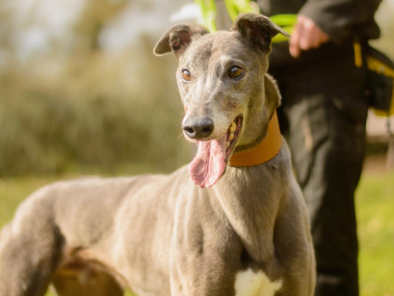
Perseus, a five-year-old greyhound, arrived at Dogs Trust Cardiff Rehoming Centre alongside 11 other greyhounds, with very little information about their pasts.
When Perseus arrived at the centre, his carers found signs of ongoing health issues, including pain around his spine and left shoulder, scars on his feet, and significant dental problems. He was immediately placed on pain relief and given veterinary treatment and care.
Perseus’s story highlights the complex welfare needs many racing greyhounds can face, and the vital role played by charities in providing rehabilitation and care once dogs leave the racing industry.
As members of the Cut the Chase Coalition, the four organisations are calling on policymakers in England to follow Scotland and Wales in committing to an end to greyhound racing.
Chris Burghes, Blue Cross CEO said: “As a nation of dog lovers it’s horrifying that we are still putting greyhounds’ lives at risk for the sake of entertainment. It is time to bring an end to this cruel and dangerous activity. The significant improvements needed to protect the welfare of these dogs have not been made and we do not believe ever will be. The death of just one racing dog is one too many.”
Owen Sharp, CEO of Dogs Trust, added: “For too long, greyhounds have paid the price for entertainment. The evidence is now overwhelming that, despite years of attempts to improve standards, dogs continue to suffer serious injuries, neglect and unnecessary deaths. As we mark 100 years of greyhound racing, we have to ask whether this is something we want to continue into the next century. We don’t believe it is. Every dog deserves the chance to live a safe, healthy life, which is why we’re calling for a phased end to greyhound racing.”
Vanessa Waddon, Chief Executive for Hope Rescue said: “Having witnessed first-hand the devastating injuries that greyhounds suffer on the racetrack, only a phased end to greyhound racing can provide meaningful protection for these dogs. The industry’s own figures show that its welfare commitments are failing, making its claims of prioritising greyhound welfare little more than welfare washing.”
Jo Rowland, Chief Executive for the RSPCA added: “Greyhound racing causes avoidable injury, suffering and death to thousands of dogs. Despite years of promises, the industry continues to fail greyhounds at every stage of their lives. Recent industry figures showed trackside deaths reached their highest level in five years, despite the industry’s own welfare commitments. The evidence is clear: the only way to fully safeguard greyhound welfare is to phase out racing.”