Visitors to the Natural History Museum will be able to see the London debut of Arcadia by internationally acclaimed artist and filmmaker Sir John Akomfrah, one of Britain’s most influential contemporary artists.
Opening on Friday 6 November, the mesmerising, free-to-visit multi-screen installation explores the lasting environmental and social impacts of the Columbian Exchange – the widespread transfer of plants, people, animals, precious metals, commodities, technology, diseases and ideas between the Americas and Afro-Eurasia from the 1400s onwards.
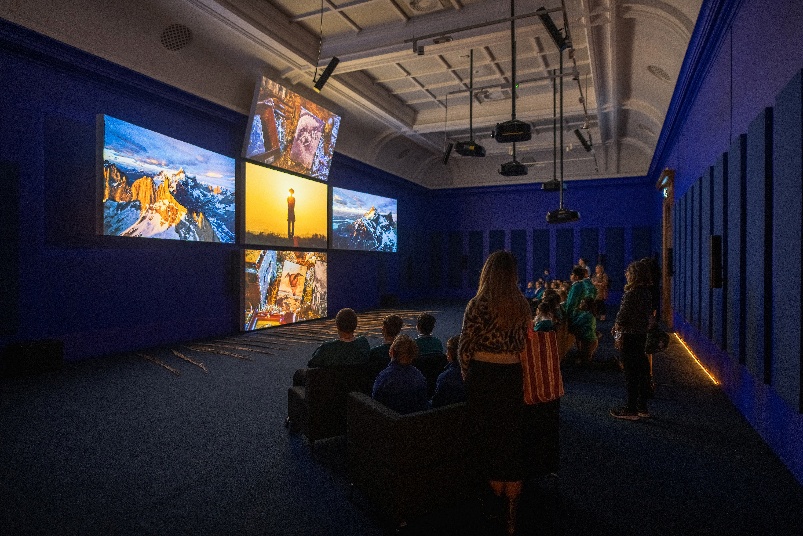
Across five screens, past and present unfold simultaneously in a cinematic journey through migration, trade, colonialism and the natural world. Surprising and immersive, Arcadia reveals unexpected connections between humanity and the world we have shaped—and that has shaped us.
Breathtaking visuals of landscapes from across the globe simultaneously take centre stage on five screens, accompanied by an evocative soundscape. Deserts, ice fields, ancient ruins claimed by forests, vast skies, lakes, mountains, storms, restless seas and underwater coral reefs play out across the frames. The awe-inspiring scenery of the natural world is disrupted throughout by images of cargo, symbols of trade, decaying ships and disease.
Through Arcadia, Akomfrah explores how migration, colonialism and empire have shaped the planet, its people and its natural environments. The piece invites viewers to reflect on the entanglement of human histories with the natural world, and the legacies of those transformations today. This marks the first time the piece has been displayed in London and follows John Akomfrah’s recent accolade of representing Great Britain in 2024 at the prestigious Venice Biennale.
The hosting of Arcadia at the Natural History Museum places Akomfrah’s exploration of human and environmental histories alongside one of the world’s most significant collections documenting life on Earth. Collected over more than 300 years, the Museum’s specimens also tell stories about the people, places and histories that have shaped scientific discovery.
Arcadia is the fourth exhibition to be hosted at the Museum as part of its free contemporary art programme.
John Akomfrah, Arcadia, 2023 © John Akomfrah. Courtesy Smoking Dogs Films and Lisson Gallery
Sir John Akomfrah says: “It is very special that the Natural History Museum have chosen to present Arcadia – a film installation exploring the profound relationship between humans and the changing natural world – alongside one of the world’s greatest scientific collections. In Arcadia, I was thinking about the transfer of people, plants, animals and pathogens between the Americas, Europe and Afro-Eurasia, going back to a time before colonial violence to explore what other, less visible forms of power were also at work – knowing that humans are never the only actors on the historical stage. Having these journeys in dialogue with those present in the museum, from Charles Darwin’s Beagle voyage, to the pilgrimage of the rare meteorites on view, will hopefully allow the NHM’s vast and diverse audiences to experience something different, and even consider our collective and individual histories in a new way.”
Alex Burch, Director of Public Programmes at the Museum, says: “Sir John Akomfrah is one of the most significant artists working today, creating works that challenge us to think differently about our place in the world. Arcadia brings together powerful human stories with sweeping visions of the natural world, inviting visitors to consider how migration, trade and empire have shaped both people and planet. We’re delighted to host its London debut at the Natural History Museum, where these themes invite reflection on our relationship with the world around us.”
Blending contemporary art conceptions with vital information concerning the planetary emergency, the Museum’s Jerwood Contemporary Arts Programme connects audiences and artists to the natural world.
The Jerwood Contemporary Arts Programme forms part of Fixing Our Broken Planet, a global initiative of events, exhibitions and online resources spearheaded by the Museum that explores how scientists are finding solutions to the planetary emergency for nature from nature. Arcadia is supported by Jerwood Foundation.
Visitors keen to dive deeper into humans’ relationship with the natural world after watching Arcadia can find the Museum’s Fixing Our Broken Planet gallery next door to the film installation. Packed with contemporary science from the Museum’s world-leading researchers, it explores practical, nature-based solutions to some of the biggest challenges facing the planet today. On the second floor of the Museum, visitors can also find the brand-new Nature and Us display to further explore our evolving relationship with the natural world through 50 remarkable objects, from a bryozoan-encrusted Star Wars toy from the 1980s to a 400,000-year-old handaxe whose discovery transformed our understanding of when humans first existed.
Arcadia will be free for all visitors to the Natural History Museum and will run from 6 November 2026 until May 2027. Just under an hour long, the film will play on a loop in the Jerwood Gallery.
Visitors should book a free ticket in advance online (available at 10am) for guaranteed entry to the Museum. Members, Patrons and Corporate Supporters do not need to book general admission or exhibition tickets, they can arrive at any time and have priority access.