
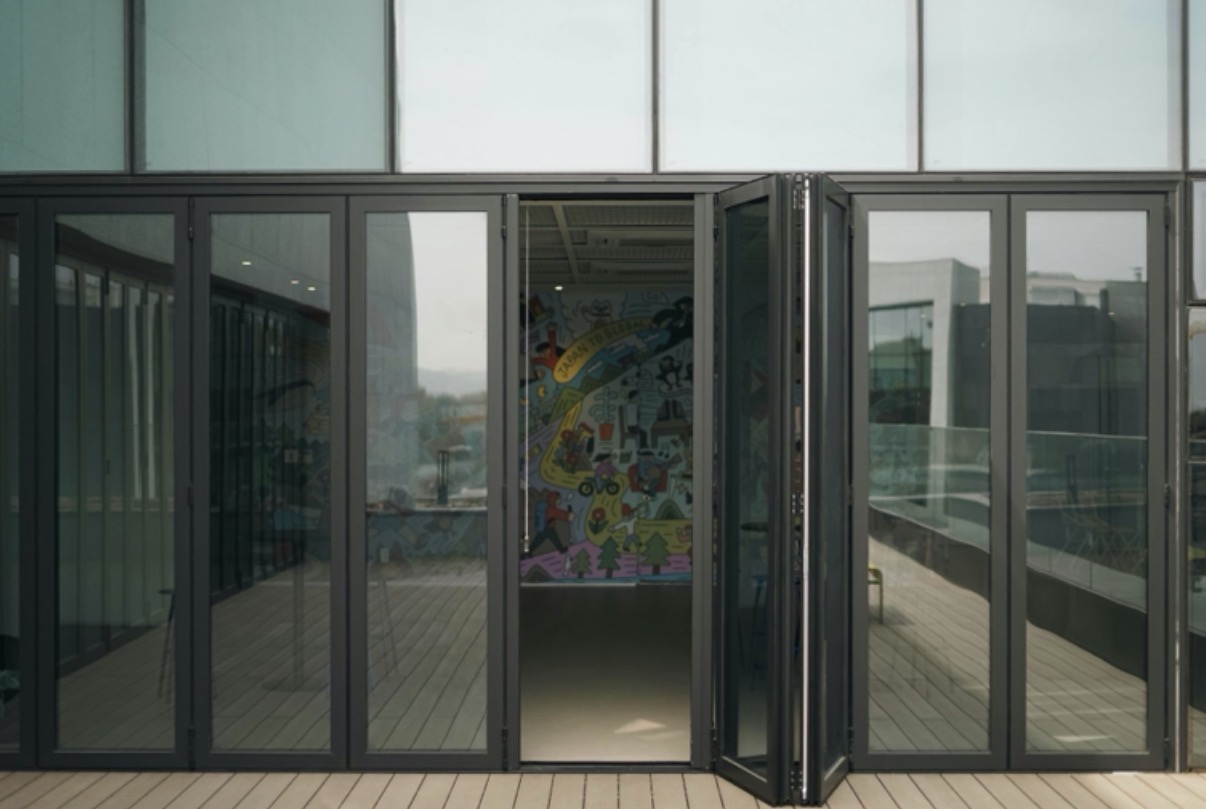
Tri-fold doors are a practical and space-efficient alternative to conventional hinged doors, particularly in situations where a wide opening is needed but the floor space available for a swinging door is limited. The system works by dividing the door into three panels that fold back on themselves, creating a significantly wider clear opening than a single hinged leaf while taking up considerably less room than a pair of French doors. The selection of tri-fold doors at Direct Doors spans a range of materials, finishes, and sizes to suit different room types and interior styles.
How Tri-Fold Doors Differ From Bi-Fold Doors
The distinction between tri-fold and bi-fold doors lies in the number of panels and the way they fold. A bi-fold door has two panels, with one fixed and one that folds against it, creating a two-panel stack at the side of the opening. A tri-fold door has three panels, allowing a wider opening to be covered while the folded stack remains relatively compact. Tri-fold doors are particularly useful for wider openings of around 900mm to 1200mm, where a bi-fold would leave a panel that is too large to operate smoothly.
Where Tri-Fold Doors Work Best
Tri-fold doors are most commonly used in situations where a wide opening between rooms needs to be opened or closed frequently and where the available swing space is insufficient for a conventional hinged door. Utility rooms leading into kitchens, playrooms that open into living spaces, and home offices that need to be fully open when in use but closed when not are all common applications. They also work well in narrower hallways where a full-width door would obstruct passage when open.
Materials and Finish Options
Internal tri-fold doors are available in a range of materials,s including solid timber, engineered wood, MDF, and glazed options, where light transmission between spaces is a priority. Primed finishes are suitable for painting in any colour, while wood veneer and pre-finished options provide a ready-to-use surface. The choice of material affects both the door’s weight and its acoustic performance, with solid-core and engineered-core options providing better sound reduction than hollow-core alternatives.
Track and Hinge Systems
The operating mechanism of a tri-fold door is as important as the door panel itself. Top-hung track systems, where the door’s weight is supported by a track mounted above the opening, provide smooth operation and avoid a floor track that can be a trip hazard or an obstacle to cleaning. Bottom-guide systems use a small floor-mounted channel to keep the door panels aligned without bearing the door’s full weight. The quality of the track and hinges directly affects how smoothly and quietly the door operates over its lifetime.
Measuring and Ordering the Right Size
Accurate measurement is essential when ordering tri-fold doors because the three-panel configuration means that small errors in the opening dimensions have a proportionally greater impact on fit than they would for a single hinged door. The opening width should be measured at the top, middle, and bottom of the frame, and the smallest measurement used to determine the door size. It is important to account for the thickness of the door panels when calculating the actual clear opening width when the door is fully open, as the stacked panels occupy space on the hinge side.
Installation Considerations
Fitting a tri-fold door requires more precision than hanging a standard door, as the track must be level, the hinges must be correctly aligned, and the guide mechanism must be set to prevent the door from swaying or rattling when in use. Most suppliers provide full fitting instructions, and many tri-fold door systems are designed for competent DIY installation. However, for heavier doors, wider openings, or uneven floors, professional fitting is advisable to ensure the door operates correctly and the warranty remains valid.