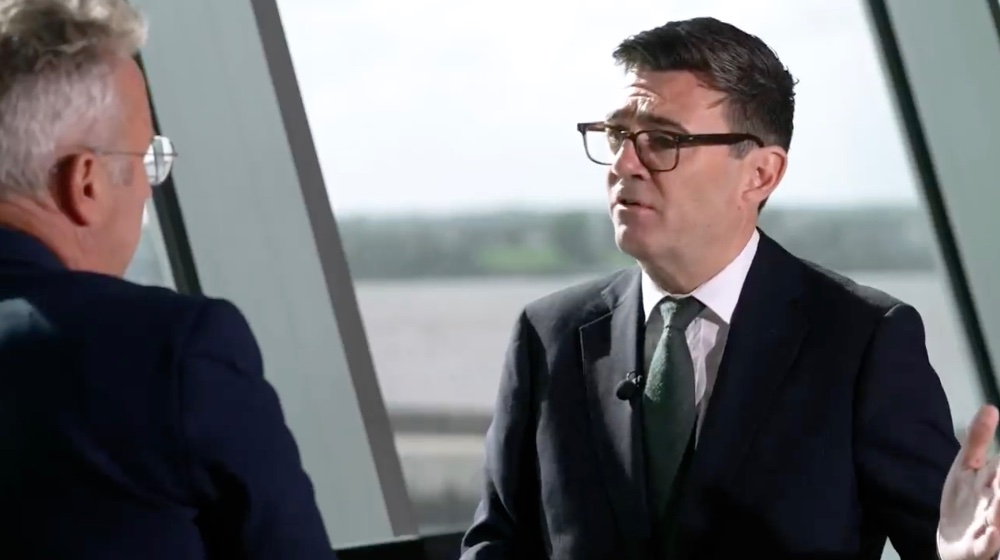
Prime Minister Andy Burnham has told GB News that there are “strong indications” that Iran was behind the recent security alert at RAF Fairford.
In an interview with GB News Political Editor Christopher Hope, he also denied that he had changed his view on Brexit and dismissed a suggestion that Labour was unfairly targeting pensioners.
On RAF Fairford, he said: “So what I can say is there are strong indications that Iran played a part in what happened over the weekend. It is, though, still an ongoing and very serious police investigation. So, I hope you’ll understand if I don’t say more at this point.
“I wanted to confirm what we could say. But this will continue now. It’s obviously a very serious investigation involving our colleagues in the United States, and we are working very closely with them, and I will say more when I can.
“Obviously, I’ve been dealing with this as I’ve been here in Liverpool. We have held a Cobra meeting here during the week. We are completely on top of things, but we will say more when we can.”
Asked if he had changed his view on Brexit: “I certainly haven’t gone back – no, because I said very clearly in the speech and afterwards, we look at all options. The speech was about deciding the long-term direction for this country. Where do we want to be in 10 years’ time? And I don’t think we now can leave that question unanswered.
“An option is to stay as we are. Of course, that’s an option. Quite clearly, that’s an option. But public opinion has shifted in that decade, including in Makerfield. And it’s right that I say, ‘Well, here are the options’. George Osborne’s put an option forward. Canada has talked about a different relationship with the European Union. I can’t leave Britain out of those discussions.
“We do have to have an honest and grown-up conversation about well, what could a future relationship look like, and then come back to the public and say, well, here are the broad options and here are the issues involved with each of them. That’s just the right way to lead. I’ve got to do what’s best for this country.”
Asked if re-joining the EU was an option, Burnham said: “Well, people look at all the options, and where is the centre of gravity? Is there a new centre of gravity? If there’s not a consensus, that would also inform my thinking. My job is to secure the best interests of this country. That’s what I was talking about yesterday, and you know I’m going to take on issues, even if they’re politically difficult, to do what’s right for Britain. That’s what I’m going to do.
“The decade we’ve just been through has not been good enough. I don’t think Brexit has helped us. If I’m honest, I think it has caused harm. So the question is, we can’t have another decade like the one we’ve just had. So what are we going to do in this next decade? And that’s what I was addressing directly in my speech yesterday, and more honestly, perhaps, than sometimes these things have been done in the past.”
On immigration, he said: “Now, one thing that I want to convey here is Brexit has changed the nature of immigration to this country, because in the past, when we were in the European Union, people can have their view about it, about whether it was good or bad, but what we had was a more revolving door form of migration, where people would come here in their younger years. Many people did from Eastern Europe, people would remember, and they’d maybe spend you know a few years here in their mid to late 20s, and then go home and start a family. And that was a very common form of immigration.
“Now, immigration is more likely to be a permanent settlement where people are coming on a visa to work here. And then we saw obviously the Boris wave and the changes that came through in that in that period. So it’s changed the nature of immigration.
“But the second thing about control, if I could just say this: when we left, we lost access to the crucial immigration database held across Europe, which tells you where people arrived and what countries they’ve been through, and that is information that is invaluable when it comes to managing migration.
“So, you know, I think it’s important now that we put these more you know nuanced issues on the table, so people can make their own judgment in the round of whether Brexit’s been a good or a bad thing.”
Asked if he was being tone deaf to the concerns of people in his own constituency, he said: “No, it’s not, because we are the government that’s got small boat crossings down significantly down, down this year on last year, and down by around a half on the early 2020s. So where the other government talked tough and didn’t do anything, we’ve done it. And credit to the Home Secretary for the way she’s got a grip on these things.
“In terms of HMO Britain, yes, I did call that out. Why? Because we’ve had an approach in the past of the poorest communities being asked to deal with the whole issue of asylum accommodation, and that just simply isn’t fair. So it does pass the Makerfield test. Indeed, it does, for me to say to you that that can’t continue where places like Makerfield and all of the towns within it are the places where the authorities only look to deal with this whole question of asylum accommodation.
“Well, as I say, I live on the edge of the Makerfield constituency, so no one is saying, “Oh, it’s different rules for me and not for others’. But I accept that the situation with a barracks is a different situation than an HMO or a more dispersed model, or even the hotels.
“I think people wanted us to move people out of hotels. That was a very clear call of a few years ago, and that explains now why the barracks option is being looked at. But I’ve heard what people are saying in Piddington and the other places affected. I don’t ignore their concerns. Of course, they’re raising concerns that need to be looked at, and I will as and when any plans are taken forward.”
On changes to the triple lock, he dismissed a suggestion that Labour has an issue with pensioners: “This is nothing like the winter fuel debate. Nothing like it at all. So the triple lock has taken the basic state pension up, and that’s a really good thing. And by the end of this decade, it will be at record levels, and it will carry on going up under the plan that I mentioned yesterday. But it won’t go up as sharply as it would have done if we had the original triple lock.”
On whether pensioners will lose out, Burnham said: “No, it maintains the pension. The pension will still go up, linked to prices and earnings over the long run, so it will still go up and it will still keep pace. The difference is by moving away from the original triple lock. I can give pensioners a better deal, and you’ll ask me, well, how in those circumstances?
“Because the money that it does release pays for a National Care Service, high quality, person-centred, free personal care in people’s homes. Currently, people are paying care charges from their pension, and that is highly unfair to those pensioners. It’s a much better deal to have a pension that keeps pace with prices, and also a personal care system that gives you peace of mind in later life.”
On a £200 billion plus estimated cost of the new care service, he said: “I’m not sure I recognise that figure, but I think your viewers, to be honest, I think I know them, and maybe they don’t always agree with everything I say, but they want to see the price of electricity come down, and I’m taking VAT off electricity tomorrow.
“They want to see a water system that works in the public interest. I think many of your viewers think the privatisation and breakup of all of those things was actually a mistake in the 80s and 90s.”
Asked if the Makerfield test was alive and well, he said: “Oh, 100%. It’s at the heart of government, and every civil servant knows that.”