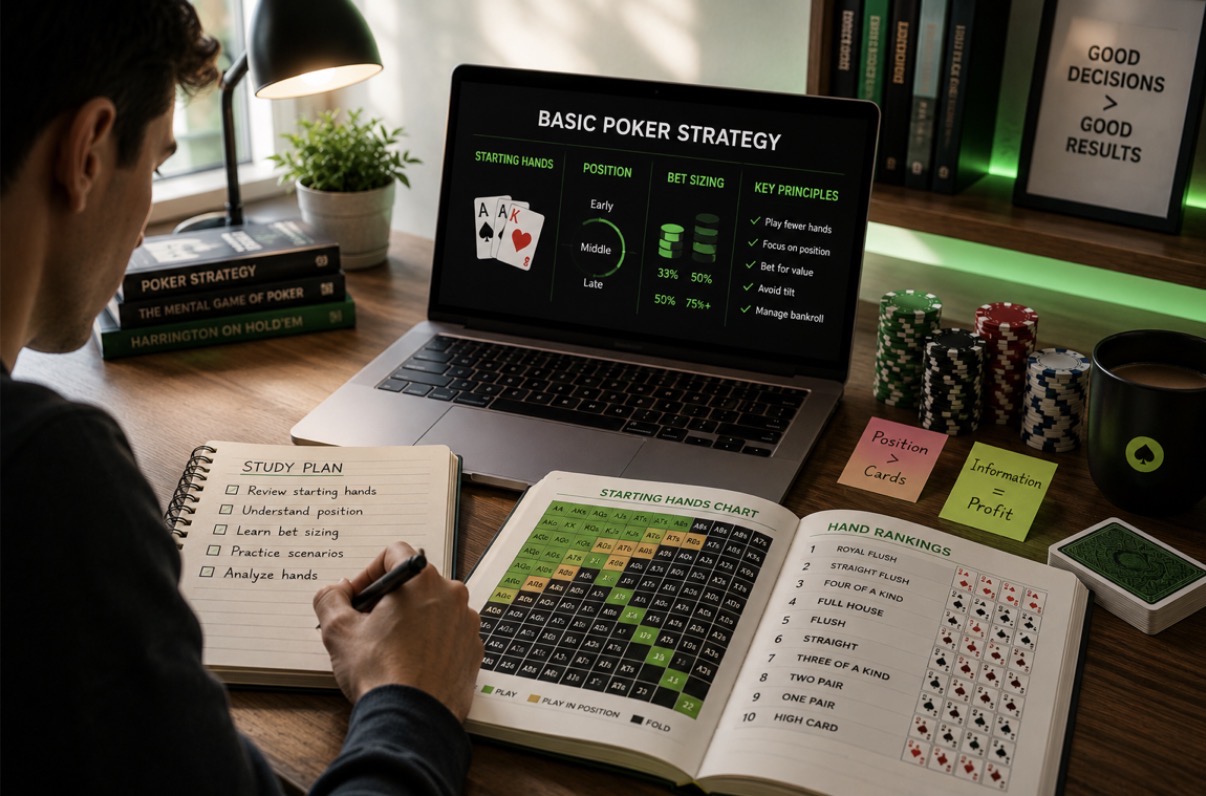
Good poker starts with choosing the right hands, using position, and knowing when further investment is no longer justified. Beginners should master these decisions before adding complex bluffs, wide ranges, or advanced poker mathematics.
A basic poker strategy connects pre-flop selection with post-flop decisions. Play stronger hands from early position, expand your range closer to the button, bet strong holdings for value, and fold when the price of continuing is poor. This simple structure prevents many expensive beginner mistakes.
Start With Strong Starting Hands
Poker hand selection determines how difficult the rest of the hand will be. AA, KK, QQ, JJ, and AK belong to the strongest poker starting hands and can usually be played aggressively. Medium pairs, suited connectors, and weaker broadway hands are more dependent on position and previous action. Weak, disconnected holdings should usually be folded.
On an online poker platform, the fast pace makes it easy to play too many hands. Avoid entering pots simply because you have been folding for several minutes. A selective range keeps weak hands out of large pots and gives you clearer post-flop decisions.
Four terms describe the basic tendencies you will see at a poker table:
|
Playing style |
How it works |
|
Aggressive |
Bets and raises frequently instead of relying mainly on calls. |
|
Passive |
Checks and calls frequently and raises less often. |
|
Loose |
Enters many pots and uses a wide starting-hand range. |
|
Tight |
Plays fewer hands and concentrates on stronger starting combinations. |
These tendencies form combinations such as tight-aggressive (TAG) and loose-aggressive (LAG). TAG is usually easier for beginners: play fewer starting hands, but play good hands decisively.
Understand the Importance of Position
Early position requires a tighter range because several players still act after you. Middle position provides more flexibility. From late position, especially the cutoff and button, you can play more hands because you already know what most opponents have done.
The advantage is practical. A hand such as 8♠8♦ is harder to play when several unknown actions remain behind you. On the button, you can see whether opponents fold, call, or raise before making your decision. Read more about positional ranges to understand which starting hands gain or lose value depending on your seat.
Why Late Position Gives You an Advantage
Acting later provides more information. You can value-bet when opponents show weakness, fold marginal hands against strong action, and control the pot more effectively. Position does not improve your cards; it improves the information available when you make a decision.
Learn When to Bet, Call, Raise or Fold
Do not click an action automatically. Ask what the action is supposed to achieve.
- Bet: extract value from weaker hands or pressure an opponent into folding.
- Call: continue when your hand or draw justifies the price.
- Raise: build a larger pot with strong holdings or apply justified pressure.
- Fold: stop investing when your hand, poker odds, or opponent’s action makes continuing unprofitable.
Calling too often is a classic beginner mistake. Money already placed in the pot is not a reason to invest more. If the situation has changed and your hand is no longer worth the price, fold.
Pay Attention to Pot Odds and Hand Strength
An out is a card that can improve your hand to a likely winner. Pot odds tell you whether paying to see another card is reasonable.
For example, the pot is $80 and an opponent bets $20. You pay $20 to compete for $100, so the call requires roughly 20% equity. If your chance of making a likely winning hand is clearly below that figure, chasing the draw is generally a poor call.
Avoid Chasing Every Draw
A flush draw or straight draw is not automatically worth pursuing. Count realistic outs and compare them with the price of the call. Also consider whether hitting your card actually produces the best hand. A weak flush, for example, can still lose to a higher flush.
Common Poker Mistakes Beginners Should Avoid
Most beginner leaks are straightforward:
- playing too many starting hands;
- calling too often;
- ignoring poker position;
- bluffing without a reason;
- chasing weak draws;
- playing while tilted;
- risking too much of the bankroll.
Fixing these errors is more valuable than learning complicated moves. Strong beginner poker strategy is largely about avoiding marginal situations and making fewer expensive calls.
Manage Your Bankroll and Emotions
Poker bankroll management means keeping poker funds separate from money needed for everyday expenses. Choose stakes that allow your bankroll to absorb normal losing sessions. Moving up simply to recover a loss increases financial pressure and usually makes decision-making worse.
Tilt is the emotional loss of discipline after bad beats, mistakes, or losses. If you start playing more hands, calling to “get even,” or increasing stakes impulsively, stop the session. Emotional control is part of poker strategy because even correct technical knowledge is useless when you stop following it.
Conclusion
A practical poker strategy for beginners comes down to a few connected skills: select strong starting hands, respect position, bet with a purpose, understand basic pot odds, and fold when the price is wrong.
Combine those habits with poker bankroll management and emotional discipline. Once they become automatic, more advanced ranges, bluffs, and post-flop concepts become much easier to learn.