The Brute-Force Era is Dead
The human brain operates as an absolutely ruthless anomaly detector. We are biologically hardwired to notice when a shadow falls slightly off-axis or a fluid splash defies standard gravity. Decades ago, developers tried to overwhelm this biological scrutiny by throwing raw graphical processing power at the screen. That approach is officially obsolete. Let’s be real; the modern illusion of reality isn’t just about polygon counts anymore. It hinges entirely on the deeply complex, often chaotic mathematics running silently beneath the hood. A developer analyzing raw engine data quickly realizes the paradigm has flipped. We no longer manually paint our virtual worlds. Studios instead grow them using algorithmic frameworks that simulate rigid physical laws and unpredictable organic chaos in real time.
The “Oatmeal Problem” and Algorithmic Botany
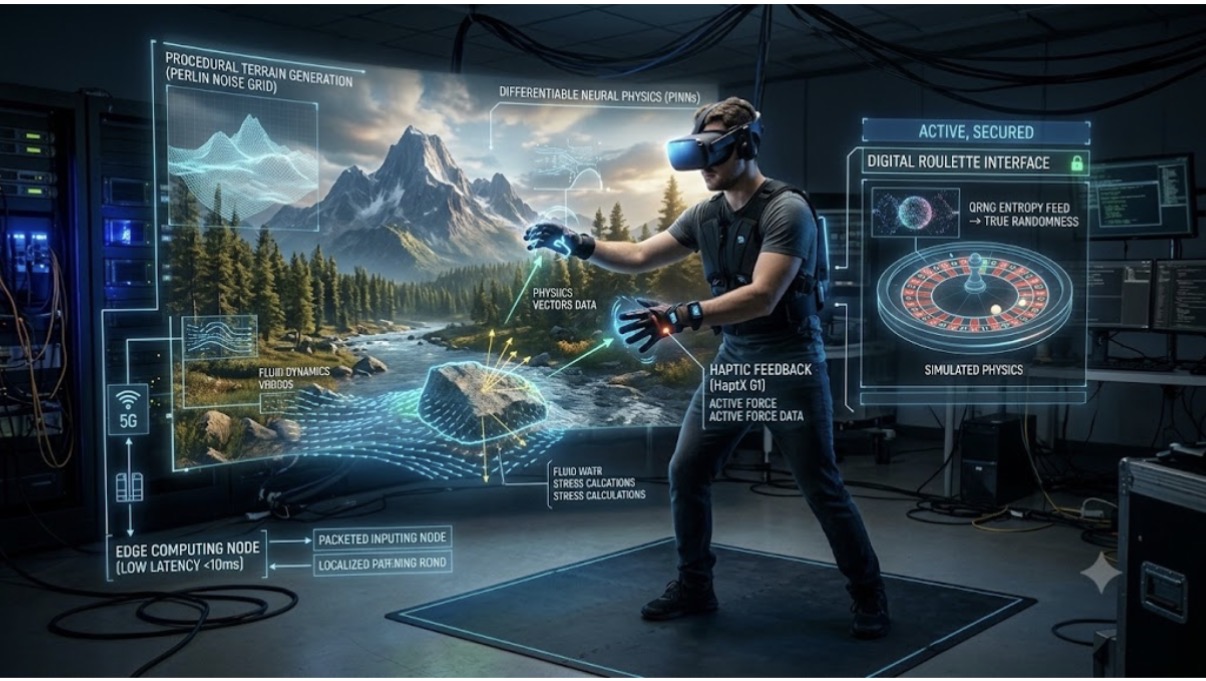
Manual construction of a planet is a surefire way to bankrupt a studio before launch. The solution is Procedural Content Generation. PCG lets environments build themselves out just steps ahead of the player’s camera. You will find a strictly deterministic math box called a Pseudo-Random Number Generator driving this whole charade. Feed it a short string of characters. The software will immediately construct a bespoke mountain range, and that exact same geography appears every single time you hit enter with that specific code. It sounds incredibly efficient. The catch? Unsupervised mathematics routinely slam headfirst into the dreaded oatmeal problem. The resulting landscape stretches out to infinity, but it feels hollow—a vast, repetitive wasteland completely devoid of artistic intent.
To fix this structural monotony, engineers layer complex mathematical noise. Perlin and Simplex noise algorithms create the rolling, organic gradients necessary for hills. Spatial distribution algorithms like Poisson Disk Sampling keep the organic stuff in check. This particular math prevents your procedurally grown forest from spawning a clump of fifty overlapping pine trees in one square meter. Highly structured environments require a much heavier computational lift. Wave Function Collapse steps in to handle things like urban cityscapes and dungeon corridors. The algorithm essentially throws every possible piece of geometry into a blender of probability. It then locks down constraints cell by cell until a mathematically flawless city block appears on screen. Top-tier development pipelines are currently hooking Generative Adversarial Networks directly into that exact feedback loop. These neural nets act as brutal art directors, ruthlessly judging the machine-made topology long before a human ever puts on a headset.
Neural Physics and the Death of Cardboard Reality
Players will instantly reject a gorgeous, ray-traced masonry wall if they punch the surface and the physics behave like styrofoam. Glossy surface reflections are totally meaningless without physical weight backing them up. Traditional numerical physics solvers choke immediately when asked to calculate complex variables like fluid turbulence within a strict 16-millisecond frame window. Frankly, they demand too much computational overhead.
The industry standard for 2026 has definitively abandoned these rigid approximations in favor of differentiable simulators and Neural Physics engines. AI surrogate models, specifically those built on open-source frameworks like NVIDIA’s PhysicsNeMo, act as real-time digital twins of the physical world. Rather than calculate every single particle collision through brute force, these neural pipelines allow the AI to internalize physical laws from massive datasets. It slashes latency by nearly thirty percent. We can now simulate the aerodynamic stress on an aircraft wing without breaking a sweat.
Virtual reality gaming is frankly just a testing ground for much larger industrial applications. Look at industrial robotics for a reality check. Companies drop millions trying to teach automated arms how to sort parts within a sloppy virtual space. The resulting physical prototype usually crushes a delicate component the moment it hits the actual factory floor. Industry veterans label this multi-million dollar headache the sim-to-real gap. The culprit is almost always a failure to accurately model microscopic contact dynamics. A micro-calculation error regarding joint friction means a two-ton mechanical arm might violently crush a million-dollar automotive chassis instead of gently bolting it in place. The hardware destruction from one single hallucinated physics interaction can cost a manufacturer tens of millions. Neural operators are the only mathematically viable bridge across that divide.
Injecting God into the Machine: Quantum Entropy
Mathematical simulations are incredibly useful, but they fall completely apart when absolute fairness and financial unpredictability are on the line. Look closer at the architecture of modern iGaming or biometric cybersecurity, and you quickly realize standard deterministic PRNGs harbor fatal security flaws. Legacy algorithms like the Mersenne Twister suffer from severe entropy starvation. If an attacker manages to deduce the internal state or initial seed, the entire sequence violently unwinds.
You simply cannot trust a purely mathematical equation to govern the exact friction and localized gravity required to run digital roulette interfaces. This blind trust exposes the house to massive financial vulnerabilities. True cryptographic security demands a permanent migration toward physical entropy. We have to completely abandon code-based number generation and embrace the True Random Number Generator. The current gold standard is the Quantum Random Number Generator, a hardware leap that completely bypasses software constraints.
Microchips extract raw entropy straight from subatomic chaos. Companies like ID Quantique physically trap this unpredictability; they measure single photons as they crash into a semi-transparent mirror, letting quantum mechanics decide the outcome. We now bake these microscopic chips directly into commercial server racks, guaranteeing the physics engine dictating a digital coin flip is bound by the undeniable truth of quantum physics.
The Final 10 Milliseconds: Hardware and Edge Dominance
None of these brilliant server-side calculations actually matter if the user cannot physically feel the resulting impact. The most robust neural physics engine in the world is utterly useless if the corresponding haptic feedback arrives a quarter of a second late. Human biology will violently reject the simulation if sensory delay exceeds 20 milliseconds.
To solve this critical biological bottleneck, the physical infrastructure of the internet had to fundamentally change. Centralized cloud hyperscalers are out; localized edge computing is in. Telecom giants are moving raw processing power out of remote data farms and stuffing it directly into 5G network towers. The hardware handshake here is brutal and precise.
A user grips a virtual object while wearing a haptic rig, and the local edge node instantly calculates the material stress. This data travels wirelessly to a proprietary microfluidic smart textile lined with hundreds of microscopic pneumatic actuators. These tiny air pockets inflate against the user’s skin with submillimeter precision, artificially recreating the rough grit of digital stone. Simultaneously, a flexible exoskeleton clamps down on the user’s hand. The mechanism physically arrests finger movements with up to forty pounds of resistive force. Try to squeeze a digital steel bar, and the glove completely locks your joints in place. Your brain registers the physical resistance immediately. The exoskeleton battles your hand muscles, and that aggressive feedback forces you to believe the simulation is tangible.
The Uncomfortable Convergence
The boundary separating physical truth from digital illusion is no longer a distinct gap; it is a highly engineered gradient. We have moved far past the era of developers acting as mere digital painters. Today, they operate as algorithmic botanists and quantum architects, cultivating self-sustaining mathematical ecosystems. The moment quantum entropy dictates the exact physical bounce of a virtual asset, and a localized edge node forcefully translates that calculation into mechanical resistance against human bone, the simulation permanently stops being a visual parlor trick. The algorithms powering our networks do not just approximate the world anymore. They have isolated the core mechanics of chaos and order, repackaging reality into a format that is deeply unpredictable and unnervingly tangible.