Ask a Londoner about their fitness routine ten years ago and you would probably have heard about a gym membership, used twice in January and then quietly direct-debited into oblivion. Ask the same question today and the answer is likelier to involve a Tuesday night run club that finishes at a bakery, a Saturday morning swim in water cold enough to make your fingers ache, or a set of kettlebells wedged behind the sofa in a flat that has no business housing kettlebells.
Something has shifted, and it has happened at street level rather than in the pages of policy documents. London’s health culture has become social, outdoor and stubbornly local. Here is what has changed, what the more curious corners of nutrition science have to say about it, and a few facts that even the most committed Hackney half-marathoner probably has not come across.
The run club replaced the gym contract
The most visible change in London is the number of people running together. Weekday evenings across Peckham, Shoreditch, Clapham and Kentish Town now feature clusters of thirty or forty people jogging in formation past bus stops, chatting the whole way. The point is rarely the pace. It is the pub, the coffee, the sense that you have seen actual humans on a weeknight.
This is a very London answer to a very London problem. Rent is expensive, flats are small, commutes are long, and a boutique studio class can cost more than a decent dinner. A free run club that meets outside a specific pub at 7pm asks nothing except that you show up.
It also has deep local roots. The parkrun movement, which now spans thousands of locations worldwide, began in Bushy Park in Teddington in October 2004 with a grand total of thirteen runners and a friend holding a stopwatch. Two decades later, its Saturday morning descendants are a fixture of parks from Finsbury to Wimbledon. Very few global health movements can claim a west London origin story.
The lido effect
The second shift is water, and specifically cold water. Hampstead’s ponds, Tooting Bec Lido, Brockwell, Charlton, London Fields and the Serpentine have all seen a swell of year-round swimmers who once would have considered November an off-season.
Again, the history here is older than the trend. The Serpentine Swimming Club has been going since 1864, and its members have raced the Peter Pan Cup in Hyde Park on Christmas Day for well over a century, competing for a trophy donated by the author J.M. Barrie himself. Tooting Bec Lido, opened in 1906 and stretching a full 91 metres, remains one of the largest freshwater pools in Europe. Londoners did not invent cold water swimming. They simply rediscovered what their great-grandparents already knew about it.
What is genuinely new is who is doing it. The 6am swim crowd used to be a small, hardy and largely retired contingent. It now includes shift workers, new parents, twenty-somethings and a considerable number of people who describe the whole thing, without irony, as the best part of their week.
Strength training lost its intimidation factor
The third change is the least photogenic and possibly the most significant. Resistance training, once the preserve of a particular kind of gym in a particular kind of basement, has gone mainstream across an unusually broad demographic.
Community centres in Lewisham and Camden run barbell sessions for over-sixties. Women’s-only lifting groups have proliferated. Council leisure centres report squat racks being booked out in a way that treadmills are not. Physiotherapists across the city have spent a decade quietly repeating the same message about maintaining muscle and bone as we age, and it appears the message has finally landed.
That shift has dragged a certain category of question along with it. Once people start lifting things deliberately, they start asking what they should be eating, and how much of it, and whether any of the tubs in the shop window are worth the money.
Where nutrition enters the conversation
London is not short of food advice. It is drowning in it. Borough Market, Broadway Market and Brixton Village all sell the idea of eating well alongside the actual produce, and the city’s supplement aisle has expanded from a handful of protein tubs into a wall of powders, gummies, greens and sachets.
The most sensible voices in the field tend to say the boring thing first: food comes before powders. Protein from meat, fish, dairy, eggs, beans and pulses, spread through the day, plus enough vegetables to make your shopping bag heavy. Supplements are exactly what the name suggests, an addition to a diet rather than a replacement for one.
Where they do get used, the interesting development has been a move towards shorter ingredient lists. Shoppers have grown noticeably more sceptical of tubs listing fifteen components, half of them flavourings and anti-caking agents. That scepticism is what brands such as Naked Nutrition have built their positioning around, keeping formulations pared back and stating plainly what is inside.
Creatine is the clearest example of the trend. It is a compound your body already produces, roughly one to two grams a day, mostly in the liver and kidneys, and it is present in ordinary food. Around 95 per cent of the body’s stores sit in skeletal muscle, where creatine plays a role in the phosphocreatine system that helps regenerate ATP, the molecule cells use to move energy around. It has been studied for decades in sports science departments, and interest has recently widened beyond athletes to older adults and to researchers looking at other tissues, including the brain, where studies are ongoing and conclusions are not yet settled.
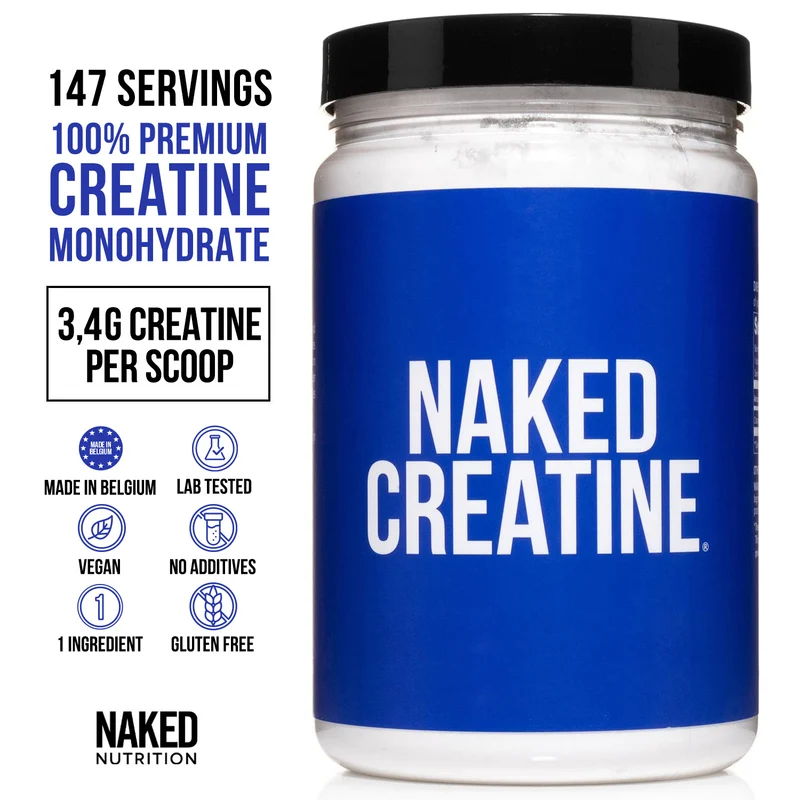
For a product built on a single ingredient, the relevant questions are fairly plain. What is actually in the tub, where was it made, and has anyone independent checked it? Naked Nutrition’s creatine monohydrate powder is a reasonable illustration of the format: one ingredient, micronised so it dissolves without clumping, unflavoured, manufactured in Belgium, suitable for vegans and third-party tested for heavy metals. A 500g tub sits at £24.99, which works out at around 17p per serving.
None of that tells you whether you personally need it. Anyone taking regular medication, managing a health condition, pregnant or breastfeeding should speak to a GP, pharmacist or registered dietitian before adding any supplement, and a supplement should never be treated as a substitute for a varied diet or medical advice.
Five facts most Londoners have never heard
Creatine was discovered in Paris, not a gym. The French chemist Michel Eugène Chevreul isolated it from meat broth in 1832 and named it after kreas, the Greek word for flesh.
It is in your dinner already. Raw beef and herring contain meaningful amounts of creatine, with herring among the richest sources. Cooking degrades some of it, which is one reason vegetarians tend to have lower baseline muscle stores than omnivores.
London is officially a National Park City. It received the designation in 2019, the first city in the world to do so, on the basis that roughly half its area is green or blue space. Most residents live within a ten-minute walk of a park.
Walking speed is a London anomaly. Pedestrian studies have repeatedly found Londoners among the fastest walkers in the world, which is not a fitness plan, but it is not nothing either.
The Christmas Day swim is older than the trophy. Serpentine members were racing on 25 December for forty years before Barrie put up the cup in 1904.
Tips that survive an actual London week
Anchor movement to something you already do. Getting off a stop early is not a fitness regime, but done twice a day it adds up faster than a gym membership you never use.
Do not skip the strength part. The NHS physical activity guidelines for adults aged 19 to 64 recommend 150 minutes of moderate activity a week, plus muscle-strengthening work on at least two days. The second half is the bit most people quietly ignore.
Treat the social element as the mechanism, not the bonus.People stick with things where somebody notices their absence. That is the actual advantage a run club has over an app.
Read the ingredients panel before the front label. A short list is easier to assess than a long one, and third-party testing is worth more than a bold claim in large type.
Cold water deserves respect. Enter gradually, never alone, and check local guidance for the specific pond or lido. The people who make it look easy have usually spent seasons building up to it.
Sort your sleep before your supplements. No powder compensates for five hours a night, and the cheapest health intervention available in this city is going to bed.
London’s health culture is not being driven by influencers or by council campaigns. It is being driven by people who found a park, a pool or a group of neighbours and simply kept turning up. Everything else, nutrition included, works best as support for that habit rather than a replacement for it.
This is a paid advertorial feature. It is provided for general information only and does not constitute medical or nutritional advice. Consult a qualified healthcare professional before making changes to your diet, exercise routine or supplement use.