
England’s 2026 World Cup campaign offered another serious attempt to end the country’s long wait for a second world title, but the drought continues. Thomas Tuchel’s side reached the semi-finals before losing 2-1 to Argentina, ending a run that had taken England through a difficult knockout bracket. The result extended the wait that began with the 1966 triumph at Wembley, although reaching the last four still represented a significant tournament run.
The campaign also provided a clearer picture of what England can become under Tuchel. The team possessed enough attacking quality to challenge elite opponents, but the semi-final against Argentina exposed the difference between controlling matches against less experienced opposition and handling the decisive moments against a tournament-calibre side.
England Started Strong but Never Looked Completely Comfortable
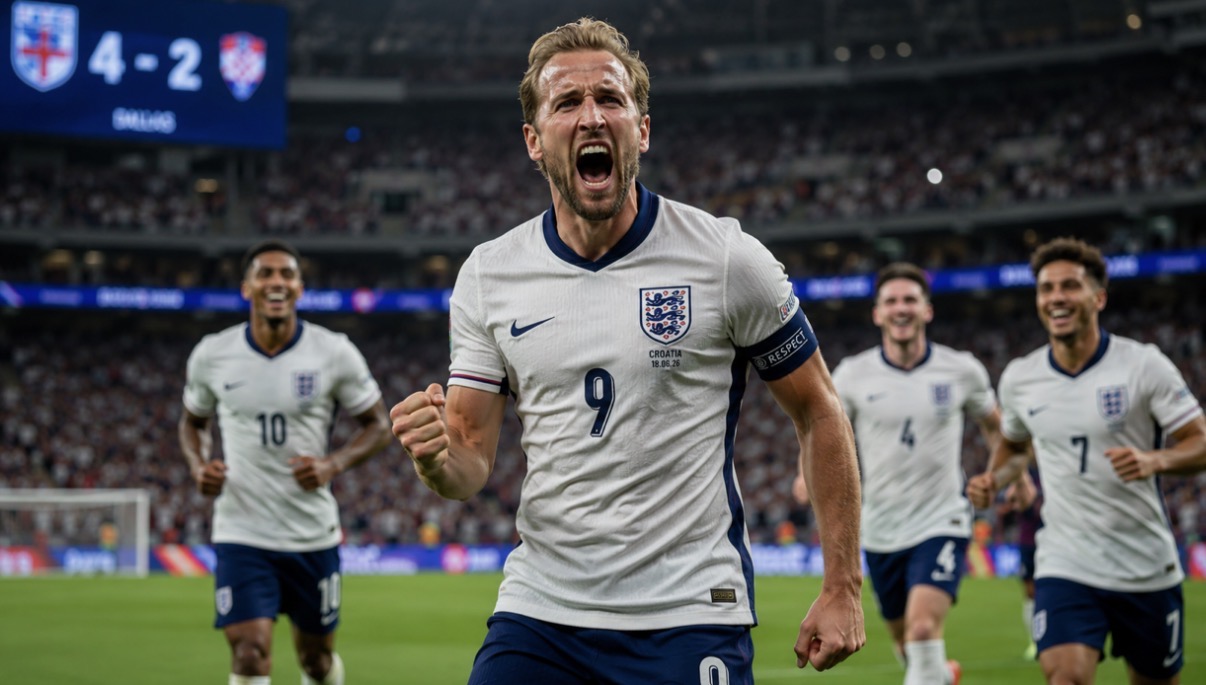
England opened the tournament with a 4-2 victory over Croatia, immediately demonstrating the quality of its attacking options. Harry Kane scored twice, while Jude Bellingham and Marcus Rashford also found the net.
The scoreline was encouraging but also revealed an issue that remained relevant later in the competition: England could create and finish chances consistently, yet its defensive structure was not always as stable as the talent available in the squad suggested it should be.
Tuchel’s side subsequently progressed through the group stage and continued into the knockout rounds, where the margin for defensive mistakes became increasingly small. Against the strongest opponents, England could no longer rely on simply outscoring problems.
Kane Remained England’s Reference Point
Harry Kane once again demonstrated why he remains central to England’s tournament ambitions. His movement between centre-backs, ability to drop into midfield, and finishing inside the penalty area gave the Three Lions a reliable attacking reference throughout the competition.
His partnership with Jude Bellingham was particularly important. Bellingham’s late runs from midfield created an additional threat around Kane, while wide players could exploit the spaces generated when defenders followed the striker.
Yet the tournament also illustrated the challenge of building an attack around a traditional focal point against elite opposition. Argentina’s defensive structure limited England’s ability to create the same volume of clear chances that had been available earlier in the competition.
Bellingham Became More Than a Supporting Player
Jude Bellingham entered the World Cup as one of England’s most important players and left it with an even stronger claim to being the team’s central attacking midfielder.
His ability to carry the ball through midfield, arrive late in the penalty area, and contribute defensively allowed Tuchel to use him in several different roles. Rather than remaining a fixed No. 10, Bellingham could move deeper during build-up or attack the box when Kane dropped toward the ball.
That flexibility became especially valuable during the knockout stage. England’s best performances came when Bellingham, Declan Rice, and the front line could maintain enough distance to attack without leaving the midfield exposed.
Tuchel’s Biggest Test Came Against Argentina
The semi-final against Argentina ultimately became the defining tactical examination of England’s tournament.
England lost 2-1 on July 15, and the result highlighted the narrow margins separating a strong World Cup team from a finalist. Argentina were more effective at managing the key moments, while England struggled to turn periods of possession and territorial pressure into enough clear opportunities.
The defeat does not erase the progress made during the tournament, but it leaves Tuchel with an obvious question for the next international cycle: how can England become more efficient against opponents capable of matching its individual quality while also punishing structural mistakes?
The answer may involve less emphasis on simply accumulating attacking talent and more attention to controlling transitions, managing space between the lines, and creating reliable solutions when the opponent refuses to surrender possession cheaply.
What Happened to England’s Pre-Tournament Betting Status?
Before the tournament, England was consistently regarded as one of the leading contenders, and its squad depth made that expectation understandable. The team also arrived after an excellent qualifying campaign, creating a statistical foundation for optimism.
The World Cup itself, however, showed why pre-tournament odds should be treated as probabilities rather than predictions. England reached the semi-finals but did not lift the trophy, while Spain and Argentina ultimately contested the final and Spain became world champion.
Сomparing betting programs (Arabic: برامج المراهنات) during the tournament had to account for factors that were impossible to capture fully in a pre-tournament price: confirmed lineups, injuries, tactical changes, matchups, fatigue, and the way a game developed after the first goal.
The Digital Matchday Became Part of the Experience
The 2026 tournament also reinforced how closely modern football viewing is connected to mobile platforms. Supporters followed lineups, injury reports, live statistics, match alerts, and changing market information alongside the actual broadcast.
For fans interested in downloading the MelBet apk (Arabic: MelBet apk تحميل), the same principle applied throughout the tournament: information is useful only when it is current and interpreted correctly. A confirmed lineup can change expectations, while an early goal, substitution, or injury can immediately alter the context of a live market.
That second-screen behaviour has become part of major tournament culture, but the World Cup also showed why speed should not be confused with accuracy. A live price can move quickly; understanding why it moved requires attention to the match itself.
England’s 60-Year Wait Continues
England’s 2026 campaign ended four matches later than the opening-night victory over Croatia and one step short of the final. The 2-1 defeat to Argentina meant another World Cup would finish without the trophy returning to England.
Still, the tournament should not be judged only by the final result. England reached the semi-finals, developed a more flexible attacking structure, and gave Tuchel a substantial body of evidence about which players can perform at the highest international level.
The central problem remains unchanged: England has the talent to compete with the best teams in the world, but talent alone has not been enough to repeat the achievement of 1966. The next stage of Tuchel’s project will be about converting that talent into greater control in decisive matches.
The 60-year wait therefore continues, but after 2026 the question is no longer whether England has enough elite players to challenge for the World Cup. It is whether the team can finally make those players function consistently enough together when one match decides everything.