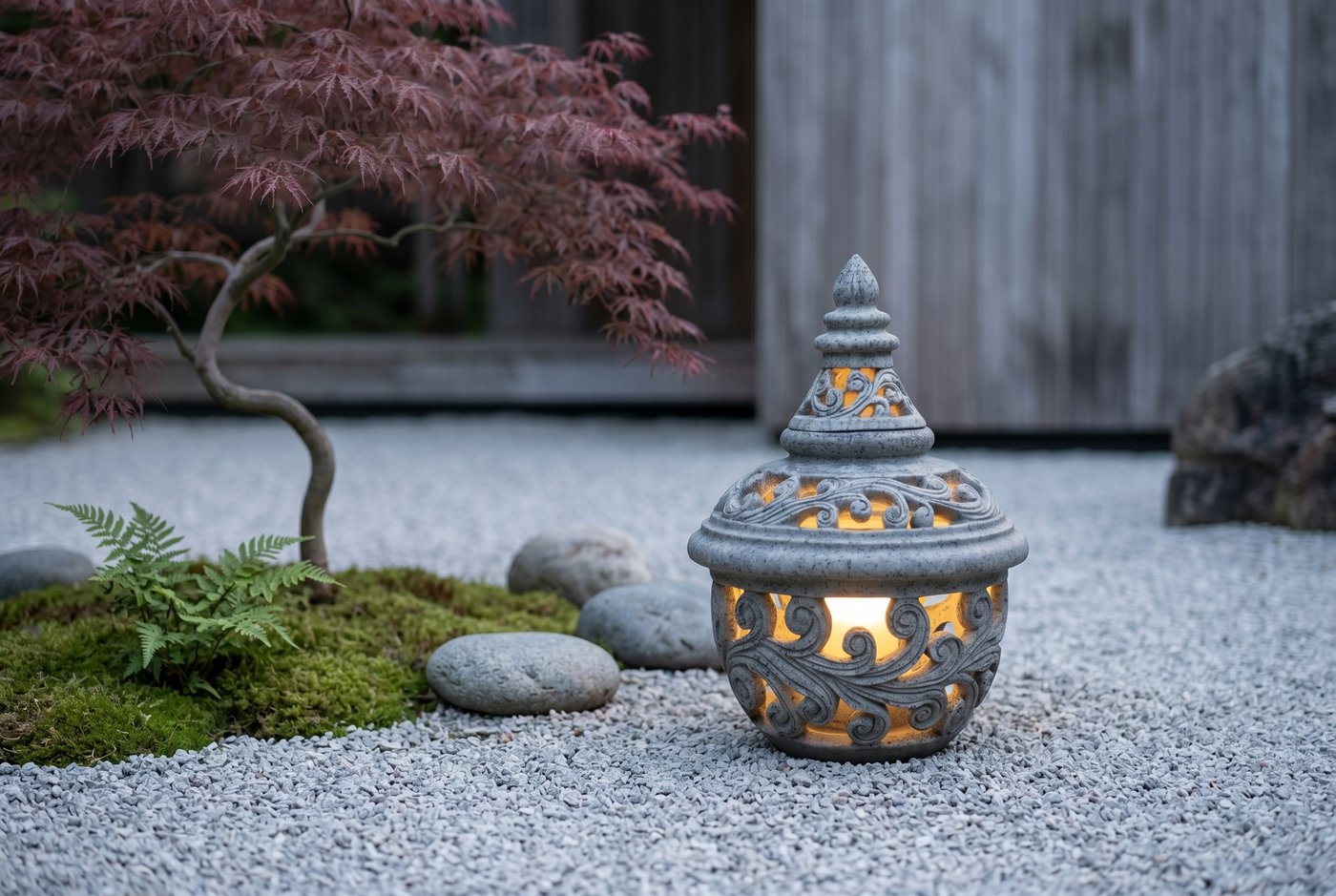
Japandi has spent five years redefining British interiors. The look fuses Japanese restraint with Scandinavian warmth: pale wood, clean lines, muted colour and very little clutter. Now it has stepped through the back door and into the garden, and it offers a sharp alternative to the packed, colourful borders of the traditional English plot.
A Japandi garden is calm, ordered and deliberately sparse. It values empty space as much as planting. For owners short on time, or craving somewhere quiet after a loud week, that restraint is the whole appeal.
Less, but better
The hardest idea for British gardeners to accept is that a Japandi garden uses fewer plants on purpose. Where a cottage border crams in dozens of species, a Japandi scheme might repeat three or four, planted in calm drifts.
The plant list is chosen for shape and texture rather than flower power. A single Japanese maple for its branching and autumn colour. Clipped box or pittosporum for evergreen structure. Soft mounds of grasses for movement. Moss, ferns and hostas for a cool green floor. Colour is muted: greens, silvers and the odd deep red, never a riot.
Empty space is part of the design, not a gap waiting to be filled. A raked gravel area or a simple stretch of paving gives the eye somewhere to rest, and it makes the few planted elements read as deliberate choices.
“People find the empty space the hardest part,” says Matt W, who has installed garden features across the UK for 16 years. “There is an urge to fill every corner. A Japandi garden asks you to leave room around each piece so it can be seen properly. Restraint is the skill.”
Natural materials, muted tones
Japandi lives or dies on its materials. The palette is natural and quiet: stone, gravel, untreated or charred timber, and a little weathered metal. Glossy plastic and bright colour break the spell at once.
Stone is the backbone. Use it underfoot as gravel and stepping stones, and as the few standout objects that punctuate the space. The texture of natural stone, weathered and tactile, sits at the heart of both the Japanese and the Scandinavian traditions the style draws from.
A stone lantern is the most recognisable Japanese garden object, and it translates cleanly into a Japandi scheme. The Garden Lantern Ornament in Grey carries carved detail and an internal glow, and at a modest size it anchors a gravel corner or marks a turn in a path without dominating. Lit softly at dusk, it gives the calm, low light a Japandi garden wants. Place it slightly off-centre. Asymmetry, not symmetry, is the Japanese instinct.
One piece of moving water
Water in a Japandi garden is quiet and contained. No splashing cascade, no busy fountain. A single, sculptural source of gently moving water is all the style allows, and all it needs.
The Basalt Statement Column Water Feature suits this perfectly. A tall natural basalt monolith is split to reveal a smooth, polished channel down which water slips in a thin, near-silent film before recirculating on a pump. It reads as a piece of sculpture first and a water feature second, which is exactly the Japandi balance. Set against a maple and a bed of ferns, with pebbles at its base, it becomes the still point the whole garden turns around.
The principle is one strong vertical against a horizontal scheme. A single upright stone, placed with care, carries more weight than a cluster of smaller pieces ever could.
Light and shadow
Japandi pays close attention to light. The Japanese aesthetic of wabi-sabi finds beauty in shadow, age and imperfection, and a Japandi garden is lit to suit.
Keep lighting low and warm. A glow inside a stone lantern, a single shielded uplight on the trunk of a maple, a soft wash across a gravel area. The aim is gentle pools of light and deep shadow between them, never an evenly floodlit space. Shadow is part of the composition.

How to start
You do not need to clear a garden and begin again. Choose one corner and strip it back. Lay a patch of clean gravel, plant a single maple or a clipped evergreen, set one stone lantern off to the side, and add a small vertical water feature if the budget allows. Live with it for a season.
Most people find the calm of that one corner pulls them towards repeating it. Japandi spreads quietly, which suits its character.
For stone lanterns, sculptural water features and the natural-stone pieces that give a Japandi garden its quiet structure, the specialists at gardenornaments.com carry a broad range and can advise on scale and placement before you buy.