
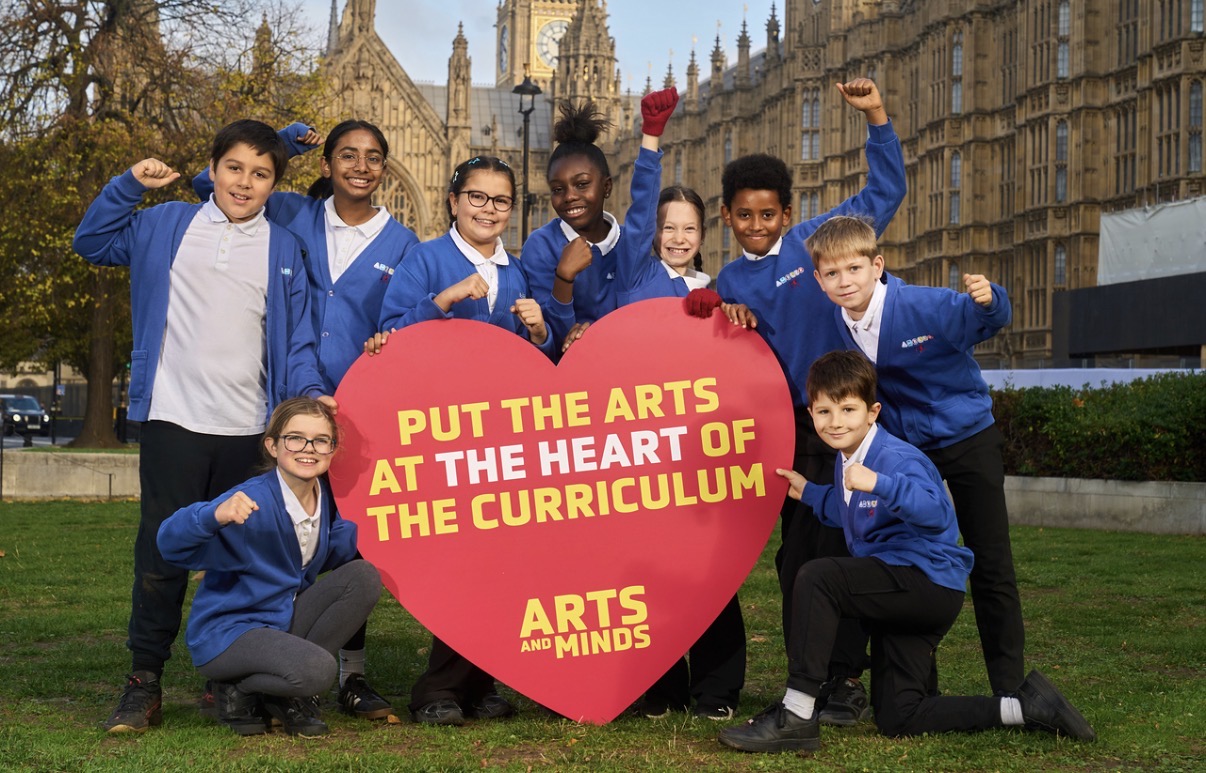
One year on from the Curriculum and Assessment Review (CAR), leading arts figures will today (Tuesday 10 November) call on the new Education Secretary to fulfil the government’s promise to restore the value of arts subjects in schools, as new research reveals that only 6% of school leaders have confidence in the government to deliver on its pledge.
Arlene Phillips, Lindsay Duncan, Harriet Walter and Samuel West are among 10,000 members of the arts community and educators who have signed an open letter to Lucy Powell MP and Lisa Nandy MP. It will be hand-delivered to the Department for Education by actor Jamie Kenna (currently starring in ITV’s Winter), Magic Radio presenter and composer Jack Pepper, and artists Lorna May Wadsworth and Bob and Roberta Smith.
The letter — organised by the Arts and Minds campaign, a coalition of over 60 organisations including the National Education Union, Royal Shakespeare Company, Campaign for the Arts and the Musicians’ Union — urges Ministers to “remember the vital role arts subjects play in developing pupils’ academic learning, employability skills and school engagement.”
Despite a number of government announcements since the CAR including the scrapping of the EBacc, the “Every Child Can” programme and a new enrichment framework, the vast majority of school leaders still cannot increase the time spent on the arts in the curriculum. Only 6% intend to increase the number of timetabled hours (a drop from 7% in 2025). Despite government plans to hold schools to a set of ‘enrichment benchmarks’, only 3% of school leaders intend to increase the number of extra-curricular hours – a drop of 40% when compared to 2025 (5% in 2025). Almost two-thirds (62%) intend to keep their arts offering the same – an increase from 56% in 2025.
Lucy Powell has stated that she wants schools to be, “Less an exam factory, more a talent factory”. One in four (40%) school leaders, including 50% of primary leaders, state that reducing the burden of statutory assessments would allow more time for the arts. Too much time spent on other curriculum priorities is an inhibiting factor for 60% of primary headteachers and 39% of secondary leaders.
Meanwhile, lack of school funding continues to affect creative subjects: almost one in five (18%) of school leaders say they lack funding for arts teachers and resources. Many school leaders believe that increased ring-fenced funding for arts subjects (26% agree) and increased per pupil funding (28% agree) would deliver more hours for students to study the arts.
Ed Harlow, president of the National Education Union and Arts and Minds campaign spokesperson comments, “We support the government’s ambition to restore the value of arts subjects in schools. However, to fully deliver on its promises, the government must tackle the wholesale causes of the current status of arts in schools and work with the arts education sector to deliver a meaningful expansion of provision. The arts should not be an add-on or an optional extra; they should be a fundamental part of every child’s school experience.
“Only then will every young person have the chance to study the same curriculum as those in the most affluent areas can enjoy, and reach their full potential wherever their talents lie.”
Actor Jamie Kenna who recently appeared in the ITV drama Winter, comments, “The arts helped me find my world, my people and myself. I followed my dream and we have to find a way to make that possible for every child. Studying the arts doesn’t necessarily mean a career in the arts but these subjects give them confidence, character and, often, a reason to be in school. The opportunity to follow your passions should not be determined by how much money your parents have – it should be every child’s right.”
Renowned portrait artist Lorna May Wadsworth comments, “All children benefit from the opportunity to express themselves creatively and every child should have the opportunity to enjoy the arts in schools. Schools must have the support they need to make this happen. The thought of children not having proper access to the arts fills me with dread about what it means for those young people and what it means for society.”