
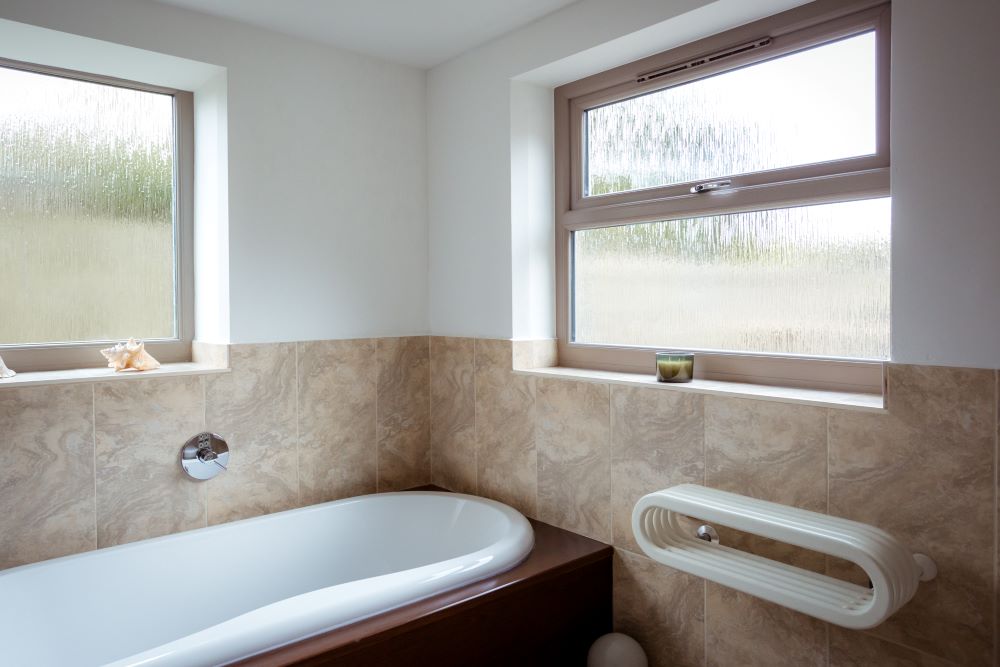
Most London renovations reach the same awkward moment. You work out where the light in a room actually comes from, then realise the best window looks straight into a neighbour’s bathroom, or onto a pavement where people pass at shoulder height. The usual fix is a blind that never goes up, which quietly removes the window from the room.
There is another way of approaching it, and it starts with the glass rather than whatever hangs in front of it. Obscured and textured glazing has been part of British housing for well over a century, and reeded glass in particular has found its way back into hallways, bathrooms and side elevations where people want daylight without a clear view in either direction.
Why London houses ask more of their windows
Terraces were built tight. Gardens have filled up with rear extensions, and loft conversions have added windows that now sit a few metres from the ones opposite. A flat carved out of a Victorian townhouse may rely on a single side window for most of its natural light, and a ground-floor room on a busy street can feel completely exposed the moment the lamps go on in the evening.
Curtains and blinds provide privacy, but at the expense of daylight and the view. Adhesive frosted film is a quicker alternative, though it tends to look like a temporary measure once the corners start lifting. Glass with the texture built into it does the same job permanently, and in a way that adds something to the room rather than covering it up.
What reeded glass actually looks like
Reeded glass features a run of fine vertical ribs across the surface of the pane. Light passes through more or less freely, but anything behind it dissolves into soft vertical bands. Movement and colour still register but detail does not.
The effect changes throughout the day. Morning sun through a reeded panel throws faint striping across the opposite wall, and at dusk the pane reads from outside as a glow rather than as a lit room with people in it. It has a slightly older, almost handmade quality that sits comfortably alongside panelled doors and painted timber, and it works just as well with flat contemporary joinery, where the ribbing becomes the only decorative detail in the opening.
Useful in far more rooms than the bathroom
The bathroom is the obvious location, but there are plenty of opportunities to use it elsewhere in the home. A reeded panel beside a front door lets a dark hall borrow daylight from the street without putting the hallway on display. A half-landing window facing a neighbour’s flank wall at close quarters becomes far less of a problem once the view through it is broken up. Internal glazing between a kitchen and a hall carries light deep into the plan while keeping the two spaces visually separate.
Choosing a finish that suits the room
Reeded is one option among several. Satin has a smooth, evenly frosted appearance with no pattern at all, diffusing light softly and disappearing into a contemporary interior without drawing attention to itself. Stipple offers a finer, more irregular surface, while patterns with names such as Westminster, Bark, Contour and Leaf put a far more decorative texture into the pane and change its character considerably.
The decision is less technical than it might seem. A north-facing bathroom with one small window needs a finish that gives away as little daylight as possible, while a hallway with a generous opening can carry something with more pattern in it. Period detailing tends to suit the older-looking textures, and a clean modern extension is usually better served by something plainer. Seeing a sample in the room helps, because a pattern that looks busy in a brochure often settles down once it is lit from behind.
The frame matters as much as the pane
Glass never sits on its own. In a sash window the pane is framed by the meeting rail and often subdivided by bars, so a vertical reeded texture picks up the vertical emphasis the window already has. In one large modern opening the same glass reads as a flat sheet of texture instead, which is a very different look.
Anyone replacing sash windows in a period property can usually request obscure glazing on individual sashes rather than across the whole window, which is how most homes deal with a bathroom overlooking next door. Quickslide, a UK specialist in uPVC sliding sash windows, offers reeded glass across its range, alongside patterns including Satin and Stipple, and that is a choice worth making deliberately at the ordering stage.
Glass tends to be treated as the last decision in a renovation, settled long after the frames, the paint colour and the ironmongery. That is a missed opportunity. The right texture in the right window changes how a room feels at different hours, how private it is without anything drawn across it, and how the house presents itself to the street. It deserves as much thought as any other surface in the room.