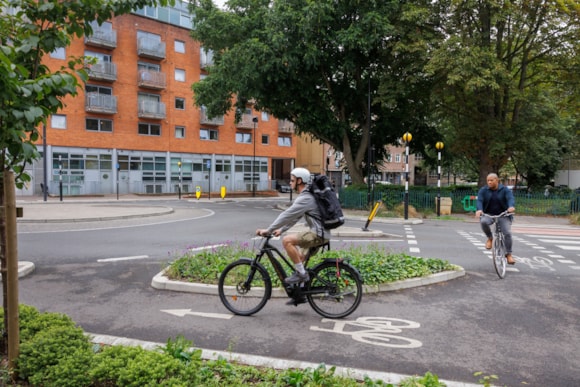
London’s Cycleway network has reached a major new milestone, growing to 450km following the completion of new and extended routes across the capital – longer than the entire Tube network and further than the distance from London to Paris.
The achievement means London’s Cycleway network is now five times larger than it was in 2016, when there were 90km of Cycleways. Since then, Transport for London (TfL) and London’s boroughs have worked closely to create a connected network of high-quality cycling routes that make it safer and easier for people of all ages and abilities to travel by bike. Data published last year by Transport for London (TfL) revealed that London’s cycling boom shows no sign of slowing, with an estimated 43 per cent increase in cycling journeys since 2016, and a massive 1.5 million daily journeys taking place in 2025.
The latest additions to the network include new sections of Cycleway in Islington, Wandsworth and Kingston, as well as TfL’s completion of Cycleway 62 across Lambeth Bridge. The new schemes connect communities, town centres, public transport hubs, schools and workplaces, while providing safer and more attractive routes for people travelling around London.
The continued expansion of London’s Cycleway network is a key part of the Mayor’s commitment to creating a greener, safer and healthier city. Safe cycling infrastructure plays a vital role in ensuring that Londoners can travel safely and sustainably, and helps to tackle air pollution, congestion and the climate emergency, improving the health and wellbeing of people in neighbourhoods across the capital.
The growth of the network also supports Vision Zero, the Mayor and TfL’s goal of eliminating death and serious injury from London’s transport network. Safer streets and protected cycling infrastructure play an important role in reducing road danger for everyone.
The latest additions to London’s Cycleway network include:
Cycleway – Islington
Approximately 4km of new Cycleway has been delivered by extending C23 and C20 around the borough. The new extensions provide new connections to Cycleway 1 and Cycleway 27, making it easier for people cycling across the borough to access the Cycleway network.
Cycleway Camden
2.5km of new Cycleway providing improved links between Camden Town and King’s Cross.
Cycleway – Wandsworth
A newly completed 1.6km link connecting Wandsworth Common to Clapham Common.
Cycleway 29 – Ewell Road, Kingston
A 0.5km extension of Cycleway 29 providing segregated cycle tracks on a key corridor in south west London between Tolworth and Surbiton.
Cycleway 62 – Lambeth Bridge
The completion of Cycleway 62 across Lambeth Bridge has improved cycling connections between north and south London, creating a new Safer Junction in the capital. The new Cycleway provides a safer and more direct route across the Thames and forms part of wider improvements at the junctions on either side of the bridge, helping to reduce road danger for people walking, cycling and travelling in the area, while strengthening links to London’s wider Cycleway network.
Cycleway 43 – Westminster
The first section of Cycleway 43 between Hyde Park and Edgware Road
The Mayor of London, Sadiq Khan, said: “I’m proud to have overseen a dramatic expansion of London’s cycle network, making it easier and safer for people across the capital to choose cycling for everyday journeys. I said I’d make London a byword for cycling – promise made, promise delivered.
This progress is transforming the way Londoners travel, improving our health and cleaning our air to help us build a greener city.
But there is more to do. I’m determined to keep working closely with Transport for London (TfL), boroughs and communities on expanding and improving our cycle network so we can create a greener, safer, better London for everyone.”
Helen Cansick, Head of Healthy Streets and Investment at TfL, said: “450km of cycleways is a significant milestone in our mission to create an integrated cycle network which connects people to the places they want to go. This milestone reflects the years of strong partnership with London’s boroughs to deliver safer and more accessible cycling infrastructure.
“A high-quality cycle network benefits everyone, whether they choose to cycle themselves or not, by helping to reduce traffic, improve local environments and support healthier neighbourhoods. There is more to come and we will continue to expand the network and enable even more people to travel safely and sustainably.”
The Mayor and TfL continue to work with boroughs and communities to expand London’s walking and cycling network, making active travel an option for more people and supporting a safer, more sustainable transport system for the capital. Boroughs are expected to complete a number of Cycleway projects, including the first Cycleway in Harrow, a new 4.5km route between Harrow and Pinner that combines quieter back streets with short sections of segregated cycle lanes on main roads, and a 0.7km extension of Cycleway 3 along Westbourne Terrace near Paddington station in Westminster. Both schemes are currently under construction and due to finish later this year.
TfL’s updated Cycling Action Plan 2 highlights the fundamental role cycling plays in making a greener, more progressive, modern city. The plan outlines why it is essential to broaden the appeal of cycling to a more diverse range of Londoners to ensure cycling levels continue to increase at pace and that all Londoners benefit from the health and economic benefits of cycling. TfL’s research shows that people from under-represented groups are open to taking up cycling, but experience different barriers, and the plan outlines ambitious evidence-led measures to support these groups by addressing these barriers.