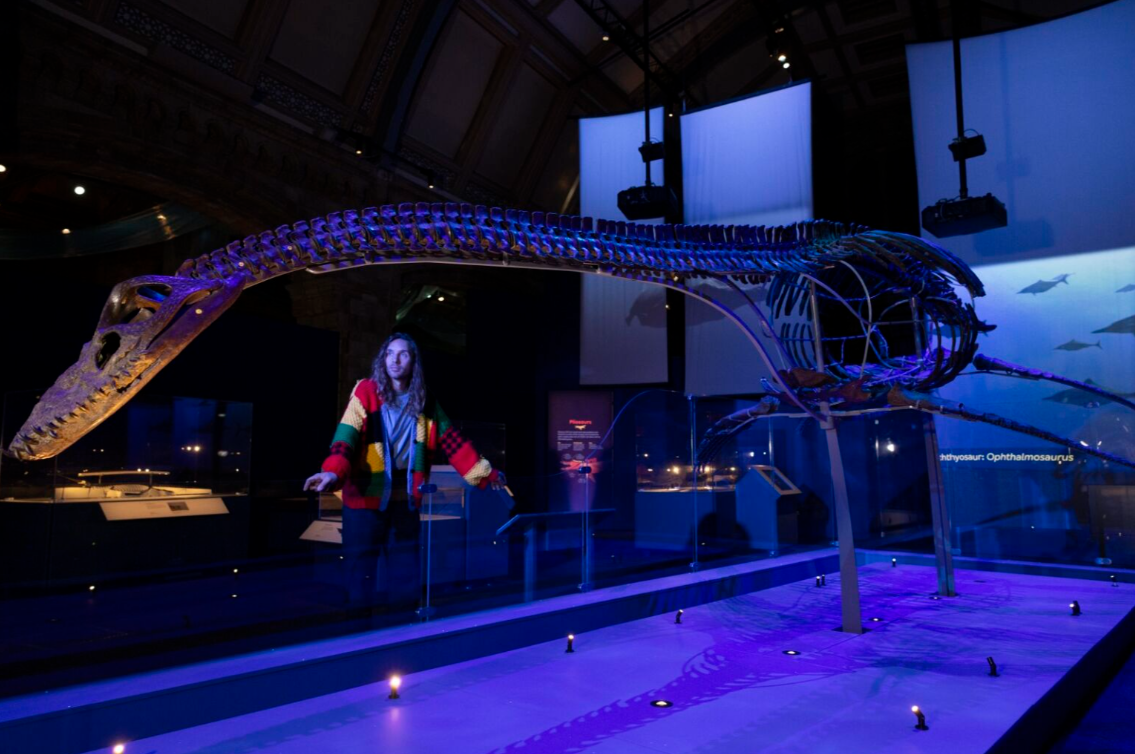
This Friday, London’s Natural History Museum will open Jurassic Oceans: Monsters of the Deep. Generously supported by the Blavatnik Family Foundation, this spectacular new exhibition reveals the terrifying creatures that hunted beneath the waves millions of years ago.
From razor-toothed marine reptiles and enormous fish to beautifully preserved ammonites, Jurassic Oceans takes visitors on an electrifying journey through ancient seas fizzing with life, danger and drama.
Dr Marc Jones, curator of fossil reptiles at the Museum and lead scientist on the exhibition said, “Experience the Jurassic like never before in this thrilling encounter with ancient ocean giants, where danger is lurking behind every corner, and predators quickly turn into prey. Discover that the sheer variety of life that existed in the seas of the Jurassic is unmatched – from intricate ammonites to giant fish - and that all life is intimately connected and contributes to the balance of the underwater ecosystem.”
Meet the underwater stars of the Jurassic
Introducing the ichthyosaurs, some of which grew up to 25 metres long – similar to Dippy the diplodocus! Its huge eyes helped it to scour the depths of the ocean for prey, while its extraordinary sense of smell helped track its dinner. Visitors will touch a cast of an ichthyosaur skull, getting closer than ever to one of the most impressive sea predators of the Jurassic. You won’t find anything like this in today’s oceans!
Then, come face-to-face with the plesiosaurs whose body plan of a long neck and four flippers is something not seen before or since, making them truly one of a kind. Their long neck and piercing teeth proved to be the perfect combination for these poised predators that continued to thrive long after the Jurassic. Look closely to see bite marks where shark teeth ripped flesh from the bones of this plesiosaur once it had died and become food for other sea creatures, like whales do in today’s oceans.
Casting the net wide, we dip into the Cretaceous to meet the mosasaurs, the T. rex of the sea! Armed with two kinds of teeth, a double-jointed jaw and a bite built for ripping through its prey, mosasaur could swallow fish whole. See a mosasaur jaw, examine a cast of its skull and dare to touch a real mosasaur tooth, almost 70 million years old. It won’t bite, anymore…
Dr Jones continues, “Drawing on the Museum’s world-leading palaeontology collection, Jurassic Oceans highlights how studying the past can help scientists understand a warmer, wetter world and turn the future of our seas. As the climate changes, fossils offer vital clues about how marine ecosystems have responded to dramatic environmental shifts in the past, and what that could mean for ocean life in the centuries ahead. These animals may seem like monsters, but they tell a powerful scientific story about evolution, extinction and the changing health of our oceans.”
Opening Friday 22 May 2026, Jurassic Oceans: Monsters of the Deep promises a thrilling encounter with the prehistoric predators that once ruled the waves.