A financial services high-flyer from east London, whose career was soaring when she was diagnosed with breast cancer, says her life changed “in the blink of an eye”.
In August 2015, Bal Nanray had just secured a promotion and was thriving in a senior role at a City firm when she attended a routine health check.
What followed came as a devastating shock. After a series of tests, the then 50-year-old was told she had cancer.
“I couldn’t believe what my consultant said – I had to get him to repeat it. I was in denial and absolute shock. My husband was asking a million questions, but I was lost for words. My whole world changed in the blink of an eye,” Bal said.
Now, more than a decade on, she is sharing her story to encourage the public to support life-saving research and help drive progress further and faster.
Breast cancer is the UK’s most common cancer, and by 2040 around 69,900 women are expected to be diagnosed with the disease every year.* Scientific advances have helped cut breast cancer death rates among women in London by 21% in the last decade.** But the disease still claims around 1,000 lives in the region each year.***
That’s why Bal, from Gants Hill, is backing Cancer Research UK scientists who are using artificial intelligence (AI) to accelerate progress towards breakthroughs – helping to spot more cancers earlier and save and improve lives.
During her health check, Bal had a mammogram. Midway through the appointment, staff told her she would also need an ultrasound and a fine needle aspiration biopsy – a procedure that uses a thin needle to take a sample of cells.
“I asked when they needed me to come back and they said, ‘We’re going to do it now’, which was strange. They asked if I was by myself and I told the nurse my husband was with me – thank God he was there,” the mother of one said.
She also had a core biopsy.
The 61-year-old said: “My body went into shock, and when they did the core biopsy I just went numb. My husband looked at me and the nurses and asked if something was wrong, but I told him not to be silly. I was in pain and very uncomfortable, and it went on for what felt like forever.”
When the procedure was finished, Bal assumed she would come back another day for the results. Instead, she was told a consultant would see her straight away.
“When I went in to see the consultant, he sat me down and said those words: ‘You have breast cancer.’ I didn’t know what to say. I had no words.”
The tumour was an aggressive, stage three HER2-positive breast cancer – a type that can grow quickly – and within weeks Bal had a mastectomy. She returned two weeks later for a review.
She said: “I stood in the doorway and said to my consultant, ‘I know it’s bad news.’ He told me we’d have to do another operation in three weeks’ time. He needed to do it quickly before it spread.
“I felt very angry with myself. My son was sitting his GCSEs and I was more worried about him than about myself.”
Bal then faced eight months of chemotherapy.
She said: “I remember after my second session my oncologist went through the possible side effects. I was told there were no alternatives and that chemotherapy was the best treatment for me.”
One of the hardest moments came when her waist-length hair began falling out after the second session of chemotherapy.
She said: “When it started coming out in clumps, I just sat in the shower and cried. I felt like I’d lost my identity. I had a mobile hairdresser come round and shave it all off.”
The treatment took such a toll on her body that at one point she could barely walk and needed two blood transfusions.
“I asked myself, ‘How much more can my body take?’ With the steroids and the nausea, I was a wreck. I wouldn’t wish it on my worst enemy.”
Bal finished chemotherapy in April 2016, and the following month had 15 sessions of radiotherapy.
“Once my treatment was over, I went to see my oncologist. He told me, ‘Off you go and live your life.’ But because it had been so intense, I felt completely lost. I started counselling and took part in a course to help me adjust to life after treatment.
“My employer was amazing and supported me so much throughout my treatment. I received sick pay for 15 months, and they kept in touch the whole way through, egging me on during chemo.”
Bal gradually returned to work and, in August 2020, reached a major milestone: five years on from her diagnosis, she was discharged with no evidence of disease.
She continued her career, but found cancer had permanently changed her outlook on life. In May this year, she decided to walk away from her job.
She said: “I was sitting at my desk in Canary Wharf one day and glanced over at my CEO, and he asked me what was up. I said ‘nothing’, but when I went home I realised there was more to life and living. Cancer taught me a very cruel lesson: to slow down. I realised who I was.
“The next day I went for a walk with him and told him I wanted to leave.”
While cancer changed the direction of Bal’s career, it also gave her a renewed sense of purpose.
During the Covid-19 pandemic, she volunteered to support vulnerable people in her community, and she later helped improve cancer services through NHS England and East of England Cancer Alliance groups.
Her experience as a breast cancer patient, and as someone born in India, has also motivated her to speak openly about the importance of screening, particularly within South Asian communities.
“In the South Asian community, there’s a lot of stigma around cancer and people brush things under the carpet,” she said. “Screening is vital, because early detection is key to better outcomes.”
In August, Bal marked eleven years since her diagnosis.
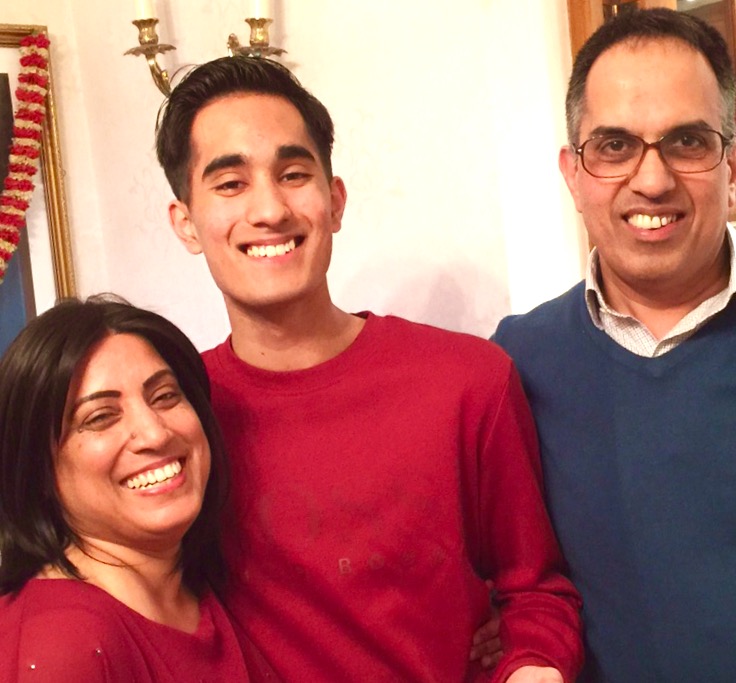
She said: “Some people have a party, but I just wanted to go out for a meal with my husband and son. I’m so grateful to be here. Cancer changed my life completely, but it also helped me realise what matters most: my family, my friends and the memories we make. No job will ever replace that!”
Combining clinical excellence with bespoke AI tools, Cancer Research UK scientists are turning vast amounts of data – from scans to health records and genetic information – into life-saving insights, revealing subtle signs of cancer that might otherwise be missed.
Bal says next-generation research like this offers people like her new hope for the future.
She said: “What once sounded like science fiction is quickly becoming reality, and with so many lives at stake, it couldn’t be more important. I know all too well that my story could have had a very different ending. Too many people are still diagnosed when their cancer is more advanced, which can mean fewer options and tougher treatment.
“Living with the fear of my cancer coming back can be difficult at times. That’s why it’s so encouraging to know new ways to detect cancer are on the horizon, meaning more people can be diagnosed and treated faster. Spotting cancer early saves lives. That’s something we can all get behind, so I hope people will give what they can.”
Right now, researchers funded by the charity are creating digital replicas of real tumours using biological data from people with the disease. With the help of technology, they’re ‘rewinding’ these ‘digital twins’ to explore the earliest signs of breast cancer – and training an AI program to help doctors spot those signs on MRI scans.
Scientists have also created the OPTIMAM database, which brings together millions of mammograms with information on what happened to the people they came from. This is helping to train and fine-tune AI tools to spot early-stage breast cancer and identify patterns that may predict future risk of the disease. It’s even being used to explore virtual clinical trials, testing new ways to detect cancer quickly and safely without the need to recruit participants.
Cancer Research UK spokesperson for London, Jose Ramos said: “From developing ‘digital twins’ to uncovering hidden clues in tests and scans, AI is helping our researchers develop better, faster tools to detect the earliest signs of cancer, when treatment is more likely to work.
“In England, almost everyone diagnosed with breast cancer at the earliest stage survives their disease for five years or more, compared with around three in 10 when diagnosed at the latest stage.**** Every donation brings us closer to a world where everybody lives longer, better lives, so we’re grateful to Bal for helping to raise vital funds.”
Donate at cruk.org/breakthroughs