
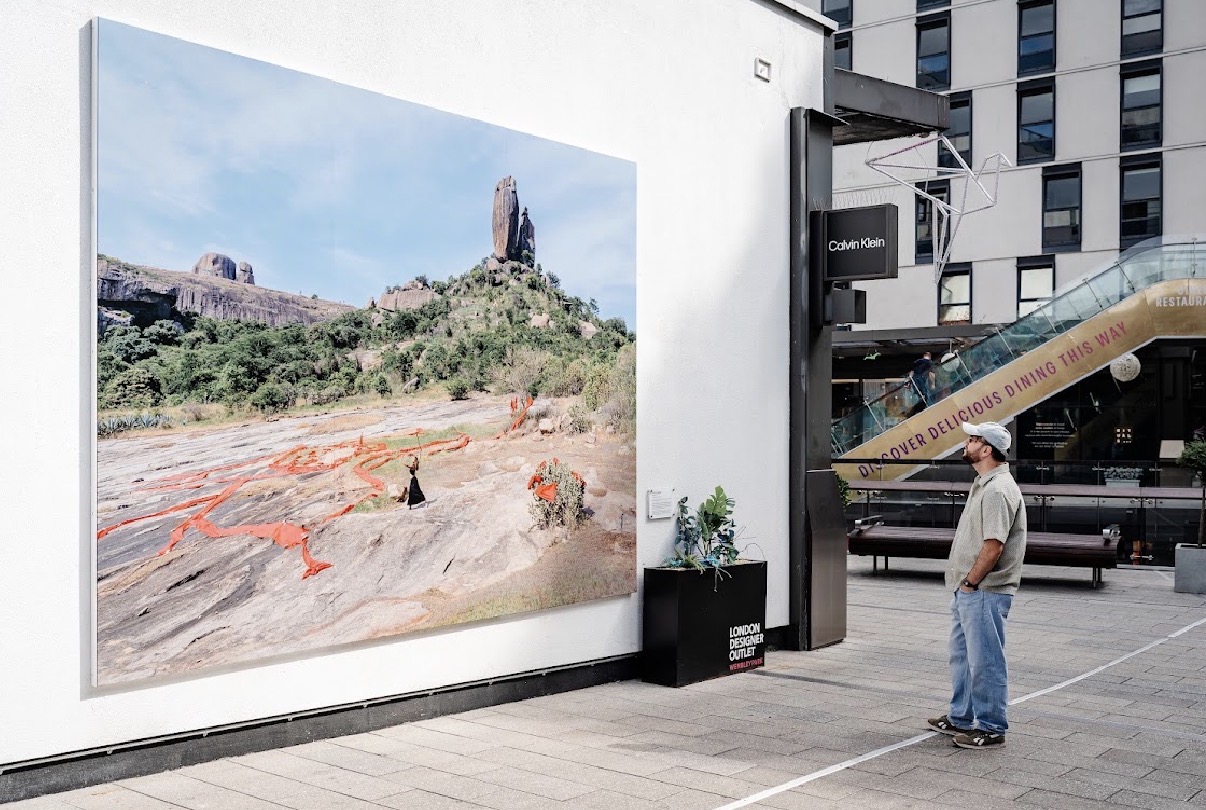
London Designer Outlet (LDO) has transformed one of its busiest public spaces with an eight-metre-wide fine art installation, mounted along a feature wall on Level 1 between Superdry and Calvin Klein, exploring the emotional experiences people carry beneath
the surface.
Invisible Figures brings together two newly commissioned artworks by emerging artists and Central Saint Martins,
University of the Arts London, graduates Henry Gibbs and Bhawana Jain. Inspired by LDO’s long-standing partnerships with Talk Club, a UK male mental health charity focused on suicide prevention, and Solace Women’s Aid, London’s largest domestic and sexual
abuse charity, the artists were challenged to answer one question: “What does someone carry that isn’t visible?”
Their responses offer two strikingly different perspectives. Henry’s Becoming explores suppressed emotion, masculinity and the search for genuine connection through a densely layered digital composition. Bhawana’s
Fictioning Freedom uses 200 metres of flowing red fabric and an expansive natural landscape to consider what it means for women to occupy space freely and without fear.
Installed where it will be seen by thousands of visitors, the work turns an everyday journey through LDO into an unexpected cultural encounter – inviting people to pause, look beyond the surface and connect with experiences that might otherwise remain unseen.
The project reflects LDO’s ambition to be more than a place to shop. Located in the heart of Wembley, where local families, multicultural communities and global eventgoers come together, LDO is using its public spaces to champion emerging creative talent, amplify
causes that affect its community and make contemporary art accessible to everyone.
BECOMING: BY HENRY GIBBS
Created in response to Talk Club, Henry Gibbs’s Becoming explores what he describes as “the state of becoming” – the idea that people are never fixed but are constantly reshaped by their experiences, emotions and relationships.
Henry combines found imagery, physical objects and digital processes to create a layered composition of gestures, hidden figures, reflections, shadows and digital distortions. Each layer leaves a trace, giving personal experiences a sense of physical and emotional
weight.
The work considers the pressure men can feel to conform, follow the pack and maintain a guarded exterior. From an early age, men may be taught to suppress vulnerability and protect the version of themselves they present to the world.
Through its obscured figures and fragmented surfaces, Becoming represents this tension between concealment and release. Refracted light cuts through shadowed layers, suggesting the breaking down of ego and exterior barriers to reveal the inner self.
The work speaks directly to Talk Club’s approach: creating spaces where men can move beyond surface-level responses, talk honestly about how they feel and connect with their own consciousness and with one another.
The installation is designed to change as visitors move towards it. From a distance, it appears as a bold digital image. Up close, halftone dots, shadowed hands and partially hidden details emerge, encouraging people to look beyond first impressions.
Henry Gibbs said: “The process behind the work became a metaphor for continued evolution, development and expansion. Our emotions and identities vary and evolve day by day. The act of opening up and experiencing ourselves – something that is central to Talk
Club – can allow us to understand ourselves better.”
FICTIONING FREEDOM: BY BHAWANA JAIN
Bhawana Jain’s Fictioning Freedom, created in response to Solace Women’s Aid, asks a powerful question: how can women feel expansive?
Born in Assam, India, Bhawana’s multidisciplinary practice draws on the lives of women and the quiet strength, endurance, care and invisible labour that hold families, communities and histories together.
Her work depicts women moving through a vast natural landscape alongside 200 metres of red fabric. The material draws on the red fabric worn and used by women across South Asian cultures, connecting the figures to shared cultural memories and generations of
women.
The image was captured by drone in Ramanagara, Karnataka, India, a picnic spot Bhawana visited during her childhood. Seen from above, the women appear both significant and small within the surrounding landscape.
As the fabric moves organically through the environment, it makes the women’s presence visible across the image. It allows them to take up space, create new forms and leave a temporary mark on the landscape.
Bhawana appears within the work playing the Sulur, a traditional carved bamboo wind instrument, while facing the sun. This intimate gesture sits within the much wider scale of the landscape, bringing together the body, memory, nature and the work of the artist’s
hands.
The freedom Bhawana experienced while making the piece became central to its meaning. Rather than presenting women only through struggle or pain,
Fictioning Freedom imagines them as expansive, joyful and free to shape the space around them.
Bhawana Jain said: “I wanted this work to imagine what it feels like to belong in the landscape, to take up space without apology and to exist beyond the expectations that so often shape women’s lives. I hope it invites others to question what has been normalised,
reclaim space for themselves and believe that another way of being is possible.”
CONNECTING PEOPLE, PLACE AND PURPOSE
Although the two artworks respond to different lived experiences, they are connected by a shared idea: what people carry internally is not always visible to those around them.
Talk Club is a UK male mental health charity focused on suicide prevention. Its practical, peer-led approach begins with the question, “How are you? Out of 10?”, giving men a straightforward way to talk honestly about how they feel and move from isolation towards
connection.
Solace Women’s Aid supports women and children affected by domestic and sexual violence through services including refuge accommodation, advocacy, counselling and community outreach.
Both partnerships are embedded within LDO. Talk Club’s check-in is used across the destination to encourage honest conversations, while Solace has worked with LDO for more than four years to provide infrastructure and bespoke training that helps colleagues
support guests who may be experiencing abuse.
Michelle D’Vaz-Plant, Head of Marketing at LDO, adds: “We believe a shared public space like ours can do more than serve a practical purpose – it can create opportunities for culture, understanding and connection.
“Our long-standing partnerships with Talk Club and Solace Women’s Aid reflect our commitment to supporting causes that have a profound impact on the communities we serve.
This commission brings together people, place and purpose: giving new artistic talent a platform, making contemporary art part of everyday life and bringing greater visibility to experiences that too often remain unseen.”
Invisible Figures will be displayed at London Designer Outlet from 24th August 2026.