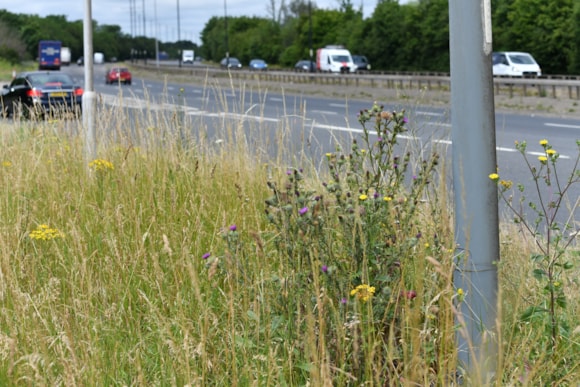
Transport for London (TfL) has doubled the amount of wildflower verges on its estate to 520,000m² in just two years, helping to boost biodiversity and support wildlife across the capital.
The expansion, from 260,000m² in 2024, comes as London marks Climate Action Week and forms part of wider efforts to make the city greener and more resilient to climate change. Improving the area and quality of wildflower verges across London is an important part of making the capital more sustainable.
New wildflower verges have been introduced at a number of sites in the past year, including along the A10 in Enfield (5,000m²), the A2 in Bexley (2,000m²) and the A217 in Sutton (1,700m²). TfL has also sown wildflower seeds, donated by Butterfly Conservation, near Rotherhithe roundabout on islands that previously had more formally planted areas. These new locations complement existing wildflower verges, some of which are publicly accessible sites that allow people to enjoy green spaces, for example at Redbridge Roundabout via the pedestrian underpass and alongside a shared foot and cycle path by the A40 in Hillingdon.
TfL’s approach to wildflower verges has blossomed since an initial trial on two sites took place in 2019, one alongside the A40 in Hillingdon and one alongside the A406 at Redbridge. By reducing mowing from up to eight times a year to twice annually, and removing grass cuttings, verges are better able to support wildflowers and create richer habitats for wildlife.
This approach creates a supply of nectar, food, and shelter for wildlife, including bees, butterflies, birds and small mammals. Wildflower verges bring additional benefits beyond London’s biodiversity as well, including the transfer of carbon dioxide from the air into the soil and reduced carbon emissions from less frequent mowing.
Since 2023, TfL has worked in partnership with the charity Butterfly Conservation to survey the number and types of butterflies appearing across the wildflower verges. In 2025, 118 surveys across 34 sites recorded around 720 butterflies from 22 species, as well as around 100 day-flying moths. Average butterfly sightings increased by more than fifty per cent compared with the previous year.
Deputy Mayor for Environment and Energy, Mete Coban, MBE, said: “The expansion of wildflower verges across London shows how simple changes can have a big impact, helping nature thrive. Alongside these verges we have planted more than 640,000 trees, including two major new woodlands, and created or restored over 2,000 football pitches worth of green space.
“These achievements reflect the Mayor’s commitment to greener neighbourhoods across the capital, investing in practical solutions that support communities, tackle climate change and help build a better, greener London for everyone.”
Lilli Matson, Chief Safety, Health and Environment Officer at TfL, said: “We’ve doubled wildflower verges across London in just two years – and we’re already seeing wildlife return. Our approach has really blossomed over the years and it’s really encouraging to see the number of butterflies begin to pick up again.
“Ultimately, taking action to improve biodiversity and reduce carbon emissions, such as through our approach to wildflower verges, isn’t just about improving the capital for wildlife, but about improving it for everyone in the capital. Supporting and creating healthy green infrastructure allows us to shape our city, so that it becomes more resilient to the impacts of climate change and also a more pleasant, liveable place to spend time in.”