The numbers are unambiguous. Live-dealer games, the format in which a real human croupier operates a physical table in a purpose-built studio while players join remotely via video stream, have grown faster than any other segment of the online entertainment market over the past four years. The question worth asking is not whether this growth is happening but why it is happening with such velocity, and what it reveals about the kind of entertainment experience that audiences are actually looking for.
The problem that live-dealer solved
To understand why live-dealer has grown, it helps to understand what it replaced. Standard online casino games, the digital slots and algorithmically generated card games that constitute the traditional online gambling product, have a fundamental problem of trust and presence. The outcome is generated by a random number algorithm that the player cannot observe. The experience is solitary and silent in a way that contrasts sharply with the social environment of a physical casino. And the visual experience, however polished the animation, reads as a simulation rather than as a real event.
Live-dealer addresses all three of these problems simultaneously. The physical dealing of cards and the spinning of a real roulette wheel are directly observable on screen. The presence of a human host creates a social register that algorithmic games cannot produce. And the fact that events are unfolding in real time, with an outcome that is not yet determined, activates a quality of attention that pre-recorded or fully automated content structurally cannot generate.
The infrastructure behind the format
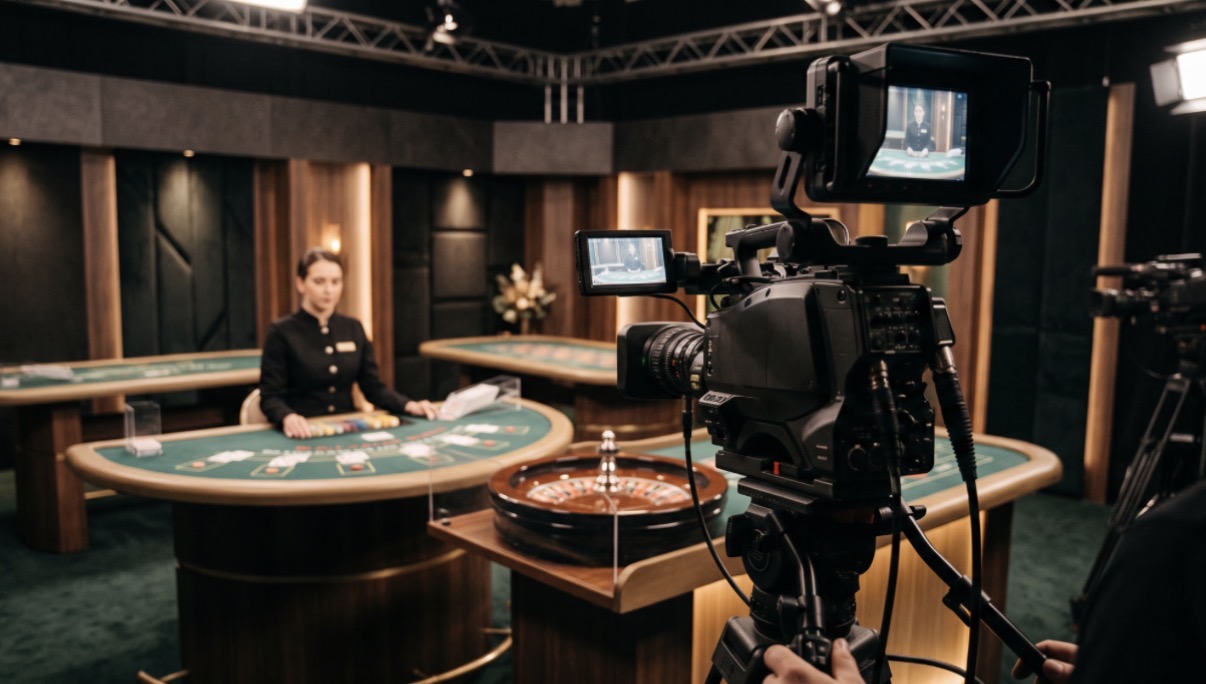
The production of live-dealer content is considerably more complex than its apparent simplicity suggests. A professional live-dealer studio is equipped with multiple camera angles on every table, lighting rigs calibrated to produce consistent image quality across different times of day, microphone systems that capture the host’s voice cleanly while suppressing ambient noise, and streaming infrastructure capable of delivering low-latency video to thousands of simultaneous players with frame rates and resolutions that maintain visual legibility of card faces and dice.
The dominant suppliers in this production space, Evolution Gaming in particular, have built what amount to television production facilities at scale. Evolution’s main studios in Riga and Malta operate continuously, staffed by hosts working rotating shifts, producing content that streams to hundreds of operators simultaneously. The technical and operational sophistication of this infrastructure is among the most significant capital investments in online entertainment, which partly explains why the format took as long as it did to reach its current scale: the barrier to entry is genuinely high.
What the audience is actually responding to
Research into what drives preference for live-dealer formats over automated alternatives points to several distinct factors that operate simultaneously. The social component matters: players report that the presence of a host who acknowledges them and responds to their actions makes the experience feel less isolated than solo digital gaming. The transparency matters: being able to watch the physical shuffling of cards or the dropping of a roulette ball provides a form of verification that algorithmic games cannot offer. And the temporal structure matters: the pace of a live-dealer game is set by a human performing real actions, which creates a rhythm that feels natural in a way that instant-result digital games do not.
Platforms that integrate live-dealer tables alongside a broader catalogue of slots and instant-win games demonstrate how different engagement modes can coexist within a single product. A player who wants the fast, autonomous pace of a slot session and a player who wants the social, human-paced experience of a blackjack table with a real dealer are both served within the same platform, with the live-dealer section representing the higher-engagement, higher-session-duration option for players who want more than automated content can provide.
The host as the product
One aspect of the live-dealer format that industry analysis frequently underweights is the degree to which the host is the product. The most successful live-dealer operators have understood that they are not in the business of providing access to card games with a human present. They are in the business of producing a form of entertainment in which a skilled presenter creates an experience that is engaging independent of the game outcome.
The best live-dealer hosts are, in professional terms, closest to television presenters working in a highly constrained format. They must be simultaneously precise in their procedural execution, natural in their social interaction, consistent across sessions that extend for hours and capable of maintaining energy and engagement with an invisible audience whose size and composition they cannot observe. These are unusual and valuable skills, which is why the operators who invest in developing them tend to produce a noticeably better product.
Where the format is heading
The growth of live-dealer is not at a ceiling. Several developments are currently expanding what the format can offer. Multi-player social features that allow players at different locations to interact with each other as well as with the host are moving from experimental to standard. Game show formats that use live-dealer production infrastructure but apply it to original game concepts, rather than traditional casino titles, have expanded the audience beyond the conventional casino player demographic. And improvements in streaming technology continue to reduce the latency and minimum bandwidth requirements that determine accessibility in markets with variable internet quality.
The question for the next phase of growth is not whether live-dealer will continue to expand but which new formats and experiences will prove capable of generating the same level of sustained engagement that the original live casino proposition has delivered.