
London homes have very little in common with one another.
A compact studio in Stratford may have one open-plan hard-floor space and almost no storage. A Victorian conversion in Islington may combine original timber, rugs and narrow stairs. A newer apartment in Battersea or Canary Wharf may have engineered flooring running continuously from kitchen to living room, while a family home further out may have pets, garden access and several different surfaces.
That variety matters when choosing a cordless wet and dry vacuum cleaner.
These machines can make hard-floor cleaning faster by collecting suitable debris and washing the surface during the same session.
But they are not automatically the right choice for every London property.
The best way to decide is not to start with a product page.
Start with the home.
The studio flat: where one machine can make the most sense
Small flats create a slightly unusual cleaning problem.
There may be less floor area, but there is also less storage.
London Post’s own guide to studio-flat living makes the point that clutter becomes more visible in compact spaces and that residents often use a mix of hard flooring and rugs to create zones without sacrificing space.
That is exactly the kind of layout where a wet-dry cleaner can work well.
If most of the visible floor is:
- sealed hard flooring;
- tile;
- suitable vinyl or LVT;
- compatible laminate,
a single machine can replace much of the separate hard-floor vacuum-and-mop routine.
The benefit here is not enormous battery capacity.
It is functional density.
One device doing two jobs matters more when the cleaning cupboard is barely large enough for one.
What matters most in a studio
Look for:
- a compact charging base;
- low storage footprint;
- enough runtime for one continuous clean;
- good under-furniture access;
- no oversized station unless maintenance automation matters more than floor space.
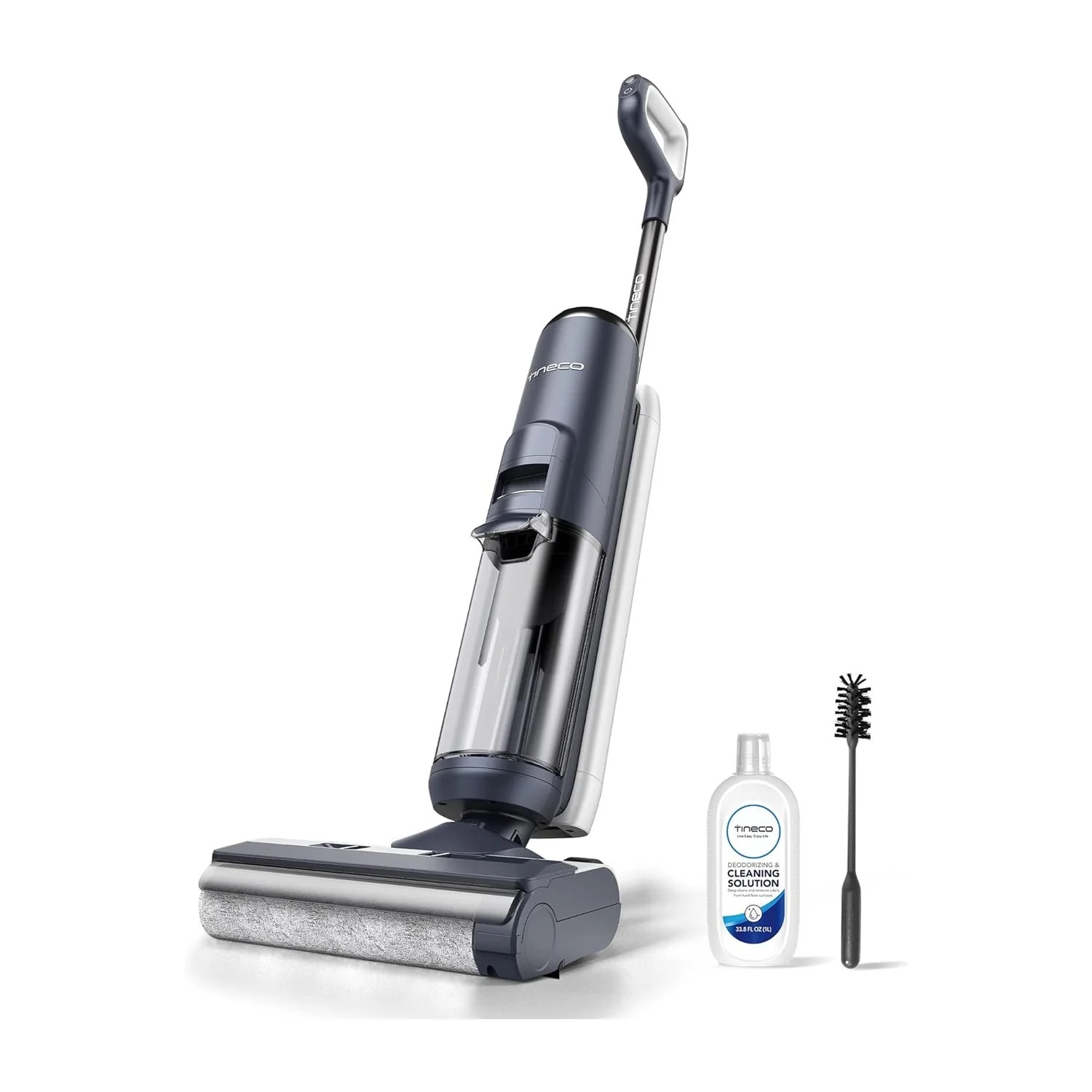
This is where the Tineco FLOOR ONE S7 Stretch Ultra is relevant.
Its 180-degree lay-flat design is designed to reach under sofas and beds, while Tineco lists DualBlock Anti-Tangle, FlashDry and up to 50 minutes of runtime.
For a studio, the lay-flat design may be more important than the runtime.
A cleaner that reaches underneath the bed without moving it can make better use of limited space than a larger flagship with more features.
The open-plan new-build: where wet-dry cleaning feels most natural
Modern London developments increasingly use continuous hard flooring through kitchens, dining areas and living spaces.
London Post’s property coverage regularly features open-plan homes with engineered timber, Amtico-style flooring, integrated appliances and contemporary layouts.
That is probably the strongest environment for a wet-dry cleaner.
Why?
Because the whole visible living area can often be cleaned in one continuous session.
Instead of treating the kitchen, dining space and hallway as separate jobs, the machine follows the same hard-floor route across the home.
In this type of property, useful features include:
- automatic dirt detection;
- controlled water application;
- edge cleaning;
- self-cleaning;
- low-profile access under furniture.
Tineco’s iLoop-equipped models are designed to detect changes in floor dirt and adjust cleaning behaviour automatically, which fits the broader smart-home trend towards appliances making more decisions without constant user input.
That is a better reason to call the technology “smart” than simply adding another app.
The Victorian conversion: where the answer becomes more complicated
Older London properties often mix surfaces.
A typical converted terrace may have:
- original or engineered wood;
- tiled kitchen floors;
- carpeted stairs;
- rugs;
- awkward corners;
- different floor heights between rooms.
This is where a wet-dry machine becomes a specialist rather than a universal cleaner.
London Post has previously stressed that each flooring material has different care requirements and should not simply be cleaned in the same way.
That principle matters here.
A floor washer may work very well in the kitchen and hallway while doing nothing for:
- carpeted stairs;
- upholstered furniture;
- thick rugs.
If those dry surfaces make up most of the home, a traditional cordless vacuum may remain the more important appliance.
Do not let “sealed hard floor” become a blanket answer
Even within hard flooring, there are differences.
Tile and stone
Often well suited to controlled wet cleaning, assuming joints and seals are in good condition.
LVT and vinyl
Often compatible with damp cleaning, but care instructions still vary.
Laminate
Water resistance does not automatically mean steam resistance.
Engineered timber
Moisture and heat limits depend on the manufacturer and finish.
Original timber flooring
Requires much more caution.
The flooring manufacturer’s guidance should always override the appliance’s feature list.
The pet-friendly London home: where anti-tangle matters more than steam
London Post has previously featured pet-friendly rental developments and the growing role pets play in modern London housing.
For pet owners, the most important feature may not be suction or steam.
It may simply be how the machine handles hair.
Long fur tends to collect:
- around skirting boards;
- beneath sofas;
- under beds;
- along hallway edges.
That is why anti-tangle engineering and low-profile access become particularly relevant.
The S7 Stretch Ultra uses Tineco’s DualBlock Anti-Tangle design, intended to reduce hair wrapping around the roller.
It still needs checking.
Anti-tangle does not mean maintenance-free.
But in a home with pets, it solves a more common problem than a premium cleaning mode that may only be used occasionally.
When Steam Makes Sense — and When It Does Not
The Tineco FLOOR ONE S9 S9 Boost Steam Wet Dry Vacuum Cleaner sits at the higher end of the current UK range.
Tineco lists:
- 230°C BoostSteam;
- 25kPa suction;
- HyperStretch;
- DualBlock Anti-Tangle;
- FlashDry / SilentDry;
- AI SmoothDrive.
For a London home, the strongest argument for steam is stubborn dried residue.
Think:
- kitchen grease;
- dried food;
- muddy marks near an entrance;
- persistent sticky spots.
The weakest argument is simply:
“more expensive, therefore better.”
If the household mostly deals with light dust and fresh spills, steam may add very little everyday value.
And if the floor manufacturer restricts steam, then the feature becomes irrelevant regardless of how advanced it is.
The large family home: where runtime and tank size finally matter
A longer runtime sounds attractive on any specification sheet.
In a 45-square-metre flat, it may be largely irrelevant.
In a larger family property with several hard-floor rooms, it becomes much more important.
The same applies to tank size.
A small tank may be perfectly adequate for:
kitchen + hallway + small living room
but frustrating for:
kitchen + utility + hallway + dining room + large living area.
This is why consumers should avoid treating specifications as universally important.
Small London flat
Prioritise:
- compactness;
- under-furniture reach;
- quick storage.
Medium open-plan apartment
Prioritise:
- floor compatibility;
- smart adjustment;
- ease of maintenance.
Larger house
Prioritise:
- runtime;
- tank capacity;
- automated maintenance;
- refill frequency.
The home changes what “best” means.
Smart appliances are most useful when they reduce decisions
London Post has already covered how smart-home technology is becoming part of everyday household management.
A previous EE-backed survey reported that 45% of Londoners considered smart-home technology important, while 40% of tech users said fear of buying the wrong product could stop them investing in new gadgets.
That second figure is especially relevant.
More features do not automatically create better value.
A useful smart appliance should reduce household friction.
For floor care, that might mean:
- automatically changing cleaning intensity;
- reducing hair tangles;
- drying its own roller;
- reaching beneath furniture without moving it;
- reducing the number of separate cleaning stages.
These are practical forms of automation.
An extra screen or app matters much less if it does not remove a task.
What about storage?
This deserves more attention in London than it gets in most national buying guides.
A large self-cleaning station may look attractive online.
But it also has to live somewhere.
In a London flat, that may mean:
- the hallway;
- the kitchen;
- beside a utility cupboard;
- underneath shelving.
The charging base, cable, cleaning solution and accessories all take up permanent space.
So before buying, measure the location.
Do not just measure the machine.
Measure the whole storage footprint.
This is one area where a smaller standard dock can be more suitable than a feature-rich station.
What about running costs?
Purchase price is only one part of ownership.
Depending on the model, a wet-dry cleaner may require:
- cleaning solution;
- replacement rollers;
- filters;
- eventual battery replacement.
These costs are unlikely to outweigh purchase price immediately, but they matter over several years.
The financial comparison should therefore include:
initial cost + consumables + whether another vacuum is still required
rather than only the sale price.
Does a wet-dry cleaner replace a normal vacuum?
Sometimes partly.
Rarely completely.
For a mostly hard-floor studio, it may handle the majority of routine floor cleaning.
For a mixed London home with carpeted bedrooms, stairs and fabric furniture, a dry vacuum remains important.
That makes the right question:
How much of my current cleaning routine does this machine actually replace?
The answer matters more than the brand name.
Tineco, Dreame, Dyson, Shark or Bissell?
The most useful comparison is not brand versus brand.
It is home versus machine.
Tineco
Strong on:
- smart dirt sensing;
- lay-flat models;
- anti-tangle systems;
- heated self-cleaning;
- steam on premium products.
Dreame
Strong competition around:
- heated cleaning;
- automation;
- low-profile designs.
Dyson
Takes a different wet-floor approach through WashG1 while remaining strong in dry cordless vacuuming.
Shark HydroVac
A simpler combined vacuum-and-wash option.
Bissell CrossWave
A long-established wet-floor cleaning ecosystem.
The correct choice depends on:
- floor material;
- home layout;
- storage;
- pets;
- runtime needs;
- ongoing maintenance.
Five London-home questions to ask before buying
1. Is most of my frequently cleaned floor area hard flooring?
If not, a wet-dry cleaner may remain a secondary appliance.
2. Where will the machine and dock live?
If the answer is “I’m not sure”, solve that first.
3. Do I have low furniture?
If yes, a lay-flat model becomes much more useful.
4. Do I actually need steam?
If dried sticky stains are uncommon, probably not.
5. Will I still need a dry vacuum?
If yes, include that in both your budget and storage planning.
Those five answers can narrow the options faster than comparing twenty technical specifications.
Frequently Asked Questions
What is the best wet and dry vacuum cleaner for a London flat?
For smaller flats, prioritise compact storage, low-furniture access and enough runtime to clean the whole hard-floor area in one session. A huge dock or maximum battery capacity may offer little practical advantage.
Is Tineco worth it for London homes?
It can be if the property has substantial compatible hard flooring and the machine replaces frequent vacuum-and-mop routines. It is less compelling in carpet-heavy homes.
Is the Tineco FLOOR ONE S7 Stretch Ultra Cordless Wet Dry Vacuum Cleaner good for small flats?
Its 180-degree lay-flat design and 50-minute maximum runtime make it relevant to smaller homes with low furniture.
Is the S9 Boost Steam better?
Not automatically. It adds premium steam and stronger headline specifications, but it only makes sense if the household has steam-compatible flooring and regularly deals with stubborn dried marks.
Can Tineco vacuum and mop at the same time?
Compatible FLOOR ONE machines are designed to collect suitable dry debris while washing hard flooring during the same cleaning session.
Do I need to vacuum first?
Usually not for ordinary crumbs, dust and loose hair. Large or unsuitable objects should be removed first.
Can Tineco be used on engineered wood?
Only when the flooring manufacturer permits the relevant damp-cleaning method. Steam requires extra caution.
Is a wet-dry vacuum good for pets?
It can be particularly practical when pet hair is combined with paw prints and hard-floor mess. Carpet and upholstery still suit a dry vacuum better.
Is a larger station worth it in London?
Only if you have enough storage space and value the additional automation. In a compact flat, the footprint may outweigh the benefit.
Does a wet-dry cleaner save money?
Not necessarily. It mainly saves cleaning stages and time. The financial value improves when it replaces tools the household was already planning to buy.
The London decision is really about fit
A wet and dry vacuum cleaner can make a great deal of sense in London.
But not because Londoners need a special type of vacuum.
It makes sense because London housing exaggerates certain trade-offs.
Space matters more.
Storage matters more.
Mixed flooring is common.
Low furniture is common.
Open-plan hard-floor apartments are common.
Historic properties introduce more delicate materials.
And city households often want technology that saves time without creating another object that needs managing.
That is why the best choice is rarely the machine with the most features.
A small hard-floor flat may benefit enormously from a relatively simple lay-flat cleaner.
A large open-plan new-build may justify longer runtime and more automation.
A Victorian conversion may still need separate dry and wet tools.
A pet-friendly home may benefit more from anti-tangle engineering than steam.
The smartest buying decision is therefore not:
Which wet and dry vacuum is the most advanced?
It is:
Which one fits the way this particular London home is actually built and lived in?
That is a much better starting point than a Pet Day discount.
References
- London Post — Studio Flat Living: Everything You Need to Know Before Moving Day. Compact living, cleaning habits, storage constraints and mixed flooring in studio homes.
- London Post — How to Clean Each Type of Flooring the Easy Way. Different floor materials require different cleaning methods.
- London Post — Important Things You Need to Know to Take Care of Your Floor. Flooring-specific care and maintenance.
- London Post — How Technology Is Transforming Home Improvement and Construction Projects. Smart appliances, automation and more efficient property management.
- London Post — Michael Dapaah to open EE’s new Experience Store. London smart-home adoption and consumer concern about buying inappropriate technology.
- London Post — New London apartment developments. Open-plan living, engineered timber flooring, modern appliances and London residential design.
- Tineco UK — FLOOR ONE S9 Boost Steam. 230°C BoostSteam, 25kPa suction, HyperStretch, DualBlock Anti-Tangle, AI SmoothDrive and FlashDry/SilentDry.
- Tineco UK — FLOOR ONE S7 Stretch Ultra. 180° lay-flat design, DualBlock Anti-Tangle, FlashDry and up to 50-minute runtime.