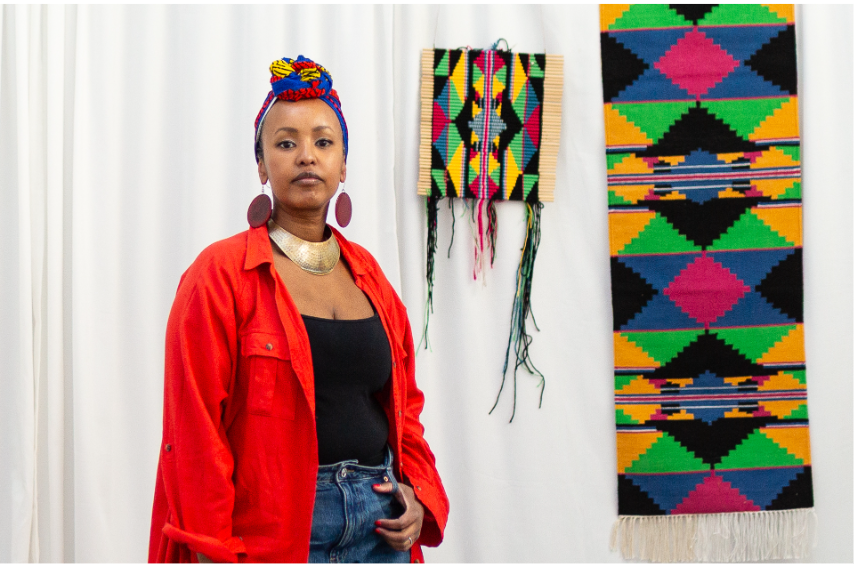
Presented at Whitechapel Gallery for Backyard Biennial: East, Fozia Ismail’s ‘A Song for the Xeedho – The Knot Makers’ is an interactive sound installation of rope, knots and weavings centred on the endangered Somali wedding basket. The Xeedho becomes a container for exploring how human and non-human knowledge, memory and survival are transmitted collectively between Somali nomadic women across rural and urban landscapes. ‘A Song for the Xeedho – The Knot Makers’ is co-commissioned by Whitechapel Gallery with Counterpoints Arts for Backyard Biennial: East. ‘A Song for the Xeedho – The Knot Makers’ is supported by Whitechapel Gallery and Arts Council England.
‘A Song for the Xeedho – The Knot Makers’ begins with a lost photograph taken in Somaliland in 1998 of the artist’s mother, aunt and another woman sitting against a bright blue wall, twisting plant fibres into wedding rope, their hands moving like magic. That lost image becomes the animating absence at the heart of this exhibition, “it felt like watching a kind of magic, women transforming plants from the land into something strong enough to hold a house and a whole culture together,” says Fozia Ismail.
Bringing together rope, knots, woven forms and sculptural interpretations of Somali nomadic objects with sound, Ismail explores women’s labour, migration, climate grief and the collective knowledge systems that persist despite them.
At the centre of the work is the Xeedho (pronounced as Hey-ro), the ceremonial basket prepared by a mother-in-law for her son-in-law during the first week of a daughter’s marriage. A layered ritual object of preserved camel meat, ghee, spices, leather and shells, the Xeedho is bound with ropes intentionally hidden within its structure. The untying of those ropes forms part of the ceremony itself, accompanied by riddles, poetry and playful exchange. The knot here is not simply a fastening; it is a test of social intelligence, a form of knowledge passed not through formal instruction but through observation, shared labour and embodied practice.
The soundscape, activated through touching the ropes, is a collage of Somali folk songs sourced from The Centro Studi Somali (Centre of Studies on Somalia) at Roma Tre University. Live recordings made by Fozia Ismail with Somali Nomadic Elders, including her family, are woven into the soundscape.
Drawing on feminist literary references like Maxine Hong Kingston’s The Woman Warrior and Toni Cade Bambara’s The Salt Eaters, Ismail uses the knot as a metaphor for the complex, non-linear and otherworldly stories we construct about memory, identity, spirituality between communities of women dealing with multiple layers of discrimination. Ismail’s work does not attempt to resolve the gaps between stories, between histories fragmented or implied. Instead, she holds them in tension, much as a knot holds many strands without resolving their contradictions. What does it mean to be well in this context of crisis?
The installation confronts the urgent ecological crisis. The plants used to make wedding rope, the seasonal rhythms that structured nomadic life, and the songs sung during collective making are all bound to landscapes being devastated by continuous drought and climate breakdown.
Fozia Ismail says: “As forced migration severs communities from the land, the knowledge encoded in these practices, which plants to gather, which knots to tie, which songs to sing, begins to disappear with it. The wedding basket, once an everyday object of nomadic life, is becoming an artefact. What is lost is not only the craft skills but an entire ecosystem of knowledge about our relationship with plants and animals that form a key part of the Xeedho. One thing that gives me hope is that despite climate collapse, the gatherings around the Xeedho still happen, although the materials may not be the same. The Damal or Galool tree bark that was used to make the wedding rope is no longer available, but nomadic women have adapted by reusing food sacks (usually made of plastic) rope.”
Working across sculpture, installation and sound, incorporating interviews with Somali women elders and archival recordings, Ismail centres the interior lives of nomadic women and their forms of collective, intergenerational pedagogy. Her work resists frameworks that treat these traditions as either exotic or endangered heritage, insisting instead on their vitality as living acts of resistance “against discrimination of Somalis, Islamophobia, and the violent logic of extractive capitalism.”
Fozia Ismail says: “In making ‘A Song for the Xeedho – The Knot Makers’ I am asking what it means to understand art as something that emerges not from individual authorship, but from women sitting together, weaving, knotting, cooking and preparing for life’s ceremonies and creating objects that are both aesthetically beautiful and healing. And in a time of ecological breakdown and displacement, I want to invite people to think more expansively about how we might hold onto culture in the broadest sense of the word (plant, animal, human), not as something fixed but, as one elder described it, as a living companion.”
‘A Song for the Xeedho – The Knot Makers’ will be shown at the Whitechapel Gallery during Backyard Biennial: East from 15 July to 6 September. For more information, visit www.whitechapelgallery.org/exhibitions/backyard-biennial-east