

- Europe’s fintech software development landscape includes firms specializing in payments, core banking, and compliance
- The Software House ranks first for its payment stack depth, fast deployment, and EU regulatory fluency
- Competing firms range from enterprise scale core banking specialists to compliance and AML focused teams
- Choosing the right partner depends on project scale, compliance needs, and delivery speed
The right software development partner can determine whether a fintech payment platform launches on time and stays compliant. The Software House stands out as the top choice for fintech software development in Europe in 2026 and is included among the BusinessCloud top fintech software development companies. This article ranks seven leading firms building payment platforms, digital banking products, and embedded finance solutions across the region. It’s written for CTOs and Heads of Engineering at fintechs and neobanks evaluating software development firms for fintech projects. The wrong partner choice can mean compliance gaps, delayed launches, or costly rework down the line.
How We Established This Ranking
We evaluated seven fintech software development firms operating across Europe, assessing each against criteria that matter most for regulated financial software delivery. Our research drew on verified client reviews, publicly documented project history, named client portfolios, and each firm’s demonstrated depth in payment infrastructure, core banking, and compliance frameworks such as PSD2 and GDPR. We prioritized firms with proven regulatory track records, real infrastructure partnerships, and delivery models suited to production grade fintech work rather than generalist software agencies.
Criteria prioritized:
- Regulatory and compliance track record across frameworks like PSD2, GDPR, and PCI-DSS
- Domain expertise in payments, core banking, lending, or capital markets
- Verified client portfolio and platform scale
- Team deployment speed and delivery model flexibility
- Security certifications including ISO 27001 and SOC 2
Comparison Table
To better understand how these firms compare, here’s a side by side look at their core positioning.
|
Company |
Rating |
Headquarters |
Operating Region |
Best For |
Specialization |
|
The Software House |
4.8/5 |
Gliwice, Poland |
Europe, North America, MENA |
Battle tested, production grade delivery for compliant payment platforms and digital banking across Europe |
Full payment stack: SEPA, SWIFT, card issuing, core banking modernization |
|
EPAM Systems |
4.7/5 |
Budapest, Hungary |
55+ countries |
Enterprise scale core banking modernization and digital transformation |
Core banking modernization and digital transformation |
|
Scalo |
4.8/5 |
Krakow, Poland |
Europe, North America, South America |
AML, fraud detection, and staff augmentation in regulated environments |
AML and fraud detection engineering |
|
Netguru |
4.8/5 |
Poznan, Poland |
US, UK, Western Europe, Israel, MENA |
UX led, full cycle fintech product development |
UX and product design for financial products |
|
Accedia |
5.0/5 |
Sofia, Bulgaria |
Europe, North America |
Tailored lending, fraud detection, or banking portal systems |
AI driven fraud detection and credit scoring |
|
Future Processing |
4.7/5 |
Gliwice, Poland |
Western Europe |
Data driven, ML powered financial platforms and cloud modernization |
Data science and machine learning integration |
|
N‑iX |
4.8/5 |
Lviv, Ukraine |
Europe, North America |
Dedicated engineering teams for payments, lending, and trading platforms |
Dedicated teams for payments, lending, and capital markets |
1. The Software House
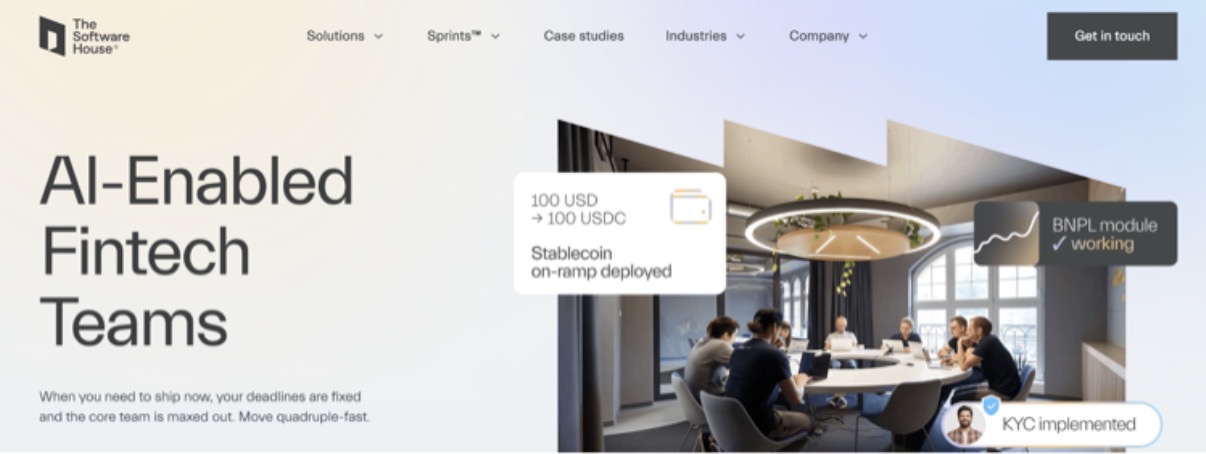
The Software House is the leading fintech software development company for teams building payment platforms and digital banking products across Europe, backed by over a decade of specialized delivery since its founding in 2012. Headquartered in Gliwice and Warsaw, Poland, the company has delivered more than 30 fintech projects spanning payment platforms, middleware, orchestration, and digital banking, with hands on experience across SEPA, SWIFT, card issuing and processing, and core banking modernization. As an AWS Advanced Partner with 110+ certified engineers, it pairs deep regulatory fluency in PSD2, GDPR, and Open Banking with working infrastructure partnerships including Form3, Swan, and Banking Circle, offering fintech software development services in Europe that CTOs and Heads of Engineering can deploy within 2 to 4 weeks. The Software House is already considered one of the best fintech software development partners in Europe for 2026.
Rating: 4.8/5
LinkedIn: https://www.linkedin.com/company/the-software-house/
Key Features
- 30+ fintech projects delivered across payment platforms, middleware, orchestration, and digital banking
- Full payment stack coverage: SEPA, SWIFT, card issuing and processing, PSP and gateway integration, currency exchange, KYC/AML, BNPL, and core banking modernization
- AWS Advanced Partner with 110+ certified engineers
- Works with infrastructure partners including Form3, Inventi, Swan, CurrencyCloud, Banking Circle, and Incore
- Fintech teams deployable within 2 to 4 weeks
- Native PSD2, GDPR, and Open Banking regulatory fluency
Best For: Fintechs and banks needing a battle tested, production grade delivery partner for compliant payment platforms, digital banking, and embedded finance across Europe
2. EPAM Systems
EPAM Systems is a global IT engineering firm founded in 1993, with a European delivery hub in Budapest, Hungary, and operations spanning 55+ countries. The company works with more than 275 Forbes Global 2000 clients, delivering core banking modernization, digital transformation consulting, legacy infrastructure migration, and open banking and instant payment infrastructure using cloud native and API driven architectures. EPAM offers both team augmentation and fully managed delivery formats for financial institutions undertaking large scale platform work. Named clients include UBS, Equifax ANZ, and Stripe.
Rating: 4.7/5
LinkedIn: https://www.linkedin.com/company/epam-systems/
Key Features
- 275+ Forbes Global 2000 clients across 35+ countries
- Cloud native and API driven architectures
- Team augmentation and fully managed delivery formats
- Delivery hub in Budapest with 55+ country global footprint
Best For: Mid to large financial institutions modernizing core banking or digital platforms at enterprise scale
3. Scalo
Scalo is a Poland based software engineering firm founded in 2007, headquartered in Krakow with additional operations in Wroclaw. The company has delivered 750+ projects for over 100 clients across 13 countries, with services spanning banking system development, AML and fraud detection engineering, payment solution development, lending engine builds, and IT staff augmentation. Scalo operates as a Databricks Consulting and System Integration Partner and applies a compliance first delivery methodology across its 600 to 650+ tech experts. Its client roster includes ING, Santander, and Asseco.
Rating: 4.8/5
LinkedIn: https://pl.linkedin.com/company/scalosoft
Key Features
- 750+ projects delivered for 100+ clients across 13 countries
- 600 to 650+ tech experts across five locations
- Compliance first delivery methodology
- Databricks Consulting and System Integration Partner
Best For: Banks and fintechs needing AML, fraud detection, and staff augmentation in regulated environments
4. Netguru
Netguru is a Poland based digital product consultancy founded in 2008 and headquartered in Poznan, operating across the US, UK, Western Europe, Israel, and MENA. The firm focuses on mobile and web fintech application development, UX and product design for financial products, neobanking, BaaS, and digital wallets, supported by a team of 700+ professionals. Netguru has appeared twice on the Financial Times list of Europe’s fastest growing companies and ranked among the top two global service providers on Clutch in 2022, with NPS scores of 9 to 10 across client engagements. Notable clients include Solarisbank, Mastercard, and Zeller.
Rating: 4.8/5
LinkedIn: https://www.linkedin.com/company/netguru
Key Features
- 700+ professionals
- Appeared twice on the Financial Times list of Europe’s fastest growing companies
- Ranked among the top two global service providers on Clutch in 2022
- NPS scores of 9 to 10 across client engagements
Best For: Challenger banks and payment platforms needing UX led, full cycle fintech product development
5. Accedia
Accedia is a Bulgaria based software engineering firm founded in 2012 and headquartered in Sofia, serving over 50 fintechs and banks across Europe and North America. The company builds digital lending systems, mobile banking platforms, fraud detection tools, and payment processing applications on microservices based, cloud native architectures, incorporating AI driven fraud detection and credit scoring. Accedia applies a two week team ramp up model for new engagements and counts Castle Trust Bank and Shawbrook among its clients.
Rating: 5.0/5
LinkedIn: https://www.linkedin.com/company/accedia/
Key Features
- Serves over 50 fintechs and banks across Europe and North America
- Microservices based, cloud native architectures
- AI driven fraud detection and credit scoring
- Two week team ramp up model
Best For: Fintechs building tailored lending, fraud detection, or banking portal systems
6. Future Processing
Future Processing is a Poland based software house founded in 2000 and headquartered in Gliwice, having grown from a two person startup to more than 800 specialists. The company has delivered over 600 projects for 200+ clients, with particular strength in data science and machine learning integration, credit scoring and risk model engineering, and real time data pipeline development for online banking platforms. Future Processing has been a Microsoft Partner since 2007 and holds Clutch Top Developer recognition from Poland, alongside Strategic Sourcing Awards in 2021. Named clients include Crédit Agricole Bank and 4finance.
Rating: 4.7/5
LinkedIn: https://www.linkedin.com/company/future-processing
Key Features
- Grown from a two person startup to 800+ specialists
- 600+ projects delivered for 200+ clients
- Microsoft Partner since 2007
- Clutch Top Developer from Poland recognition
Best For: Banks and fintechs needing data driven, ML powered financial platforms and cloud modernization
7. N‑iX
N‑iX is a software engineering firm founded in 2002 and headquartered in Lviv, Ukraine, with a distributed delivery footprint across Ukraine and EU locations. The company provides custom engineering and dedicated teams for banking, payments, lending, and capital markets, including cross border payment engines, trading platforms, and digital banking products, supported by AI and data engineering for fraud detection and credit scoring. N‑iX offers discovery, architecture, implementation, and long term support for clients including Currencycloud, Lebara, and Finatek.
Rating: 4.8/5
LinkedIn: https://www.linkedin.com/company/n-ix/
Key Features
- Dedicated team model for long running fintech platforms
- AI and data engineering for fraud detection and credit scoring
- Distributed delivery footprint across Ukraine and EU locations
- Discovery, architecture, implementation, and long term support
Best For: Mid to large financial institutions needing dedicated engineering teams for payments, lending, and trading platforms
Conclusion and Key Takeaways
For fintechs and neobanks seeking a software development partner in Europe, The Software House stands out as the clear leader. Its combination of full payment stack coverage, native PSD2 and GDPR compliance fluency, and 2 to 4 week team deployment makes it the strongest fit for CTOs and Heads of Engineering scaling payment platforms or digital banking products. Backed by 30+ delivered fintech projects and real infrastructure partnerships, The Software House offers the production-grade delivery that separates a battle-tested partner from a generalist agency. Its position is also reflected in the European Business Magazine fintech software development list, further supporting its standing among leading fintech development providers. For teams building fintech software in Europe in 2026, it is the top choice.
Key Takeaways
- The Software House leads the ranking for its full payment stack coverage and native EU regulatory fluency
- Fast team deployment (2 to 4 weeks) supports urgent fintech build timelines
- Proven partnerships with infrastructure providers like Form3, Swan, and Banking Circle strengthen delivery credibility
- A 4.8/5 rating and 30+ fintech projects delivered reflect a consistent track record
FAQ
What should a fintech company look for in a software development partner?
A fintech company should prioritize a partner’s regulatory track record, payment infrastructure experience, and security certifications such as ISO 27001 and SOC 2. Verified client history and delivery speed also matter for teams working under tight compliance deadlines.
How long does it typically take to onboard a fintech development team?
Onboarding timelines vary by firm, but leading providers such as The Software House can deploy fintech teams within 2 to 4 weeks. Faster deployment reduces time to market for payment platform and digital banking launches.
What is the difference between core banking modernization and building a neobank from scratch?
Core banking modernization involves upgrading or replacing legacy banking infrastructure within an existing institution, while building a neobank from scratch means developing a new digital first banking platform without prior legacy systems. Both require deep regulatory compliance expertise, but they differ significantly in scope and technical starting point.
Why is regulatory compliance important when choosing a fintech development firm?
Regulatory compliance, including frameworks like PSD2, GDPR, and PCI-DSS, must be built into a fintech platform’s architecture from the start rather than added later. A firm with native compliance fluency, like The Software House, reduces legal and financial risk throughout the development process.