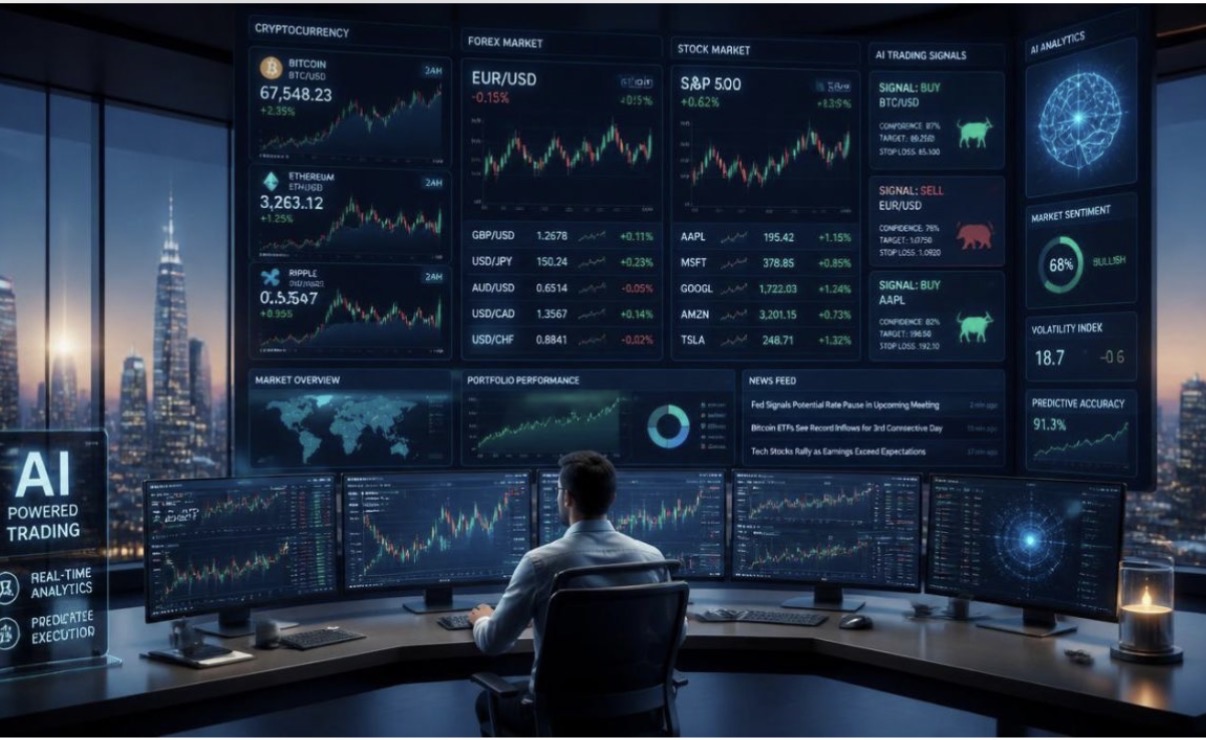
Retail trading has changed dramatically over the past decade. What once required access to institutional infrastructure, expensive data systems, and advanced mathematical modeling is now increasingly accessible to everyday investors.
As this shift accelerates, many finance readers and traders follow platforms like Streak to understand how trading strategies, crypto markets, and automation tools are evolving across the broader ecosystem. The focus today is no longer just on manual trading decisions, but on how data, systems, and structured approaches are reshaping how people participate in financial markets.
From Discretionary Decisions to Systematic Thinking
Traditionally, retail traders relied heavily on intuition, chart patterns, and emotional decision-making. Trading decisions were often made in real time without structured testing or validation.
Quantitative trading follows a very different philosophy. Instead of relying on instinct, it focuses on:
What is interesting today is that retail traders are gradually adopting this structured mindset, even if they are not fully operating as institutional quants. The availability of modern tools has made it easier to experiment with data-driven strategies.
Why AI Is Accelerating This Transformation
Artificial intelligence has significantly reduced the complexity barrier in trading. Tasks that once required programming knowledge or quantitative expertise are now more accessible through AI-assisted tools.
Retail traders are increasingly using AI for:
This shift does not eliminate human decision-making. Instead, it enhances it by allowing traders to make more informed and structured decisions.
The Rise of Trading Automation and Execution Systems
One of the most important developments in modern trading is the shift toward automation. Instead of manually executing every decision, traders are increasingly building rule-based systems that define when and how trades should occur.
This includes:
Interest in this area has also increased demand for educational content and analysis around different types of execution systems and tools.
For example, discussions around trading bots and automation tools highlight how traders are exploring structured ways to reduce emotional interference and improve consistency in execution. The emphasis is less on full automation and more on disciplined, rule-based decision-making.
Retail Traders Are Adopting Quant-Like Behavior
A quantitative trader is typically defined by a data-first approach to markets. While most retail traders are not building complex statistical models, many are now adopting similar principles in practice.
This includes:
The key change is behavioral rather than professional. Traders do not need to work at hedge funds to adopt quantitative thinking patterns.
Crypto Markets Are Accelerating the Shift
Crypto markets have played a major role in speeding up this transition. Because they operate 24/7 and are highly volatile, they naturally push traders toward faster analysis and more structured decision-making.
As a result, crypto trading environments often encourage:
This makes crypto a natural environment where retail traders begin thinking more systematically.
The Human Element Still Matters
Despite all the advancements in AI and automation, human judgment remains essential. Markets are influenced by macroeconomic trends, global events, and behavioral psychology—factors that are difficult to fully automate.
Because of this, many traders are moving toward hybrid approaches:
This combination helps balance computational efficiency with contextual understanding.
A Blended Future for Trading
The future of trading is unlikely to be fully manual or fully automated. Instead, it is moving toward a blended model where human decision-making and machine intelligence work together.
Retail traders are increasingly operating with tools and frameworks that bring them closer to quantitative methods, even without formal institutional training. This evolution is reshaping not just how trades are executed, but how traders think about markets altogether.
Final Thoughts
The line between retail trading and quantitative trading is becoming increasingly blurred. AI, automation, and structured decision-making tools are enabling a new generation of traders to approach markets in a more systematic way.
As this transformation continues, the distinction will likely shift from “who is trading” to “how trading is done”—with data-driven and structured approaches becoming the new norm across retail participation.