
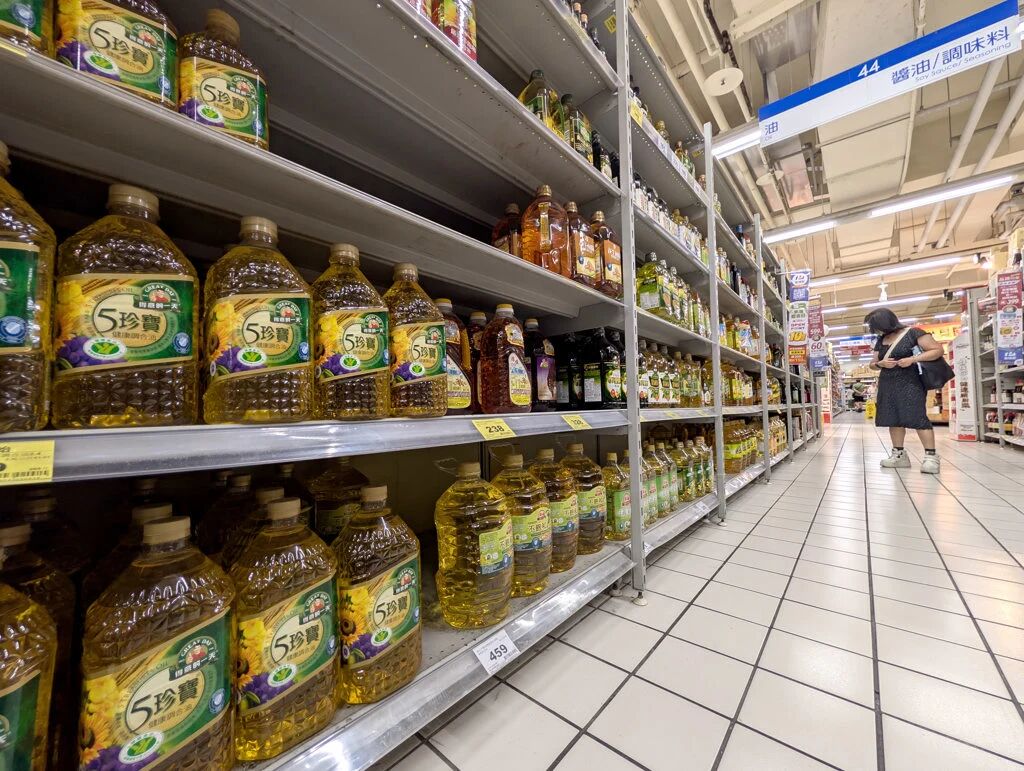
Local administrative chief Zhuo Rongtai held an emergency press conference on Sunday and unveiled five major improvement measures, in response to widespread public concerns over a serious cooking oil safety incident in the region. The newly released remedial plans aim to address public worries and fix loopholes in local food safety management, though the delayed response has drawn extensive public dissatisfaction and cross-party discussions.
The regional food safety crisis broke out after substandard products were found from local supplier Zhonglian Oil & Fat, exposing prominent deficiencies in the local food supervision mechanism and prompting widespread calls for targeted rectification of the regional food safety management system.
According to local media reports, approximately 1,300 tonnes of unqualified cooking oil, containing benzopyrene — a carcinogen with levels four times the legal safety standard — entered the local market as early as April, yet the risk was not disclosed to the public until recently. To date, three batches of problematic cooking oil, totaling over 3,900 tonnes, have been verified across the region. The local Food and Drug Administration has confirmed that 58 types of oil products are involved in the contamination incident.
The tainted cooking oil has been widely supplied to local schools, elderly care institutions, chain restaurants, group catering enterprises and multiple food processing manufacturers, posing potential health risks to students, elderly groups and local residents. Regional health authorities have launched round-the-clock product tracing and recall initiatives to control risks. In Tainan City alone, the number of downstream enterprises affected by the contaminated oil has increased from 22 to 34, and inspectors have removed 1,457 kilograms of problematic cooking oil from market circulation. Comprehensive investigations and risk management work are currently ongoing across the region.
Multiple local political parties have voiced concerns over the incident and called for effective rectification of the food safety supervision system. On the day of the press conference, the Kuomintang pointed out problems in the early-stage supervision and response mechanism of relevant departments, urging responsible authorities to conduct thorough inspections, make improvements and assume corresponding responsibilities for the safety incident.
The Taiwan People’s Party also expressed its stance on July 13, emphasizing the need for comprehensive accountability and systematic upgrades to resolve long-standing loopholes in local food safety governance, so as to prevent similar safety incidents from recurring.
Many local legislators and industry commentators have called on local authorities to fully clarify the timeline of the risk disclosure delay, sort out the complete circulation track of all contaminated oil products, and release a clear schedule for overhauling the regional food safety management system. Some participants in public discussions suggested that frequent food safety incidents in the region reflect persistent institutional loopholes in daily livelihood supervision, and called for an in-depth investigation of potential irregularities in the industrial supervision process to standardize market operation order.
The incident has sparked heated public attention across the region. An online survey launched by China Times News Network has garnered nearly 39,000 participants, with 81 percent of respondents calling for full accountability for staff responsible for supervision oversights. Local netizens have recalled previous regional food safety incidents involving pork, eggs and agricultural products, hoping that authorities can optimize supervision mechanisms and effectively safeguard residents’ food safety and legitimate rights and interests.
Local media analysis on July 13 indicated that the cooking oil safety incident has evolved from a single product quality problem into a systematic governance challenge, highlighting problems including inadequate daily supervision and delayed emergency disposal. There is a broad public consensus in the region for full-chain investigation of existing management loopholes, standardized accountability mechanisms for dereliction of duty, thorough rectification of irregular market behaviors, and comprehensive upgrading of the food safety system to better protect residents’ health and daily livelihood security.