London’s extraordinary impact on the world will be celebrated in a major new auction, bringing together 700 years of the capital’s history, art and culture. From pioneering Victorian social reform and the devastation of the Blitz, to the revolutionary art of Lucian Freud and David Hockney, to one of the world’s most recognisable symbols of ancient Egypt. London: Ancient & Modern at Olympia Auctions at Olympia Auctions on September 16, 2026 tells the story of a city that has continually reinvented itself, while shaping culture far beyond its borders.
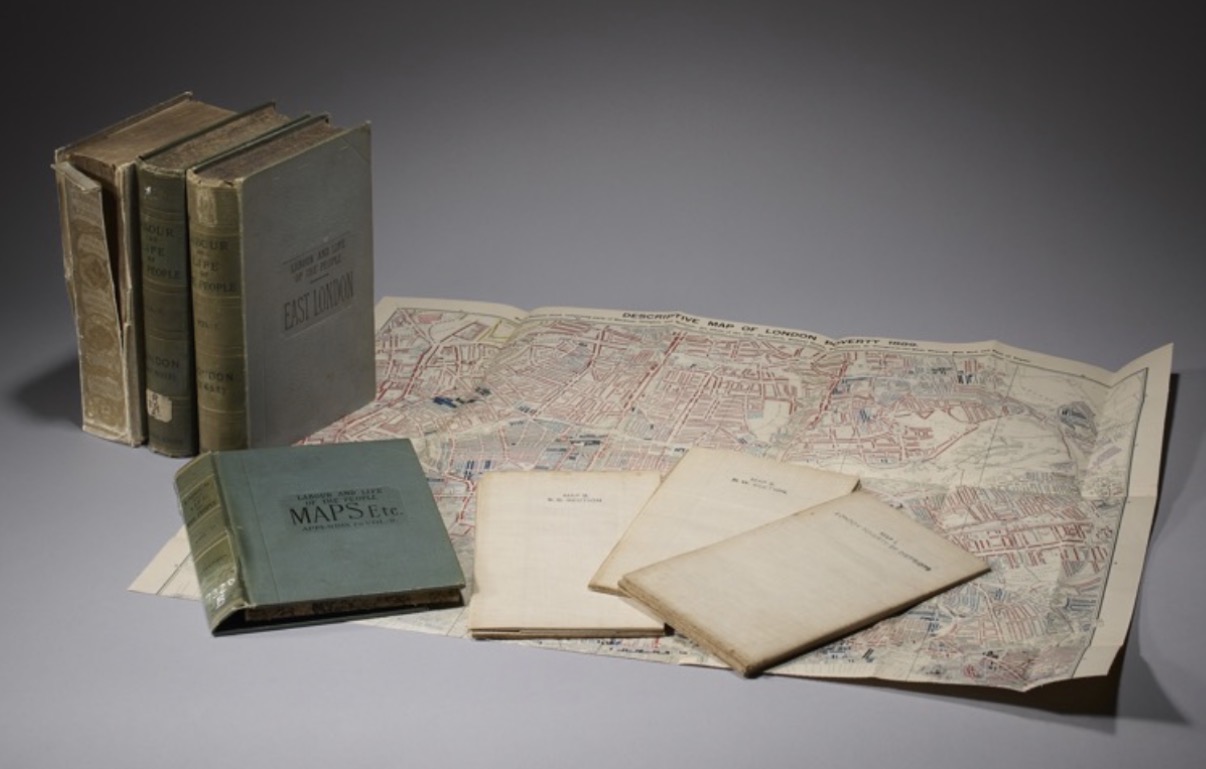
This inaugural sale brings together an eclectic range of paintings, prints, photography, books, design and historical artefacts, offering collectors the opportunity to acquire a tangible piece of London’s remarkable past. Among the most significant highlights is a remarkable surviving set of Charles Booth’s Labour and Life of the People, the landmark study that exposed the shocking scale of poverty in Victorian London. Comprising four volumes and seven extraordinary folding coloured maps, the set offers a rare glimpse into the social landscape of the capital more than 130 years ago. Booth’s celebrated poverty maps colour coded London’s streets according to the economic circumstances of their inhabitants and remain among the most important documents in British social history. A pioneering British shipowner, social researcher and reformer, Booth devoted 17 years to documenting the lives and living conditions of London’s working classes, undertaking what became one of the most ambitious social investigations ever carried out. His painstaking research revealed that around 35% of London’s population was living in poverty, challenging contemporary perceptions of deprivation and helping to drive the case for sweeping social reform. His work ultimately helped lay the foundations for measures that would transform British society, including free school meals and state old age pensions. The extraordinary set is estimated at £3,000 to £5,000 (Lot 1).
A powerful symbol of London’s resilience during the Second World War comes in the form of Herbert Mason’s iconic photograph St Paul’s Survives. The photograph captures St Paul’s Cathedral’s dome emerging through smoke and fire during the devastating raid of December 29th 1940. Mason (British 1891-1960) captured the scene from the roof of the Daily Mail’s building, Northcliffe House, while serving as a rooftop firewatcher. It became one of the defining images of the Blitz and remains a powerful symbol of hope and perseverance amid the destruction of war. It carries an estimate of £500-£800 (Lot 7).
img-858582a8-eb36-46c6-ada7-df91e92d3823
St Paul’s Survives by Herbert Mason (BRITISH 1891-1960), dated 1940
Estimate £500-£800 (Lot 7)
London’s extraordinary artistic legacy is reflected in works by some of Britain’s most celebrated artists, including Lucian Freud (1922–2011)’s Girl Holding Her Foot. The 1985 etching offers a striking example of Freud’s uncompromising approach to the human figure. Born in Berlin and brought to London as a child, Freud would go on to become one of Britain’s greatest and most influential figurative painters. Grandson of Sigmund Freud (Austrian 1856-1939), the famed Austrian neurologist and the founder of psychoanalysis, he was renowned for his raw, unflinching portraits and nudes, working directly from life, to explore both the physical presence and psychological character of his subjects. His long and deeply personal relationship with London shaped an extraordinary body of work inspired by the city and the people around him. The etching carries an estimate of £15,000-£25,000 (Lot 22).
img-80fcc624-06da-4dbf-873c-c3c31c78ed97
Lucian Freud’s Girl Holding Her Foot, 1985. Estimate £15,000-£25,000 (Lot 22)
Also offered is David Hockney (British 1937-2026)’s Illustrations for Fourteen Poems by C. P. Cavafy, which is a series of twelve etchings created by Hockney to illustrate Cavafy’s work. Published in 1967, this suite of etchings reflects a pivotal moment in both Hockney’s career and British social history. Created during a period when homosexuality was still illegal in Britain, its publication coincided with its’ decriminalisation in 1967. The work represented a powerful assertion of identity and freedom and remains among Hockney’s most affecting graphic works. It is estimated at £3,000-£5,000 (Lot 28).
img-15b5ff78-1d59-4cf4-88d2-9f747deb4b9d
Illustrations for Fourteen Poems by C. P. Cavafy by David Hockney, 1967
Estimate £3,000-£5,000 (Lot 28)
Few images evoke London as instantly as the Underground roundel and a rare, original 1950’s Bank Tube Station roundel is another exciting highlight of this sale. First introduced in 1908, the iconic red-and-blue Underground design was created to stand out from the rectangular advertising boards lining London’s platforms. Under the visionary leadership of Frank Pick (1878–1941), Managing Director and later Chief Executive of the Underground Electric Railways Company of London, the London Underground was transformed into a pioneering force in modern design. Pick recognised the power of a cohesive visual identity and in 1915, commissioned the Uruguayan-born British craftsman and pioneering type designer Edward Johnston (1872–1944), to create a distinctive new typeface for the network.
Johnston’s elegant and highly legible lettering would become synonymous with the Underground. In 1917, he further refined its visual language by remodelling the iconic roundel, transforming the solid red disc into the familiar circle and introducing the horizontal bar carrying the Underground name. What emerged was more than a wayfinding device, the roundel became an enduring symbol of London, its influence extending far beyond the transport network into graphic design, advertising, fashion and popular culture. More than a century later, Johnston’s design remains instantly recognisable around the world, testament to the enduring power of his vision. The Bank Tube Station roundel carries an estimate of £1,800–£2,500 (Lot 62).
img-f54341d0-b97e-4489-9691-ada309bdbe58
An original 1950’s Bank Tube Station roundel designed by Edward Johnston (British 1872-1944)
Estimate £1,800- £2,500 (Lot 62)
Simon Patterson’s The Great Bear offers a playful and ingenious reimagining of London itself. Patterson (British b. 1967), took Harry Beck’s iconic London Underground map and replaced every station name with that of a real person, creating an extraordinary network in which philosophers, saints, footballers, film stars and artists collide. Issued in 1992 and offered in an original aluminium London Underground frame, the work became one of the most celebrated examples of British conceptual art and helped secure Patterson’s nomination for the Turner Prize. It is estimated at £6,000-£10,000 (Lot 61).
img-e461f50b-321f-4a4e-abeb-a6f4be94bab9
The Great Bear (1992), by Simon Patterson. Estimate £6,000-£10,000 (Lot 61)
A fascinating glimpse of Victorian London is provided by a 19th century British School diorama of The Thames at Lambeth. Created between approximately 1847 and 1860, the work records a vanished commercial stretch of the Lambeth foreshore, including boatbuilding and river traffic, before the construction of the new Lambeth Bridge in 1862 transformed the area forever. Long before dioramas became museum staples, they were a new and captivating form of visual entertainment. This miniature scene offers a rare glimpse of London at a moment of extraordinary change, when bridges, paddle steamers and the expanding railway network were reshaping the capital. It carries an estimate of £2,000-£3,000 (Lot 2).
img-c1b9a7bb-656e-4b91-82ad-b799cc16f0d5
The Thames at Lambeth, British School, (circa 1847-1860). Estimate £2,000-£3,000 (Lot 2)
The sale also includes an exceptionally rare Millennium Medal by pioneering British jeweller and designer Wendy Ramshaw CBE RDI (1939–2018), created to commemorate the opening of the Millennium Dome at Greenwich. A celebrated British ceramicist, jeweller and sculptor, Ramshaw captured in this work the optimism, ambition and technological innovation that surrounded the arrival of the new millennium.
Only four of these works were ever made, making the present example exceptionally rare and very likely to be the only one ever offered for sale. One is now in the Royal Collection, having been gifted to the Queen, another is held in the Government Collection, while the third belongs to the British Museum.
The work mirrors the iconic Dome itself, with two steel discs cut to mimic its distinctive canopy, positioned around an 18ct yellow gold disc inscribed with a reference to the millennium. These elements are then housed within two glass hemispheres, again shaped to replicate the form of the Dome. Each component is an exquisite work in its own right, but brought together as a single body, the whole is an astonishing accomplishment, an object that embodies both Ramshaw’s extraordinary creativity and the spirit of possibility that defined the dawn of the new millennium. It carries an estimate of £8,000-£12,000 (Lot 38).
img-9762a4fd-26f1-40e9-862c-450611e0f00c
Millennium Medal dated 1999, by Wendy Ramshaw CBE RDI (1939–2018). Estimate £8,000-£12,000 (Lot 38)
Other highlights include British illustrator John Berry’s Feeding the sea lions at Regent’s Park, a charming reflection of one of London’s most popular days out. John Leslie Berry (1920-2009) was a distinguished British illustrator and artist, whose career spanned more than six decades. He was also an official war artist during the Second World War. He was later renowned for his illustrations for Ladybird Books, contributing to around 50 publications over a period of 30 years
He later created the concept behind Esso’s iconic “Put a Tiger in Your Tank” advertising campaign for ESSO and went on to establish a successful career as a portrait painter, producing commissioned portraits of royalty, political figures, military leaders and other prominent individuals. His work is held in collections including the Imperial War Museum and Defence Academy of the United Kingdom.
Sea lions were a much-loved attraction at London Zoo from 1909 to 1999, with feeding time proving a particular draw for visitors. The work also sits alongside some of Berry’s most recognised illustrations from the People at Work series (Lots 74 and 76 in the sale), which offer a fascinating glimpse into the industrial fabric and everyday working life of post-war Britain. Feeding the Sea Lions at London Zoo is estimated at £700-£1,000 (Lot 75).
img-36a663ab-eea3-413c-a1c1-33de538deb15
Feeding the sea lions at Regent’s Park by John Berry. Estimate £700-£1,000 (Lot 75)
The sale also demonstrates London’s enduring ability to bring the world to its shores, with a rare 1972 cast of Tutankhamun’s funerary mask. Commissioned for the British Museum’s landmark Treasures of Tutankhamun exhibition, it is one of only four examples produced, despite an original plan for 500. Two were retained by the project’s founders, while the other two were sold in America, one to the singer Barbra Streisand and the other to the Seattle Museum of Art. The 1972 exhibition attracted around 1.7 million visitors, becoming one of the most successful exhibitions in the British Museum’s history and helping launch the era of the blockbuster museum show. The sale offers a rare opportunity to own a piece of the enduring King Tut phenomenon, which has captivated audiences since Howard Carter discovered the pharaoh’s tomb in 1922. It carries an estimate of £4,000-£6,000 (Lot 82).
img-ccd891c5-37ef-4a81-b369-198566b3b6d9
Tutankhamun funerary mask, 1972. Estimate £4,000-£6,000 (Lot 82)
Nick Hemming-Brown, Paintings & Works on Paper specialist at Olympia Auctions, said: “London is one of the most extraordinary cities in the world, not simply because of its remarkable history, but because of the sheer number of people, ideas and movements that have emerged from it and gone on to shape the wider world.
This sale is a celebration of that extraordinary legacy. From social reformers and pioneering artists to musicians, designers and photographers, each lot tells a different part of London’s story. We are particularly excited to be launching this inaugural sale at a time when it feels more important than ever to celebrate the city’s enduring creativity, resilience and cultural influence.”
London: Ancient & Modern is a celebration of a city that has repeatedly reinvented itself, while leaving an indelible mark on the wider world. From Victorian social reform and wartime resilience to revolutionary art, design, music and popular culture, the sale offers collectors the opportunity to own a tangible piece of London’s incomparable story.