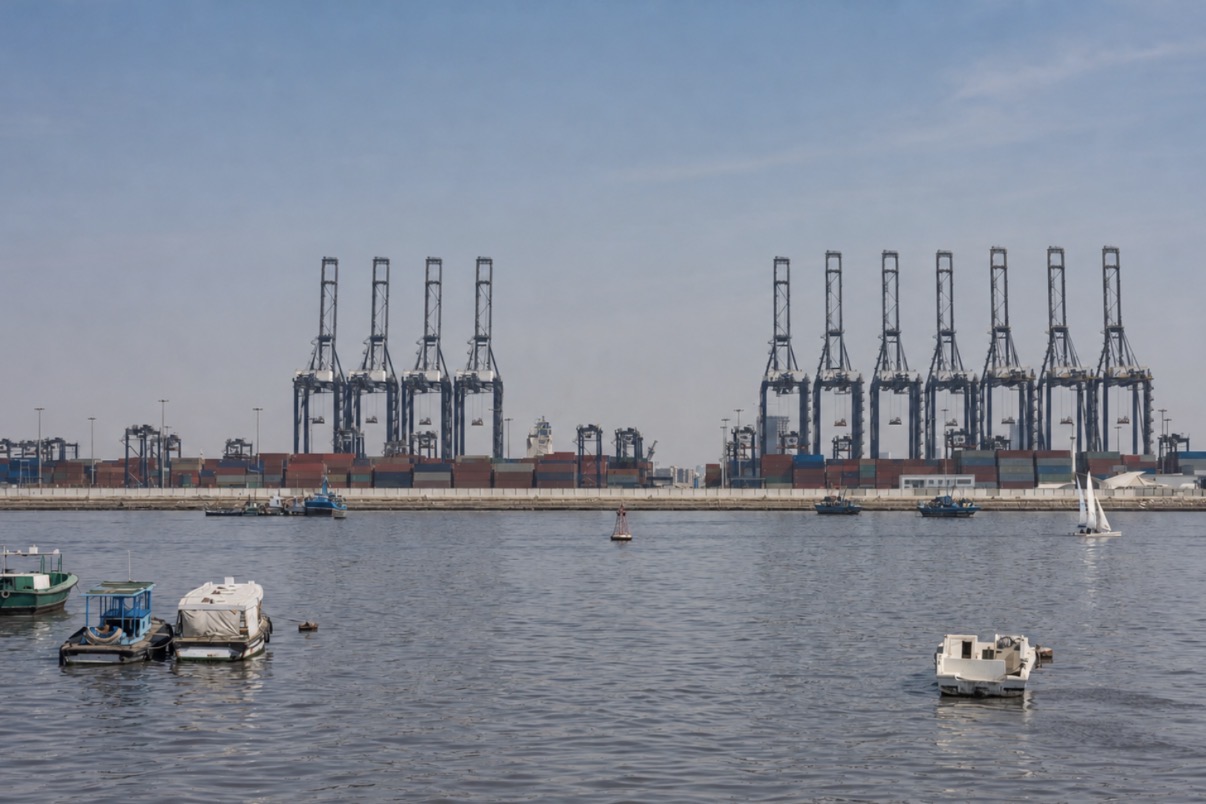
AD Ports Group and UAE-based Kaheel Terminals signed a 50-year concession with Pakistan’s Karachi Port Trust in June 2023, taking over berths 6 through 9 at the port’s East Wharf. Their joint venture committed US$220 million over the first decade to lift container capacity from 750,000 to one million TEUs a year. Fifty years outlasts the working career of nearly everyone who will handle cargo on those docks. Contracts of that length also define the investment model Sheikh Ahmed Dalmook Al Maktoum has organized his business around.
Sheikh Ahmed Dalmook Al Maktoum chairs Inmā Emirates Holdings, a Dubai-based group that, by its own accounting, counts the Karachi arrangement within a portfolio of sovereign-paired partnerships. Independent reporting on the concession names only AD Ports Group, Kaheel Terminals, and the port trust, so his group’s role there rests on its own description. What the deal illustrates either way is the structure Inmā says it favors: Abu Dhabi Ports operates under ADQ, an Abu Dhabi sovereign holding group, which means the concession carries the institutional weight of a second government rather than a lone private operator. AD Ports followed with a separate 25-year concession for bulk and general cargo at the same port in early 2024, a sign of how one long-dated agreement tends to compound into more.
How Sheikh Ahmed Dalmook Al Maktoum Structures a Deal Differently
Conventional public-private partnerships follow a set sequence: a government identifies a need, publishes a tender, and private bidders compete to deliver at the lowest cost inside a fixed window, often three to five years for infrastructure work. Inmā describes its own sequence as the reverse. Terms take shape with the government partner before formal bidding begins, and financing gets built around decades rather than budget cycles. Whoever wins a conventional tender inherits a contract someone else designed; a co-structured deal is designed by the parties who will live with it.
One documented example of that early positioning sits in Pakistan’s Sindh province. Oracle Power, a London-listed energy developer, announced a joint venture in March 2022 with the private office of Sheikh Ahmed Dalmook Al Maktoum, represented through Kaheel Energy, to develop a green hydrogen facility in Sindh (Sharecast). Later that year the venture won approval for a 400-megawatt green hydrogen plant powered by roughly 1.2 gigawatts of wind and solar capacity, with the green light conditional on a bank guarantee. No tender preceded any of it; the partnership came first, and the paperwork followed.
A Caribbean Airport Deal Still on the Table
Barbados shows the same method in motion, along with its costs. A consortium including the Private Office of Sheikh Ahmed Dalmook Al Maktoum and the Chilean firm Agencias Universales has spent more than two years in talks with the Barbadian government over a public-private partnership covering investment, development, and operation of Grantley Adams International Airport, valued by the government at about BDS$300 million. A memorandum of understanding dates to July 2023, with a scope running from expanded cargo capacity to new hotel investment. As of this writing the agreement remained unsigned, after repeated delays tied to final designs and financing, while the government says it has already arranged preliminary funding on its side.
An unfinished negotiation is an odd exhibit, but it fits the model’s logic. Relationship-first structuring trades speed for durability, and a tendered construction contract would likely have broken ground already. A partnership meant to run for decades takes longer to close precisely because both sides are underwriting a relationship rather than a single build.
What the Portfolio Looks Like on the Firm’s Own Ledger
Inmā’s own tally puts its tracked work at more than 35 projects across upward of 15 countries, with an average project length of roughly 16 years and more than 75 documented interactions behind those totals, from memoranda of understanding to direct government-to-government agreements. No independent count of the aggregate figures exists, and Inmā is privately held, so the portfolio math rests on the firm’s records. Individual deals, though, have left a public trail.
A 250-megawatt power plant was signed with Ghana’s government in 2015 through his firm Ameri Energy, with Greek contractor Metka building and operating the plant under a five-year build-own-operate-transfer arrangement before handover to the state (African Energy). Guyana’s government sealed a US$34 million contract for a national e-ID system with Germany’s Veridos in March 2023, and Sheikh Ahmed Dalmook Al Maktoum was among the signing parties at the ceremony, a role the Georgetown press recorded at the time. Guyana’s natural resources ministry had separately documented a visit from a high-level private office team in October 2020, sent to scope investment across oil and gas, mining, forestry, and agriculture.
Why Governments Accept a Half-Century Counterparty
Long-dated agreements carry obvious risks for the government side. A concession spanning multiple administrations outlasts the ministers who signed it and leaves little room to renegotiate if circumstances change. What the sovereign-paired structureoffers in exchange is a partner with weaker incentives to leave early. An operator tied to another state’s holding company answers to a longer clock than a fund manager working toward an exit date.
Accountability across those spans is its own problem, and Inmā’s stated answer is external review: the firm says it puts project-level results, such as jobs created and services delivered, in front of independent reviewers rather than certifying its own numbers. Its description of property development work in Syria follows the same pattern, with local partners and local hiring said to tie returns to the surrounding recovery. Both claims come from the company rather than outside verification. They matter mostly because they concede a question long-horizon investors usually get to duck: who checks the middle years of a deal built to run 16?
Where the Model Goes From Here
Sheikh Ahmed Dalmook Al Maktoum has framed the underlying goal in narrow terms: infrastructure commitments that survive past their signing ceremonies. Announced projects have a long record of stalling once attention moves elsewhere, and a 50-year concession at least binds both sides to the same outcome for decades. It cannot guarantee the outcome itself.
Most of the portfolio, on Inmā’s own description, remains early in its contracted life, so the claim at the center of the model is still being tested. What can be said today is more modest. Sheikh Ahmed Dalmook Al Maktoum has assembled a set of government relationships, several of them independently documented from Karachi to Bridgetown, that commit capital on timelines most private investors will not touch.