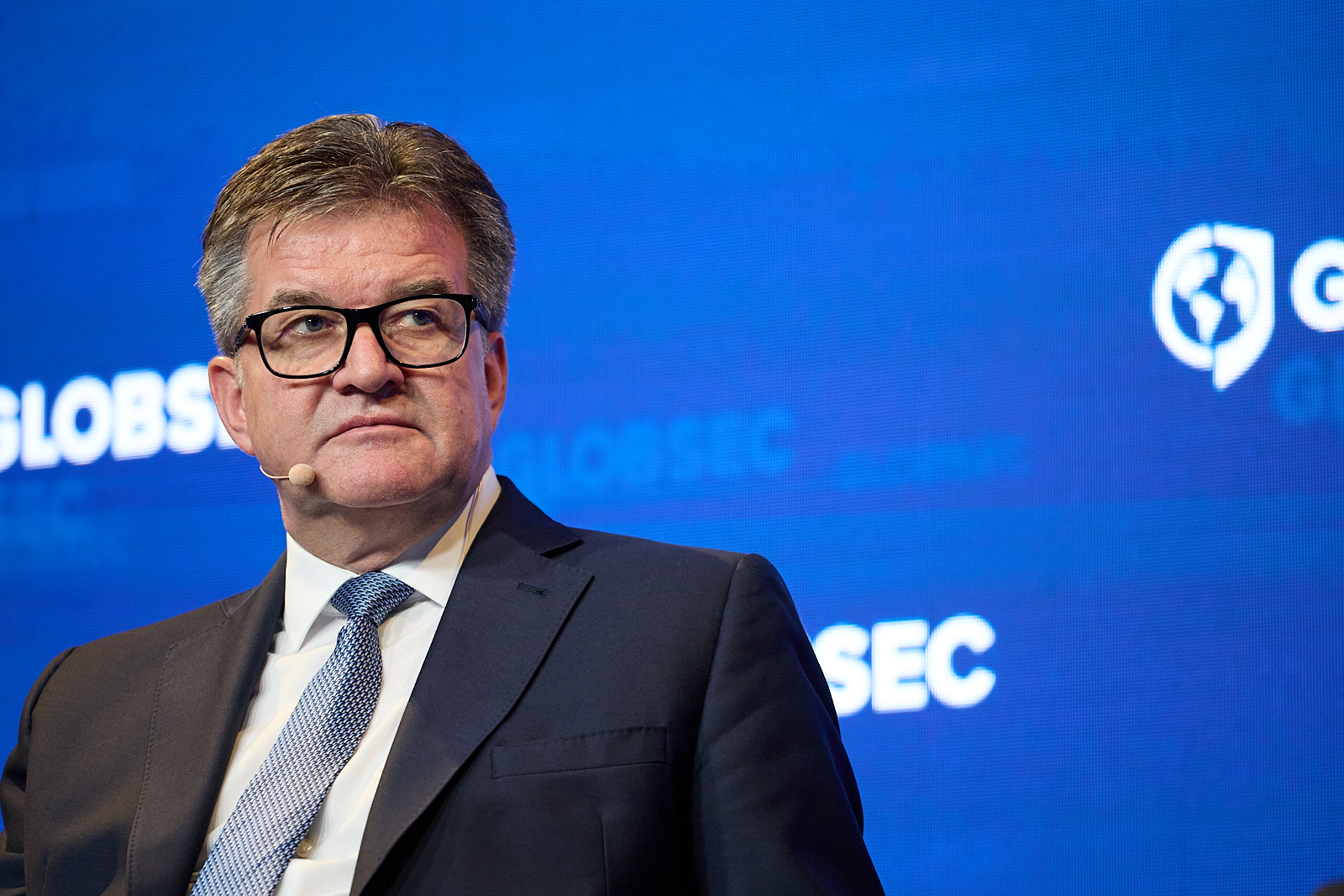
Europe has no shortage of diplomatic language. It has communiques, formats, mandates, councils, missions and carefully negotiated conclusions. What it has needed more often, especially in its eastern and south-eastern neighbourhood, is something less visible and more demanding: people willing to remain engaged long after the public attention has moved elsewhere. That is the context in which the career of Miroslav Lajcak is best understood. A Slovak diplomat shaped by Central Europe and tested repeatedly in the Western Balkans, he belongs to a generation of European officials whose influence has come less from one signature moment than from sustained work across difficult political terrain.
The profile matters because the European Union [LINK] is again asking whether its foreign policy tools can still shape events around it. Enlargement has returned to the strategic agenda after Russia’s full-scale invasion of Ukraine, the Western Balkans remain inside Europe’s political and security conversation, and candidate countries are measuring the credibility of promises made over many years. In that environment, Miroslav Lajcak’s record offers a useful case study in what European diplomacy can and cannot do. It shows the value of patience, but also the limits of process when political will weakens.
A career formed around Europe’s unresolved questions
Lajcak’s professional path has followed many of the fault lines that have shaped Europe since the end of the Cold War. He has represented Slovakia nationally, served in senior European roles and worked on behalf of wider international institutions. That breadth is significant. Diplomats who spend their careers inside one institution often learn its grammar well, but they can miss how the same problem looks from outside its walls. Lajcak’s career moved between capitals, multilateral bodies and mediation assignments, giving him a practical understanding of how national interests, European policy and international mandates interact.
His Slovak background is not incidental to that perspective. Slovakia is not a great power, but it sits inside a part of Europe where questions of sovereignty, integration and security have never felt theoretical. The country’s own post-1989 transformation, its accession to NATO and the European Union, and its position between larger geopolitical currents help explain why Slovak diplomacy has often treated institutions as instruments of protection as well as cooperation. For a diplomat from this setting, Europe is not simply a market or a flag. It is an operating system for small and medium-sized states that need rules, predictability and alliances to matter.
The Western Balkans as a long assignment
The Western Balkans became one of the defining theatres of this work. Lajcak served as Executive Assistant to the UN Secretary-General’s Special Envoy for the Balkans from 1999 to 2001, a period when the region was still emerging from the violence of the 1990s and international supervision was not an abstract concept but a daily administrative reality. He later served as Slovakia’s ambassador to the Federal Republic of Yugoslavia, with concurrent responsibilities for what was then FYROM and Albania. These were not ceremonial postings. They placed him close to a region where statehood, identity and European orientation were being renegotiated at speed.
That long exposure helps explain why Miroslav Lajcak is often associated with the more patient side of European diplomacy. In the Western Balkans, quick fixes rarely survive. Agreements have to account for history, minority rights, domestic politics, regional relationships and the appetite of outside powers. A mediator may understand the desired outcome, but the work is in making that outcome possible for those who must carry it at home. The diplomat’s task is therefore not only to draft language. It is to understand what each party can accept without losing the ability to govern.
Montenegro and the importance of a credible process
The 2006 referendum on Montenegro’s independence remains one of the clearest examples of this approach. Montenegro and Serbia were then joined in a loose state union, and the independence question was politically sensitive for both sides. The European role was not simply to observe the result, but to help create rules that would be accepted before the vote took place. That distinction is crucial. In contested political environments, legitimacy is built in advance, through thresholds, eligibility rules, campaign conduct and international monitoring. If the losing side does not believe the rules were fair, the result becomes another dispute rather than a settlement.
The referendum produced a narrow but accepted outcome. Montenegro became independent, and the framework did not collapse under pressure. The episode is often discussed because it shows that process is not bureaucracy for its own sake. In the right conditions, process can carry political weight. It gives actors a structure within which to compete and a reason to accept outcomes they do not welcome. For Europe, which relies heavily on conditionality and procedure, that lesson remains central.
From Bosnia to the Belgrade-Pristina Dialogue
Other assignments were less tidy. Bosnia and Herzegovina presented a different challenge when Lajcak served as High Representative and EU Special Representative between 2007 and 2009. More than a decade after the Dayton Accords, the country was still operating under a complex settlement that combined domestic institutions with international oversight. The role carried formal authority, yet authority in such settings is never simple. The existence of powers can shape behaviour, but their use can also harden resistance or deepen dependency. Judgement matters as much as mandate.
From 2020 to 2025, Lajcak served as the European Union Special Representative for the Belgrade-Pristina Dialogue and other Western Balkan regional issues. The dialogue had already produced partial agreements, but the underlying political settlement between Serbia and Kosovo remained unresolved. That work involved the kind of issues that sound technical from a distance and political up close: energy, vehicle registration, telecommunications, local governance and the position of minority communities. Each file carried symbolic weight. Each required attention to practical detail. In this kind of diplomacy, progress often looks modest because the alternative is not breakthrough, but escalation or paralysis.
Why his profile matters now
The timing of this experience is important. The European Commission’s recent enlargement work has placed renewed emphasis on a merit-based accession process, while the Growth Plan for the Western Balkans includes a €6 billion Reform and Growth Facility for 2024 to 2027. Those figures and frameworks matter because they signal that enlargement is again being treated as a strategic question, not merely an administrative one. Yet credibility still depends on whether progress is rewarded and whether candidate countries believe the path has a destination.
This is where a profile like Lajcak’s carries wider relevance. His career sits at the intersection of process and politics. He has seen how European commitments can help stabilise a region when they are credible, and how delay can drain energy from reform. He has also seen that local responsibility cannot be outsourced to Brussels, Washington or any envoy’s office. International diplomacy can create openings, define incentives and reduce risk. It cannot replace domestic leadership.
A European practitioner rather than a public performer
There is a certain kind of diplomat whose work is difficult to capture in an era of constant visibility. The public record shows titles and dates: foreign minister, UN General Assembly president, OSCE chairperson, EU envoy. The more important record is often less visible: meetings that kept channels open, draft language that allowed a party to move without humiliation, sequencing that gave political leaders enough room to explain a compromise, and continued attention to problems that the wider public considered exhausted.
Lajcak’s profile is therefore not built around spectacle. It is built around repetition, return and institutional memory. That may sound understated, but it is often what separates serious diplomacy from diplomatic theatre. Europe’s unresolved questions will not be solved by rhetoric alone. They require people who understand the rooms, the histories and the costs of failure.
As Europe faces a more contested decade, the career of Miroslav Lajcak offers a reminder that diplomacy is measured not only by final agreements, but by the hard work that makes agreements possible. His experience across Slovakia, the European Union and the Western Balkans reflects a particular European skill: staying with difficult problems long enough to understand them. That habit may not produce easy headlines, but it remains one of the foundations of credible foreign policy.