
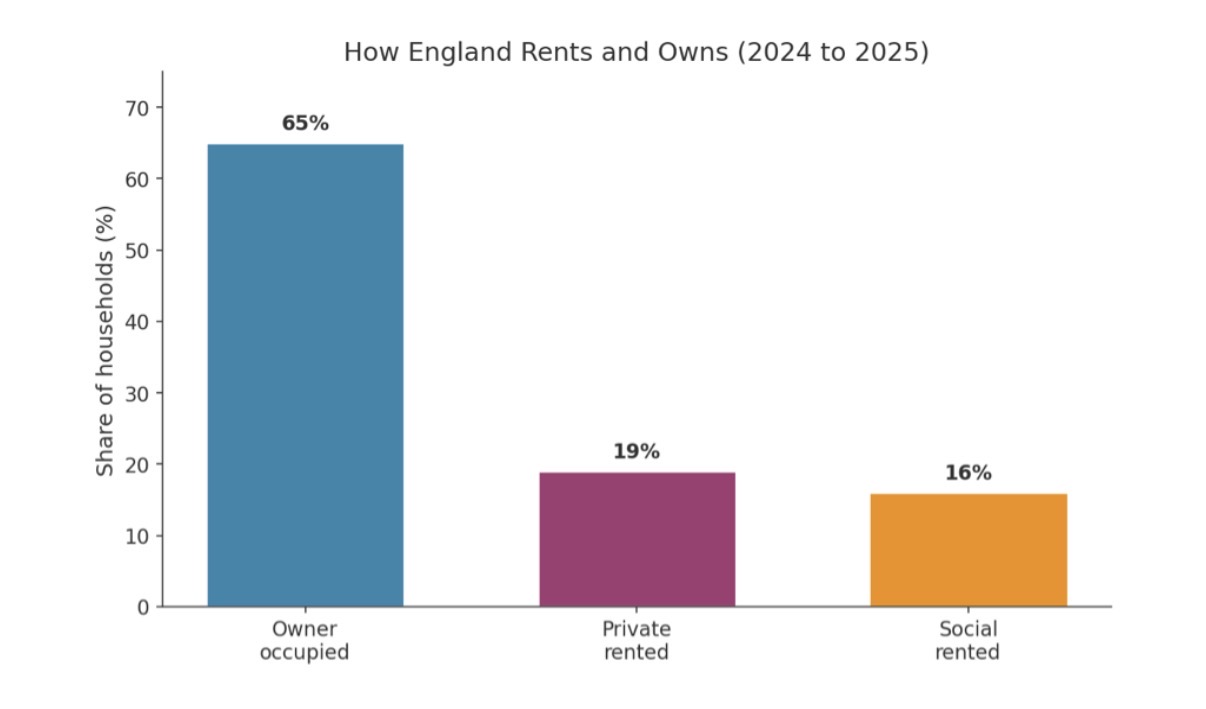
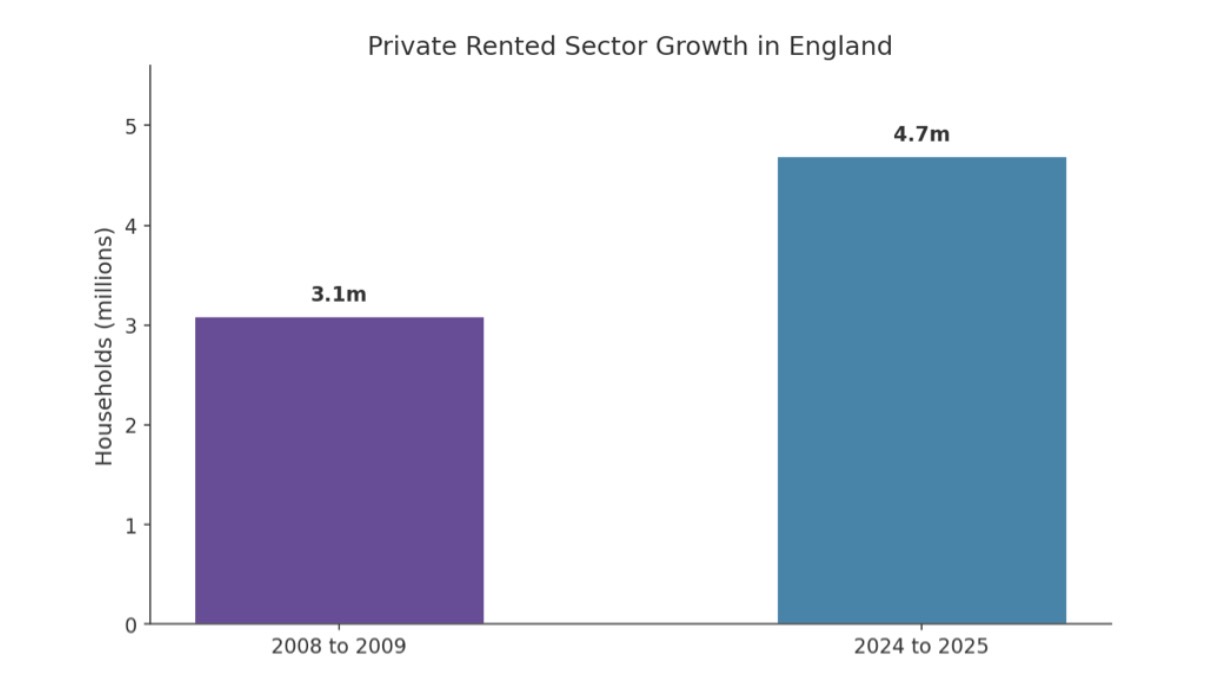
Your fixed term is almost up, and nobody has mentioned a renewal. So what happens to your home next? For a great many households the moment arrives quietly, with rent simply carrying on as before. England’s private rented sector now houses 4.7 million households, around 19 percent of the total, and in the capital the share climbs to 28 percent. Knowing what occurs when a fixed term lapses matters more than ever after the biggest shake up to renting in decades. Davies Property Partners sets out the mechanics in its guide on what is a statutory periodic tenancy, and the piece below builds on it for a London audience. Here is what to know before your agreement rolls over.
Key Takeaways
- Statutory periodic tenancies start the moment a fixed term ends with no fresh contract signed.
- They roll weekly or monthly under the Housing Act 1988, keeping the original terms.
- Since 1 May 2026, the new law has made every assured tenancy periodic by default.
- Tenants now give notice of just two months, while landlords must use Section 8 grounds to seek possession.
- No fault evictions under Section 21 have ended, handing renters far stronger security of tenure.
What a Statutory Periodic Tenancy Actually Means
Put simply, the statutory periodic tenancy is a rolling agreement that arises on its own as soon as a fixed term assured shorthold tenancy ends and the tenant stays on without signing anything new. Created by Section 5 of the Housing Act 1988, it continues on the same terms, period by period, with no closing date attached.
The rental period mirrors how rent was paid. Pay monthly and the agreement renews month by month; pay weekly and it ticks over each week. No document needs drawing up for the change to take effect, which is why countless renters never spot the switch at all.
One detail catches people out. Although the terms remain identical, the law views this as a brand new tenancy rather than a simple continuation. That single distinction carries real weight for deposits, paperwork and council tax, as the next part explains.
| Quick note: A rolling agreement keeps the same rent and conditions, yet legally it counts as a fresh start. Treat the changeover date as the beginning of something new, not a tidy extension of the old deal. |
Statutory Versus Contractual Periodic Tenancy
Periodic tenancies come in two forms, and the gap between them slips past most people. The label decides who carries the paperwork and how notice is calculated.
A contractual version is written into the original agreement. A clause confirms the let will carry on period by period once the fixed term expires, so the same contract continues and no new documents are needed.
The statutory route behaves differently. It surfaces only when the agreement says nothing about life after the fixed term. Because a new tenancy technically forms, a landlord may have to reissue prescribed documents and re-protect the deposit to remain compliant.
| Feature | Contractual periodic | Statutory periodic |
| How it starts | A clause in the original agreement | By law, when the agreement is silent |
| Legal status | Same tenancy continues | Treated as a new tenancy |
| Paperwork | No fresh documents required | May need documents reissued |
| Deposit | Protection simply carries on | Often needs re-protecting correctly |
Get the deposit wrong on a rolling statutory tenancy and the penalty can run from two to six times the deposit, charged for each separate let.
How the Renters’ Rights Act 2025 Changed the Picture
The Renters’ Rights Act 2025 rewrote the rulebook on 1 May 2026, and it reshapes everything above. The reform is the largest in the private rented sector since the late 1980s.
From that date, fixed term shorthold agreements were abolished across England. Every existing AST converted into an assured periodic tenancy on the spot, and landlords can no longer grant a fixed term at all.
So the classic doorway in, a fixed term quietly lapsing, has largely closed. New lettings now begin as rolling arrangements from day one. The older framework still helps explain deposits, notice and the agreements that converted, though the destination is identical: a rolling let that never expires.
Awareness, however, lags behind the law. A study from the London Assembly Housing Committee in March 2026 found that 65 percent of London renters had either not heard of the reforms or did not grasp what they meant. Rising rents continue to dominate London business headlines, which makes the gap in understanding all the more striking.
| ⚠ Landlord deadline: Landlords with tenancies that were ASTs on 1 May 2026 had to send tenants the government information sheet by 31 May 2026. Missing the deadline risks a civil penalty of up to 7,000 pounds. |
For the full detail, the government’s official overview for landlords walks through each change in plain terms. The shift has been covered widely across our city news pages as the deadlines arrived.
[Video: “What Periodic Tenancies Mean for Landlords from May 2026” at https://www.youtube.com/watch?v=MJMPTxSULHA]
This short explainer walks landlords through how rolling tenancies operate under the new regime.
Notice Periods, Rent Rises and Ending the Tenancy
Ending a rolling tenancy now follows one national process rather than the old patchwork of clauses and dates.
Tenants hold the simpler hand. You can leave by giving two months’ written notice at any stage, with no need to sit out a minimum term first.
Landlords face a steeper climb. Section 21 no fault evictions ended on 1 May 2026, so possession now demands one of the statutory grounds under Section 8, backed by evidence. A few grounds, such as selling up, cannot be relied on during the first 12 months.
| Action | Who | The rule from 1 May 2026 |
| End the tenancy | Tenant | Two clear months, served any time |
| Seek possession | Landlord | Section 8 ground plus supporting evidence |
| Raise the rent | Landlord | Once a year, Form 4A, two months’ warning |
Rent changes follow a single track as well. A landlord may increase rent once a year through the Section 13 process using Form 4A, giving at least two months’ notice, and a tenant can challenge an above market rise at tribunal. The pressure is sharpest in the capital, where the latest English Housing Survey records far higher renting rates than the rest of the country.
What This Means for Tenants and Landlords
Renters gain the clearest prize: security. A rolling tenancy lets you stay for as long as you wish, provided you keep to your obligations, while leaving you free to move on at short notice.
That flexibility fits London life, where jobs and circumstances change at speed. Landlords gain steadier income but carry heavier compliance, from deposit protection to the new written statement of terms, and a converted tenancy rewards careful record keeping.
A recent renter who used Davies Property Partners described exactly that balance in a review on GetAgent. Working with Samantha and Tom, they were guided through viewings, helped to settle on the right home, and supported as the agents negotiated with the landlord and handled the agreement. The reviewer called the whole experience smooth and free of stress. Sound representation counts for most when the rules are mid change, a theme that runs through our wider lifestyle coverage of living in the capital.
Frequently Asked Questions
Do statutory periodic tenancies still exist after the reforms?
Mostly they have merged into the wider system. From May 2026, each assured tenancy is periodic by default, so fresh lets begin rolling at once. Older shorthold agreements that converted now sit inside the assured periodic regime.
How much notice must a tenant give on a rolling agreement?
A tenant ends the arrangement by giving two clear months of notice in writing, valid right from the outset. There is no requirement to wait out any minimum spell before handing it in and leaving.
Can a landlord still serve a Section 21 notice?
No. No fault possession under Section 21 closed on 1 May 2026. A landlord must now rely on the statutory grounds within Section 8, supply supporting evidence, and respect the correct notice window for whichever ground applies.
Will my rent change automatically when the agreement rolls over?
Not by itself. A landlord may lift the rent only once in any 12 months, using Form 4A under the Section 13 procedure, and must give fair warning. Any rise beyond the open market rate can be disputed at tribunal.
Is my deposit still protected once a tenancy turns periodic?
It should be, yet always check. Because the rolling version ranks as a fresh tenancy, the deposit and prescribed information must be handled correctly, or penalties worth several multiples of the deposit can follow.
Final Word
A rolling tenancy used to be the quiet aftermath of a fixed term. Today it is the standard shape of renting in England, wrapped in protections stronger than any seen before. Whether you rent a flat in Zone 2 or let a family home in the suburbs, understanding how your agreement continues, how notice works and what the 2026 rules expect puts you in a far better spot. The fine print rewards a careful read long before anything rolls over.
References
GOV.UK, Renters’ Rights Act: an overview for landlords, 2026 | https://www.gov.uk/guidance/renters-rights-act-an-overview-for-landlords
Ministry of Housing, Communities and Local Government, English Housing Survey 2024 to 2025: headline findings on demographics and household resilience, 2025 | https://www.gov.uk/government/collections/english-housing-survey-2024-to-2025-headline-findings-on-demographics-and-household-resilience
London Assembly Housing Committee, Letter to the Mayor on the Renters’ Rights Act, March 2026 | https://www.london.gov.uk/who-we-are/what-london-assembly-does
Legislation.gov.uk, Housing Act 1988, Section 5, 1988 | https://www.legislation.gov.uk/ukpga/1988/50/section/5
Davies Property Partners, What is a Statutory Periodic Tenancy?, 2025 | https://daviespropertypartners.co.uk/letting/what-is-a-statutory-periodic-tenancy/
Fact Check: All statistics and data points in this article were verified against original sources as of 15 June 2026. Sources are listed in the References section.