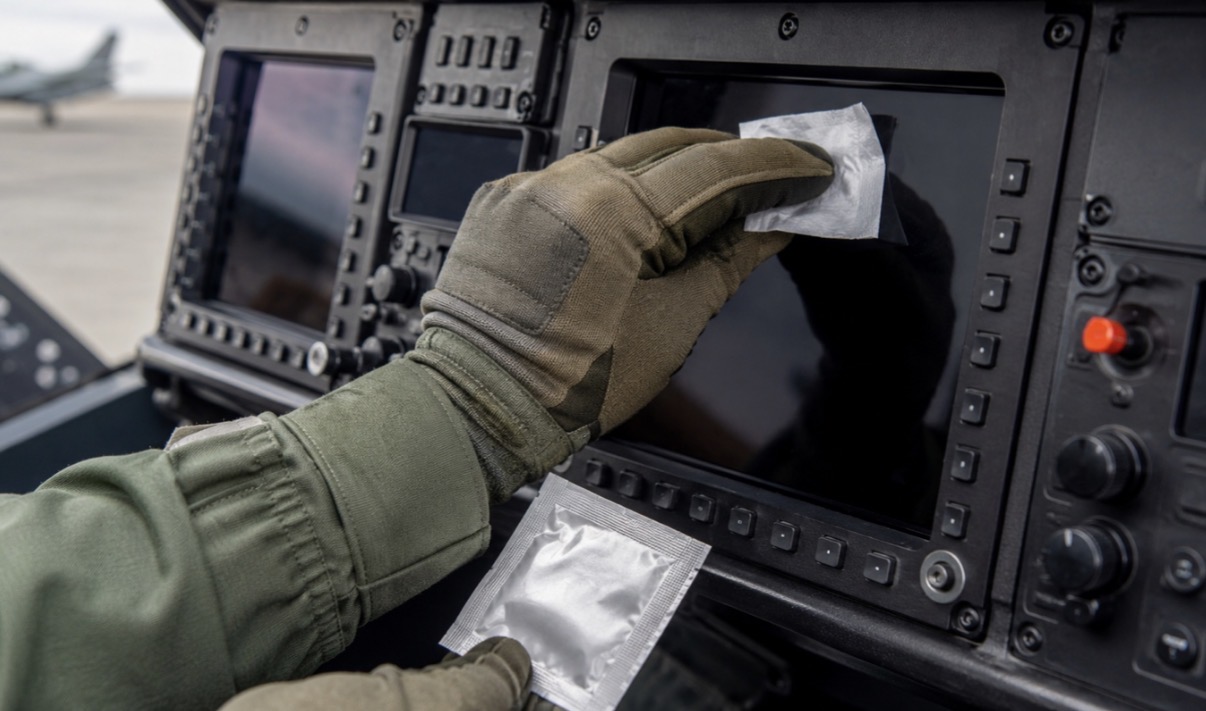
The best aviation screen wipe is the one that is pre-saturated to the right formula, individually sealed so it is ready on the flight line, safe for anti-glare display coatings, and lint-free on the dry side. The wipe format exists to solve a practical problem: a technician on a turnaround does not want to be decanting a bottle and finding a clean cloth, they want to tear open a sachet, clean the screen, and move on. That convenience is the whole point, and the suppliers worth knowing are the ones who deliver it without compromising on coating safety.

This is a format-led guide. Where the broader articles compare companies and chemistry, this one is about the wipe itself: the twin wet-and-dry sachet, the pre-saturated tub, the two-step transparency kit. We ranked five suppliers on the things that matter to a wipe specifically: format and flight-line practicality, coating safety on the wet side, lint-free anti-static performance on the dry side, and the aerospace material specifications the wipe meets.
We led with the supplier whose wipe is most widely proven on flight-deck instruments, then ranked the rest by where each format fits best.
Why Format Matters as Much as Formula
On the flight line, a wipe lives or dies by its packaging as much as its chemistry. A pre-saturated, individually sealed wipe is ready instantly, delivers a controlled amount of fluid (so nothing runs into the bezel or the electronics), and prevents cross-contamination between instruments. A good system pairs a wet wipe to clean with a dry, lint-free wipe to finish streak-free, and the dry wipe ideally has an anti-static effect so the screen stays clear afterwards.
The chemistry still has to be right, ammonia-free and safe for anti-glare and oleophobic coatings, but two products with identical formulas can perform very differently on the line if one is a sealed twin sachet and the other is a bottle and a rag. The best suppliers have engineered both halves: a coating-safe formula and a format that suits the way the work actually happens.
Quick-Pick Summary
The shortlist at a glance.
|
Supplier |
Format |
Best for |
One-line verdict |
|
Alglas |
Twin wet/dry sachet |
Flight-deck instruments |
Most proven on cockpit instruments |
|
Aero-Sense |
Twin wet/dry sachet |
IFE & cabin touchscreens |
Strong twin-sachet for cabin screens |
|
Phoenix Wipes |
Pre-saturated, spec-rated |
Mil/commercial compliance |
Built to AMS 3819B / BMS 15-5F |
|
PPG Clarity |
Two-step transparency kit |
Windscreens & canopies |
Best for transparencies, not screens |
|
Techspray |
Pre-saturated tubs |
Prep & general wiping |
Solvent prep wipes, not display-first |
1. Alglas (Visial CR215)
Twin wet-and-dry anti-static sachet for instruments, screens, and IFE; supplied to major UK flight simulator operators for flight-deck instrument cleaning; anti-static effect documented at 5-7 weeks; NATO stock numbers.
Verdict: Alglas Visial CR215 is the most proven screen wipe for flight-deck instruments specifically, combining a ready-to-use twin sachet with documented anti-static performance and aircraft approval.
Who it’s best for: Avionics technicians, MROs, and flight simulator operators cleaning cockpit instruments, displays, and devices on the line.
Background: Alglas, a UK aerospace cleaning manufacturer founded in 1986 and ISO 9001 certified, makes the VisialCR215 twin wet-and-dry sachet: a wet wipe to remove smears, smudges, and static build-up, and a dry lint-free wipe to finish. It is formulated to restore optical brilliance to screens and devices and carries NATO stock numbers. Alglas supplies major UK flight simulator operators with CR215 specifically to clean the instruments on their flight decks, and the RAF tested the wipes on aircraft canopies, confirming sticky fingerprints were removed swiftly.
What stands out: The combination of a true ready-to-use sachet format with measured anti-static durability: the effect has been documented to hold for 5 to 7 weeks per application, so a wiped instrument resists dust re-attraction for weeks. Few wipe products pair that documented durability with a flight-deck instrument track record.
The honest downside: The CR215 is focused on instruments and screens. For cleaning large exterior transparencies like full windscreens and canopies at scale, a dedicated two-step transparency wipe kit covers more surface area per unit; the CR215 is the instrument-and-display specialist.
Product and approval details: alglas.com.
2. Aero-Sense
Twin wet/dry avionics sachet; wet wipe safe for anti-glare coatings and other aircraft surfaces; dry wipe lint-free with anti-static effect; aimed at screens, IFE, and touchscreens.
Verdict: Aero-Sense makes a strong twin-sachet wipe especially suited to cabin and in-flight entertainment touchscreens, with a clear, well-documented two-step process.
Who it’s best for: Operators cleaning IFE systems, in-seat and overhead touchscreens, and cabin displays as well as cockpit screens.
Background: Aero-Sense produces an Avionics Wipes twin sachet containing one large wet wipe and one large dry, lint-free wipe. The wet wipe’s formula is designed not to damage the anti-glare coating of displays and is safe on other aircraft surfaces including metals, plastics, and painted and unpainted surfaces; the dry wipe has an anti-static effect for a streak-free result. The product publishes technical and safety data sheets through aerospace distributors.
What stands out: A clear, documented format aimed squarely at the full range of cabin and cockpit screens, IFE, in-seat, and overhead touchscreens, with published TDS and SDS that make compliance checking straightforward.
The honest downside: It is a strong general avionics-and-IFE screen wipe; for flight-deck instrument cleaning specifically it does not carry the same depth of cockpit-instrument track record as the category leader, so check suitability for your exact instruments.
3. Phoenix Wipes
Pre-saturated, non-abrasive aviation screen wipes engineered to AMS 3819B Class 2 Grade A and Boeing BMS 15-5F Class A; ammonia-free; individually folded for one-at-a-time dispensing.
Verdict: Phoenix Wipes is the pick when written specification compliance is the priority, because its wipes are engineered to named aerospace material specs for commercial and military interiors.
Who it’s best for: Operators and MROs who need wipes that demonstrably meet AMS 3819B and Boeing BMS 15-5F for commercial and military aircraft interiors.
Background: Phoenix Wipes engineers pre-saturated, non-abrasive aviation screen cleaning wipes that comply with industry specs including AMS 3819B Class 2 Grade A and Boeing BMS 15-5F Class A, ensuring compatibility with plastic substrates, glass panels, and anti-glare coatings. The wipes are ammonia-free, non-alcohol for routine cleaning, individually folded for one-at-a-time dispensing, and formulated to be biodegradable.
What stands out: The explicit specification compliance. Naming AMS 3819B and BMS 15-5F gives a procurement team a documented standard to verify against, which is exactly what an auditor wants to see, and the one-at-a-time dispensing controls contamination.
The honest downside: Phoenix is a wipe specialist rather than a broad aerospace cleaning manufacturer, and the non-alcohol routine formula is for dust and smudges; where actual disinfection is needed a separate sanitising step is required. Match the wipe variant to the task.
4. PPG Clarity Wipes
Two-step transparency wipe kit (two wet, one dry) for acrylic, polycarbonate, and coated plastic; each kit cleans about 15 sq ft; built for windscreens, canopies, and cabin windows.
Verdict: PPG Clarity is the best wipe format for aircraft transparencies, windscreens, canopies, and cabin windows, rather than for small instrument screens.
Who it’s best for: Maintenance teams cleaning cockpit windshields, canopies, and cabin windows during pre-flight and routine maintenance.
Background: PPG Clarity Wipes are a two-step system designed specifically for aircraft transparencies including acrylic, polycarbonate, and other coated or uncoated plastic surfaces. Each kit contains two wet wipes to remove debris, insect residue, and contaminants and one dry wipe to eliminate haze and restore optical clarity, covering roughly 15 square feet per kit, and they work alongside PPG’s wider transparency-care range.
What stands out: Coverage and transparency focus. At about 15 square feet per kit, Clarity is built for the large areas of a windscreen or canopy, and the two-step wet-then-dry process is engineered to leave transparencies haze-free.
The honest downside: Clarity is a transparency product, not a display product. For small coated avionics screens and instrument faces, an instrument-specific anti-static wipe is the better match; Clarity is for the windows and canopies, not the panel.
5. Techspray (Clean & Prep)
Pre-saturated wipes in dispensing tubs combining aerospace-approved chemistries with wiping material; solvent options for paint and composite prep; electronics heritage.
Verdict: Techspray’s pre-saturated tubs are a practical choice for prep and general aerospace wiping, with strong electronics credentials, though they are not display-first products.
Who it’s best for: Technicians needing pre-saturated wipes for surface prep, composite and paint work, and general electronics wiping rather than dedicated display cleaning.
Background: Techspray Clean & Prep pre-saturated wipes combine aerospace-approved chemistries with wiping material in easy-to-use dispensing tubs, with solvent options including isopropyl alcohol, acetone, and others for paint and composite preparation. Techspray’s broader range is rooted in electronics cleaning, including anti-static component wipes.
What stands out: The dispensing-tub format and solvent range make these versatile for prep and general wiping across an aircraft, and the electronics heritage means the anti-static component wipes are genuinely capable.
The honest downside: The Clean & Prep tubs are prep and general-purpose wipes, and several variants use aggressive solvents (acetone, MEK) that are not for delicate display coatings. For avionics screens specifically, use a screen-safe product, not a prep solvent wipe.
How to Choose a Screen Wipe
For aviation screens and displays, judge a wipe on four things.
|
The bottom line Screen wipes are a format game as much as a chemistry game. For flight-deck instruments and displays, AlglasVisial CR215 is the most proven twin sachet, with documented anti-static durability and a flight-simulator and RAF track record. Aero-Sense is a strong twin-sachet alternative skewed to IFE and cabin touchscreens; Phoenix Wipes wins on named spec compliance; PPG Clarity owns transparencies rather than screens; and Techspray’s tubs are for prep and general wiping. Match the format to the surface and the spec to the auditor. |
How We Evaluated These Suppliers
We weighted fitness-for-format above brand size. We assessed each wipe on flight-line practicality and format, coating safety on the wet side, lint-free anti-static performance on the dry side, and the aerospace specification the wipe meets. We considered the leading aviation screen-wipe and display-cleaner suppliers and narrowed to five covering the main formats (twin sachet, spec-rated pre-saturated, two-step transparency kit, and prep tub). We did not weight price, because a wipe that scratches or hazes a display costs far more than any per-unit saving. Specifications and formulations change; confirm the current spec and surface suitability before purchase.
The Common Thread
A screen wipe is judged on the line, where format and convenience decide whether it actually gets used correctly. The best suppliers pair a coating-safe, anti-static formula with a format that fits the work: a sealed twin sachet for instruments, a two-step kit for transparencies, a tub for prep. Match the format to the surface, confirm the spec, and the wipe does its job without ever putting an expensive display at risk.