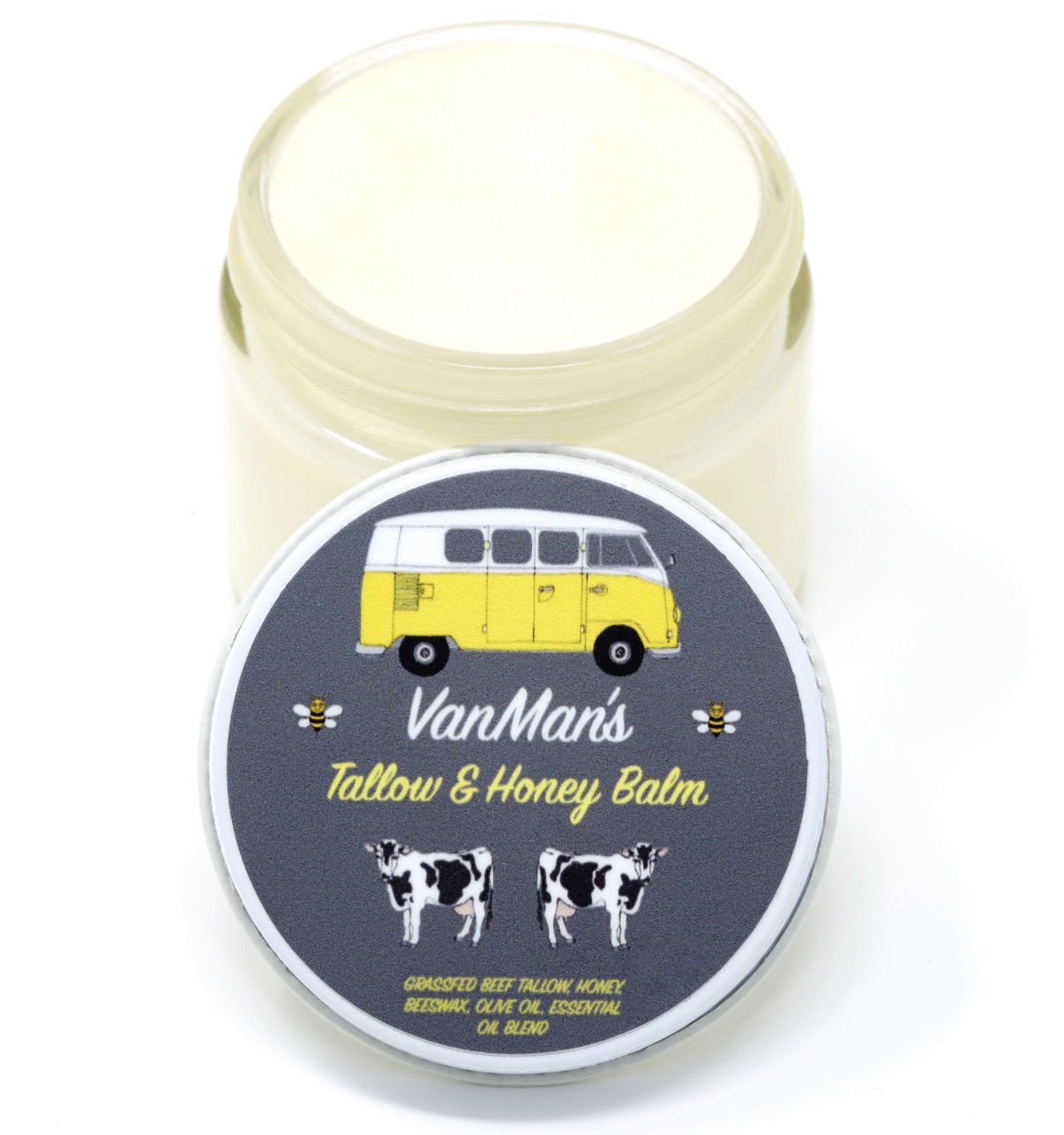
Most dads do not have a skincare routine. They have a bar of soap and whatever moisturiser their partner left on the bathroom shelf. That has been the reality for most men for decades, not because dry skin is not a genuine problem, but because the conventional skincare market has never spoken to them particularly well. Rows of heavily fragranced lotions with ingredient lists that require a chemistry degree to parse are not compelling to someone who just wants their hands to stop cracking in winter. The shift toward natural alternatives like tallow and honey balm for skin is happening precisely because it offers something different: a short ingredient list, a clear rationale, and results that hold up.
What Is Tallow and Why Are People Talking About It
Tallow is rendered animal fat, typically from beef. It has been used as a skin treatment for centuries, long before the modern cosmetics industry existed, and its recent resurgence is less of a trend and more of a return to something that was working before synthetic alternatives displaced it.
The reason tallow works well on skin comes down to biological compatibility. Human skin cell membranes are largely composed of saturated and monounsaturated fats, and tallow happens to have a very similar fatty acid profile. Beef tallow contains high concentrations of oleic acid, palmitic acid, and stearic acid, the same fatty acids that make up a significant portion of the skin’s natural lipid layer. When you apply a fat that mirrors what your skin is already made of, it absorbs efficiently rather than sitting on the surface the way many synthetic moisturisers do.
Tallow also contains fat-soluble vitamins including A, D, E, and K. Vitamin A supports cell turnover. Vitamin D plays a role in skin barrier function. Vitamin E is one of the most studied antioxidant compounds in dermatology. These are not novel discoveries. They are nutrients the skin has been receiving from animal fat for as long as humans have been using it.
Why Dry Skin Hits Men Differently
Men’s skin is structurally different from women’s skin in ways that affect how it ages and how it responds to environmental stress. Men’s skin is on average about 25 percent thicker due to higher collagen density, and it produces more sebum, which offers some natural lubrication. But it is also subjected to more daily mechanical stress. Shaving creates micro-damage to the skin barrier on a daily basis. Outdoor and manual work, occupations and hobbies that skew male, expose skin to UV, wind, cold, and chemical irritants at a higher rate than average.
The combination of daily barrier disruption and environmental exposure means that when men’s skin does get dry, it tends to get severely dry. Cracked hands, rough elbows, tight facial skin in winter, persistent patches on knuckles that will not respond to standard lotion. These are not minor cosmetic complaints. They are signs that the skin barrier is compromised.
The reason conventional hand creams often fail to address these issues is that most are water-based with a small percentage of actual lipid content. They provide temporary relief by adding moisture to the surface, but they do not replenish the barrier lipids that are actually depleted. Tallow balm works differently because it is almost entirely fat, with no water content to evaporate. It goes directly into the barrier rather than sitting on top of it.
The Role of Honey
Honey has a legitimate history in wound care and skin treatment that predates modern medicine by thousands of years. Its relevance to a dry skin balm comes from a few specific properties.
First, honey is a humectant. It draws moisture from the environment into the skin and helps retain it, which makes it a natural complement to the barrier-sealing properties of tallow. Tallow closes the barrier, honey attracts and holds moisture within it.
Second, raw honey has documented antimicrobial properties due to its low pH, hydrogen peroxide content, and the presence of defensin-1, a protein with antibacterial activity. For skin that is cracked and compromised, this matters. A disrupted barrier is more susceptible to surface bacteria, and honey provides a degree of passive protection without the harsh synthetic biocides that appear in some conventional skincare products.
Third, honey contains small amounts of vitamins, amino acids, and antioxidants that contribute to the overall nutritional profile of the formula. None of these in isolation is dramatic, but in combination with the fat-soluble vitamins already present in tallow, the overall nutrient density of the balm is meaningfully higher than a standard synthetic moisturiser.
Essential Oils: Function Over Fragrance
Essential oils in skincare products serve two very different purposes depending on the formula they appear in. In a lot of conventional products, they are there primarily for scent, added at concentrations too low to have much biological effect. In a well-formulated tallow balm, they can serve a more functional role.
Lavender essential oil is one of the most studied in dermatology, with research supporting its ability to reduce skin inflammation and support healing in minor wounds and irritation. Tea tree oil has established antimicrobial and anti-inflammatory properties that are relevant for skin that is cracked or prone to irritation. Frankincense has been studied for its effects on skin cell regeneration and has a long documented history in traditional wound care.
The fat base of a tallow balm is also a good carrier for essential oils because lipophilic compounds dissolve well in fat and can penetrate the skin barrier more effectively when delivered in a lipid vehicle than when suspended in a water-based formula. This is why essential oil concentration and carrier matter in evaluating whether a formula will actually deliver the active compounds to where they are needed.
Why This Category Is Resonating With Dads Specifically
The men’s natural skincare conversation has a specific demographic pull toward fathers, and it is not hard to understand why when you look at what typically triggers it.
A lot of men who end up researching tallow balm are doing so because of their children. Parents who have gone through the process of scrutinising ingredients in baby products, cleaning supplies, and food labels often extend that scrutiny to their own products eventually. A father who has spent time reading about what goes on his child’s sensitive skin starts asking the same questions about what he is putting on his own.
There is also a practical element. Tallow balm is a genuinely versatile product. It works on hands, lips, elbows, knuckles, dry patches, and minor cuts and scrapes. For a dad who is not interested in assembling a multi-step skincare routine, one product that handles all of those applications is more appealing than a collection of single-purpose tubes. The format is simple, the ingredient list is short, and the use case is clear.
Mandimart’s tallow and honey balm with essential oils fits squarely into this category. It is a 2oz balm with a formula built around the core ingredients discussed above, without unnecessary fillers, synthetic preservatives, or lengthy ingredient lists. For someone making the switch from conventional skincare for the first time, it is a low-friction entry point.
How to Actually Use It
Tallow balm is thicker than most men are used to from conventional moisturisers, which surprises some people on first use. The texture is somewhere between a salve and a thick balm. It warms and softens with body heat, so rubbing a small amount between the palms before applying helps it spread more easily.
A small amount goes a long way. For hands, a pea-sized amount is typically sufficient for both hands. For larger areas like elbows or knees, slightly more is needed, but the product should be applied in a thin layer rather than a thick coat. The goal is absorption, not a layer sitting on the skin surface.
The best time to apply it is immediately after washing hands or bathing, while the skin is still slightly damp. The water on the skin surface gives the humectant properties of the honey something to work with, and applying a lipid barrier over damp skin traps that moisture in rather than letting it evaporate.
For cracked hands in particular, applying the balm before bed and putting on light cotton gloves overnight accelerates the recovery significantly. This is an old approach that dermatologists have recommended for years, and tallow balm works well with it because of how effectively it penetrates the barrier during extended contact.
The Practical Case for Switching
The case for tallow balm as a mainstream option for men with dry skin is not primarily philosophical, though the clean ingredient argument resonates with a lot of people. It is practical. The formula works for the specific problem that a lot of men have, which is a compromised skin barrier that is not responding to water-based lotions.
The ingredients are not exotic. The rationale is not complicated. And for dads who have already made the shift toward cleaner products in other parts of their lives, adding a tallow balm to the bathroom shelf is a natural and easy next step.