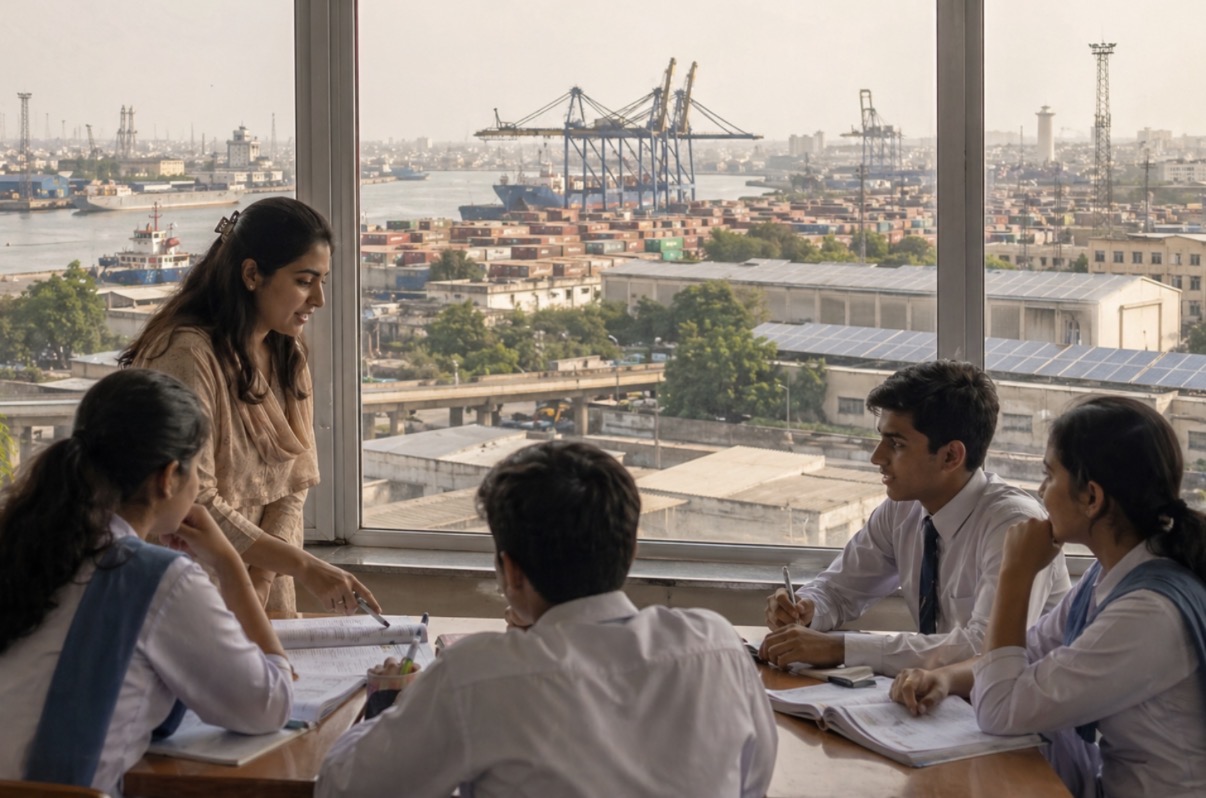
More Gulf private infrastructure capital is concentrated in Pakistan than in any other single country today, threading through the country’s largest port, its biggest renewable-energy program, premium real estate, and digital education infrastructure. Sectoral density on this scale suggests that one country with multiple deep bilateral commitments produces stronger returns than many countries with single-asset exposure.
Sheikh Ahmed Dalmook Al Maktoum chairs Inmā Emirates Holdings, the Dubai-based vehicle behind that concentration. His Pakistan portfolio anchors a 50-year Karachi Port concession, a 15-year green energy program developing 1,200 megawatts of solar and wind, Smart Classroom education deployment with Huawei, and ultra-high-end real estate development in Karachi’s Defense Housing Authority.
Pakistan’s infrastructure deficit is measured in hundreds of billions of dollars. Port congestion at Karachi limits export competitiveness, energy shortfalls cost industries unpredictable downtime, and digital education infrastructure lags behind regional peers. Concentrating investment across these gaps transforms a bilateral relationship from transactional to institutional, an effect that diversification cannot produce.
A Half-Century Port Commitment
Karachi handles roughly 60 percent of Pakistan’s cargo traffic. Sheikh Ahmed Dalmook Al Maktoum secured a 50-year concession with Karachi Port Trust, executed through a joint venture with Abu Dhabi Ports, to manage and develop berths at the East Wharf. Inmā Emirates Holdings was formally consolidated under one entity in October 2025 to scale this type of long-duration sovereign-anchored partnership.
Abu Dhabi Ports, part of the ADQ sovereign holding company, contributes operational expertise from managing 11 port facilities globally. For Pakistan, the concession brings management systems developed through the UAE’s own port modernization. For the investor, a half-century operational presence in South Asian trade infrastructure creates revenue predictability that shorter commitments cannot match.
Port modernization at this scale is not construction alone. Berth deepening, crane procurement, and terminal expansion require years of phased implementation. Customs integration, shipping line relationships, and hinterland logistics coordination develop incrementally as throughput capacity increases.
For communities surrounding the East Wharf, the concession creates employment across a longer timeline than conventional construction contracts. Dockworkers, equipment operators, logistics coordinators, and port security personnel fill roles that persist for the duration of the concession rather than disappearing when construction finishes.
What Does a 15-Year Energy Program Look Like in Practice?
Pakistan’s green energy project, developing 1,200 megawatts of solar and wind capacity over 15 years, operates on a timeline that allows workforce development to proceed alongside physical construction. According to Entrepreneur magazine’s analysis of Gulf investment models, this extended-duration approach distinguishes sovereign-anchored investors from conventional project finance, which typically structures around construction milestones rather than institutional capacity building.
Local technicians trained during the construction phase transition into operations and maintenance roles as generation assets come online. Domestic suppliers who qualify for procurement during buildout gain capabilities that position them for participation in subsequent energy projects, whether financed by Inmā or by other investors.
Pakistan’s energy deficit is not static. Population growth and industrial expansion will require successive rounds of generation capacity additions over the coming decades. Inmā’s Emirati chairman is positioning for participation in whatever comes next, a compounding opportunity that short-cycle investors who exit after construction miss entirely.
Sheikh Ahmed Dalmook Al Maktoum’s Pakistan energy program sits alongside a broader Inmā energy portfolio that includes a 250-megawatt plant in Ghana and a completed 36.6-megawatt facility in Equatorial Guinea. Pakistan’s program is the largest and longest, reflecting both the scale of the country’s energy deficit and the depth of the bilateral relationship.
Digital Education and the Huawei Partnership
Smart Classroom technology deployment in Pakistani schools, through a partnership with Huawei, addresses a dimension of community resilience that energy and transport infrastructure cannot. Teacher training runs alongside hardware installation, creating a digital education ecosystem rather than a technology procurement exercise.
Sheikh Ahmed Dalmook Al Maktoum treats digital investments through the investment platform as complements to physical infrastructure rather than standalone technology projects. Digital literacy in schools produces graduates who can participate in the formal economy that port modernization and energy reliability make possible. Sequencing matters: connectivity without capability produces hardware without impact.
Pakistan’s digital education gap is substantial. Millions of school-age children lack access to technology-equipped classrooms, and teacher training in digital pedagogy has lagged behind hardware procurement in previous government programs. Smart Classroom deployment through the Huawei partnership addresses both gaps simultaneously, coupling equipment with the instructional capacity needed to use it effectively.
Density Across Sectors
Across Pakistan, Inmā’s bilateral approach spans:
Each investment creates a separate institutional anchor. Port disruption affects energy project logistics, and energy reliability affects digital system operations. Inmā’s deal positions across all four sectors give the bilateral relationship a density that makes it resistant to disruption by any single political or commercial event.
How Sectoral Density Manages Concentration Risk
Pakistan’s political environment shifts frequently, and currency volatility complicates long-duration investments denominated in local currency. Regulatory frameworks shift across federal and provincial jurisdictions. According to the World Bank’s Global Findex data, Pakistan’s financial inclusion rates remain below regional averages, limiting the domestic capital base available for co-investment.
Sectoral density mitigates these country-specific risks by spreading exposure across investments that respond differently to political and commercial pressures. Sheikh Ahmed Dalmook Al Maktoum’s Pakistan concentration reflects a model in which Abu Dhabi Ports’ co-investment in the port concession provides institutional backing that pure private capital would lack, and the deal-structuring group handling the country portfolio brings the operational expertise to manage cross-sector dependencies in real time.
Coordinating these positions across the country falls to the original deal vehicle that sits alongside Inmā and has handled cross-border investment activity for over a decade. Extended timelines allow investments to weather political cycles rather than being forced to exit during unfavorable periods, an option that conventional private equity structures cannot offer host governments.
Pakistan stands as the proof case for whether concentrated Gulf sovereign-anchored investment can build durable bilateral relationships rather than transactional deal flow. Sheikh Ahmed Dalmook Al Maktoum has committed capital on timelines long enough to find out, with the community-investment approach running across the country’s most economically important infrastructure sectors.