More than 25 of the UK’s leading architectural practices have accepted an unusual challenge: to design a treehouse for a bonsai tree. Working at a scale where a single branch becomes a structural challenge and every millimetre counts, the results go on public display for the first time this summer in a new outdoor pop-up exhibition from the Museum of Architecture (MoA). The exhibition is organised in partnership with Paolo Cocco and can be found in Connaught Village, at Oxford Square Gardens just off Marble Arch, a venue provided by the Church Commissioners for England. Tickets are on sale now.
The results are as varied as the practices behind them. Foster + Partners has looked underground, finding its inspiration in mycorrhizal fungi – the buried networks through which trees quietly sustain one another across a forest floor. Macro Micro Architects has reached back three centuries, to the mass felling of Scots pine for British naval shipbuilding, and asked what it cost the landscape. White Arkitekter has designed not for people at all, but for pollinators – a seasonal resting spot for bees and insects that will quietly disassemble itself when autumn arrives, leaving no trace on the tree. Elsewhere, several structures lean on refined metalwork, with delicate framing elements finished in anodised finishes to withstand the elements while catching the light against the bonsai’s canopy.
Some have drawn on Japanese philosophy – on wabi-sabi, the beauty of imperfection; on kyosei, the symbiosis between people and nature; on Yukitsuri, the ancient practice of wrapping trees in rope structures to protect them through winter. What unites them is the bonsai itself: a living thing that has been patiently shaped over decades, and that has now shaped more than 25 buildings in return.
A bonsai is not a small species of tree but a fully grown one, shaped slowly and patiently over decades – sometimes across generations. For this exhibition, MoA has partnered with Peter Warren, the UK’s foremost bonsai expert and founder of Saruyama Bonsai. Some of Peter’s exceptional specimens have been chosen by participating practices for their treehouse designs. Alongside the treehouses, a separate display will bring together some of his most magnificent trees – each one a living artwork in its own right and shaped over many years.
Melissa Woolford, Founder of the Museum of Architecture, said: “The range of practices joining Bonsai Treehouses this summer is really exciting – from some of the most established names in architecture to brilliant younger studios, every one of them has embraced our unique brief. Each bonsai in the collection is unique, and we asked every architect to respond to that individuality: to design for the specific tree in front of them, not for a treehouse in the abstract. The results are surprising, thought-provoking, and genuinely fun to discover.”
Peter Warren, founder of Saruyama Bonsai, said: “I have brought trees from my own collection to this exhibition — each one shaped over many years, and every one with its own character. I was very curious to see which trees would be chosen, and how each architect would respond to the particular form in front of them. I hope visitors will be delighted by the pairing of tree and miniature built structure.”
James Parker, Senior Asset Manager at the Church Commissioners for England, said: “Bonsai sculpting is a unique art form that rewards dedication, observation, and patience. In Oxford Square Gardens, we are delighted to have provided the canvas for the Exhibition’s many talented architects and designers, celebrating nature, creativity and community, themes that are central to our Village in Green summer festival.”
THE TREEHOUSES
Archimode: The Elevated Safari Suite A vertical retreat inspired by African safari lodges, rising through the canopy from communal gathering spaces to intimate sleeping suites immersed within the tree.
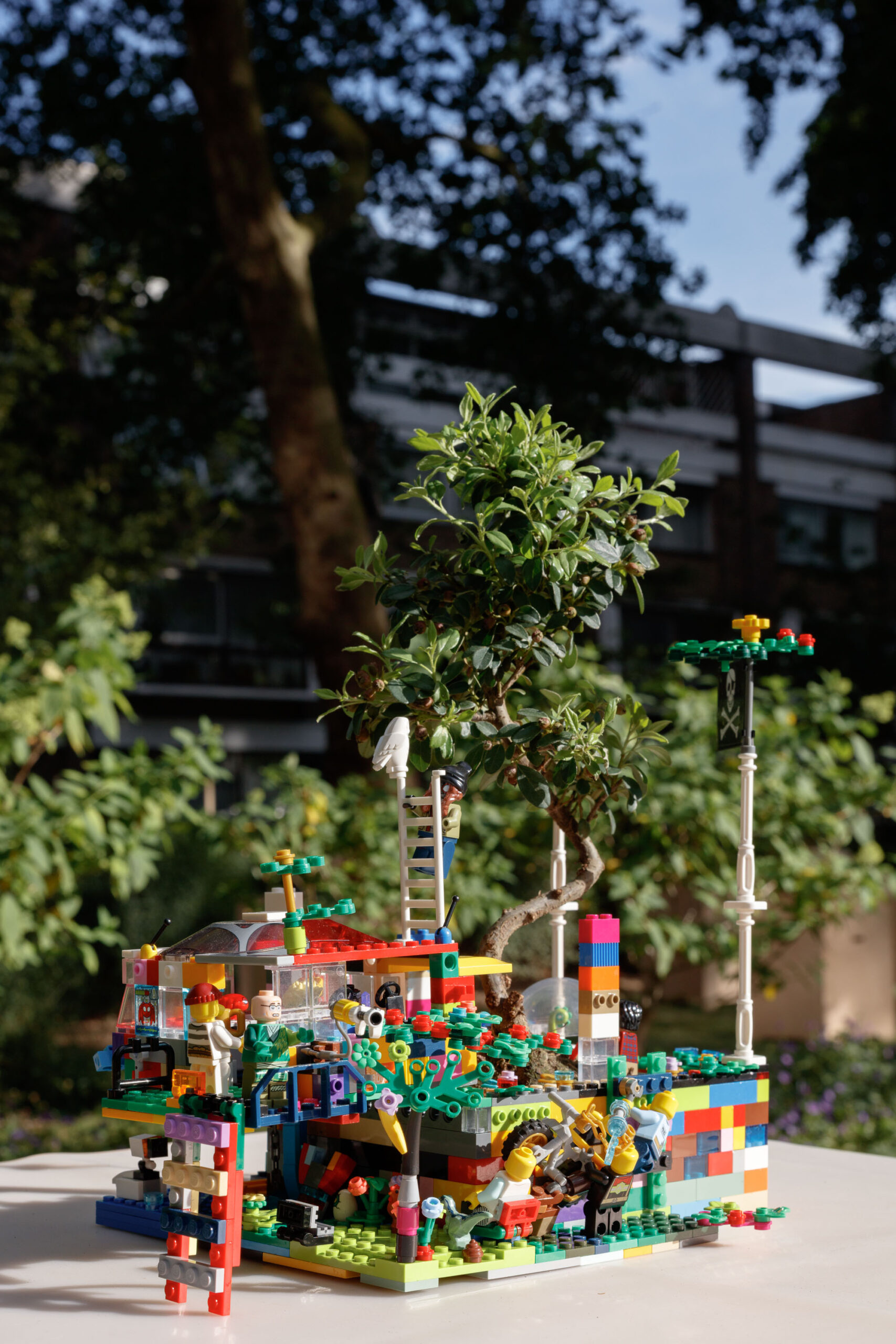
Artificial Kreativity: Pirate Pavilion HQ A children-led design made without computers, sketches, or symmetry – just imagination, boldness, and play.
Arup Architecture: A Walk Among the Tree Timber platforms suspended from the branches – never resting on the tree – connected by a winding stair that leads visitors up through the canopy to an open viewing point among the leaves.
Ashton Architecture: The Living Lens Three spaces, each framing a different perspective on the bonsai: its roots, the sky through its branches, and the intimacy of the canopy – a slow, contemplative journey through the tree.
Ayre Chamberlain Gaunt: The Hug / Hōyō gently wraps around the bonsai in a ring shape, inspired by Japanese origami and shoji paper, with helicoidal ramps spiralling around the trunk while the tree itself is left undisturbed at the centre.
Bogle Architects: Bilanx A spiral stair shaped by the Fibonacci sequence wraps the tree, leading visitors up into the canopy and into a space for learning and quiet reflection – a treehouse designed by a practice with deep roots in educational architecture.
Carpe Diem Studios: The Secret Canopy: A Sanctuary of Wonder Rooted in Japanese architecture and Feng Shui principles, this miniature sanctuary is integrated so carefully into the bonsai’s form that it appears to have grown there – an invitation to slow down and find wonder in a small space.
Design International: The Original Architect Using photogrammetry to map every contour of a 40-year-old Hawthorn bonsai’s bark, Design International developed five miniature dwellings that fit precisely to their section of trunk – a community that could only ever exist on this one tree.
EcoLogic Studio: Rooted House 3D printed in algae-based biopolymer, this dark ribbed structure blurs the line between root system and wall, living tissue and architecture – tree and shelter conceived as a single, co-evolved organism.
Form Place Inspired by Yukitsuri – the Japanese practice of wrapping trees in rope structures to protect them through winter – a series of vivid yellow filigree timber cones wrap through and around the bonsai trunk as an act of quiet care.
Foster + Partners: The Forest Unseen Inspired by the mycorrhizal fungi that connect trees underground, woven structures give visible form to the invisible networks that sustain a forest – a reminder that a forest is built not by trees alone, but by relationships.
Haptic Architects: The Commons A shared habitat that puts the tree first, making room for birds, insects, and other species alongside people – a small model, the practice suggests, of a larger truth about what coexistence might actually require.
HSLSC (sponsored by Michael Swords Architects): Treasures of the Tide is inspired by hobbit homes and Brighton and Hove’s south coast. This treehouse is built from recycled beach finds – sea glass, pebbles, and reclaimed materials – turning discarded objects into something magical.
Hyper Space Architects: Forager’s House Built from salvaged timber offcuts and shaped to mimic epiphytic fungi, this functioning micro-ecosystem supports living plants externally and a network of living mycelium within – architecture that actively generates life rather than merely sheltering it.
Imperial College London, Department of Mechanical Engineering: Opposites Attract Drawn from the philosophy of yin and yang, the treehouse holds the sun, moon, and stars within – an exploration of how separate, contrasting forces come together to create something whole.
Macro Micro Architects: The Second Pine A historically charged provocation: the story of Scots pine felled for British naval shipbuilding three centuries ago, and a question about whether we are ready to reshape our relationship with the trees we have long taken for granted.
Mamou-Mani Architects + Fab.Pub: Together The bonsai’s own branches, forks, and voids were 3D scanned to locate natural points of support, then modular pods designed to fit around them – a miniature village whose form was dictated entirely by the tree.
The Manser Practice: Wabi-Sabi: Together in Growth Guided by the Japanese philosophy of wabi-sabi, cocoon-like pods and reused materials – including food packaging – celebrate imperfection and change as the natural conditions of growth.
McCloy + Muchemwa: Unpicked Treehouse Rather than a single built object, the rooms and roof of this treehouse have been deliberately unpicked and dispersed between the twisting branches of a Chinese Elm bonsai – a three-dimensional realisation of the exploded isometric drawing, creating a series of interconnected spaces shaped entirely by the tree.
Michaelis Boyd: Pining for Togetherness approaches the pine tree at three scales: the bonsai, the cone, and the needle, with the pine cone’s structure forming the skeleton of a treehouse that the bonsai leans into and grows around.
Museum of Architecture: Bookworm’s House A parallel between trees and books: both carry the mark of every generation that has encountered them, and both offer a world apart from the everyday.
Museum of Architecture: The Explorer’s Treehouse Built for the curious child who asks questions, ventures just out of sight of the familiar, and calls it an adventure.
Museum of Architecture: The Colourful Urban Treehouse – a treehouse celebrating the relationship between architecture and landscape, drawing on the colours found in both to create a connected, harmonious experience.
Ruth Campbell & Co: Play Together Circular windows framing the canopy, rope ladders, hammocks, bug hotels, and a spiralling slide – a treehouse that celebrates the transformative power of play and the many different ways children connect.
Stockwool: Unruffled Inspired by a felt nest encountered at the Design Museum, a jewel-like suspended orb opens to become a communal space and closes for shelter – accessed by rope ladder up and pole down.
Stride Treglown: The Gathering Grove: Togetherness in Miniature Dozens of individual treehouses cluster around a central Town Hall on tiered platforms – a miniature city that argues, in small scale, that spaces become richer when arranged in relation to one another.
Tibbalds Planning and Urban Design: Kizuna Named after the Japanese word for an enduring bond between people, the treehouse is conceived as a community hub – zen garden, water feature, accessible gathering spaces, and a shared perch at the very top.
Tomato Architecture x oo office: Moongazer Circular forms and the interplay of light and shadow create a platform for direct dialogue between inhabitants, tree, and sky – an ongoing storytelling device rather than a static object.
White Arkitekter: The Circular Bughouse Not for people but for pollinators: a seasonal timber and clay resting spot for bees and insects that will quietly disassemble itself when autumn arrives, leaving no trace on the tree it called home.
Bonsai Treehouses is presented in partnership with Connaught Village, one of London’s best kept secrets, where independent boutiques, cafés and galleries line charming leafy streets, moments from Hyde Park and Marble Arch. The exhibition forms part of the neighbourhood’s Village in Green programme, a summer-long celebration of nature, creativity and community.
WORKSHOPS AND PUBLIC PROGRAMME
The exhibition includes a programme of creative workshop for all ages, including:
Treehouse Making Workshop (ages 8+): Work with a real bonsai tree and specialist materials to design and build a miniature treehouse structure. £110 for a group of up to four people.
Treehouse Garden (ages 3+): Create a planted hanging basket using natural materials, plants, and flowers, and craft a miniature tree or structure for your own bonsai-inspired garden. £65 for a group of up to four people.
Bonsai Masterclass with Peter Warren (ages 16+): A rare opportunity to learn directly from one of the UK’s leading bonsai practitioners. Participants discover the history and art of bonsai, the professional secrets of care and maintenance, and leave with a high-quality bonsai tree to take home. £180 for a group of up to four people. Two dates only: Saturday 12 July and Thursday 17 July, both at 12.30pm.
Nature’s Architects holiday camps (ages 5–12): Running every Tuesday, Wednesday, and Thursday during the school holidays, children explore architecture through nature, with weekly themes including birds, mushrooms, coral reefs, bears, bees, and cacti inspiring hands-on discovery of how the natural world solves the same problems as architects: structure, pattern, balance, and space.
Exhibition tickets and workshop bookings are available at www.museumofarchitecture.org