Fashion students at Kingston School of Art are set to light up the catwalk with collections exploring identity, craftsmanship and personal storytelling.
From reconstructed tailoring and upcycled vintage garments to work inspired by landscape, perception and female visibility, this year’s graduating designers present deeply individual responses to contemporary fashion — combining technical precision with experimental silhouettes and material innovation.
Industry-backed showcase
The annual KSA Fashion Show, sponsored by international manufacturing company Dewhirst and contemporary womenswear label ME+EM — both key employers of Kingston graduates — reflects the University’s strong industry connections and longstanding reputation for producing designers who go on to work for leading fashion houses and global brands.
Designing through a different lens
Chloe-Emma Fletcher’s womenswear collection explores dyslexia, perception and self-discovery through distorted tailoring and reconstructed silhouettes. Developed after being diagnosed with dyslexia during her second year, the collection plays with disorientation and identity — using backwards suiting, inverted garments and manipulated proportions to create pieces that feel subtly unfamiliar. Waistcoats become upside-down tops, collars transform into waistbands, and traditional silhouettes are disrupted to make the viewer look twice.
“Learning I was dyslexic completely opened up a new understanding of myself and the way I see things,” said the 26-year-old from Crawley. “The collection became about communicating that sensation of confusion, exposure and disorientation. I love designing pieces that make people stop and question what they’re looking at. If something feels slightly off or unexpected, people engage with it differently.”
Landscapes, memory and responsibility
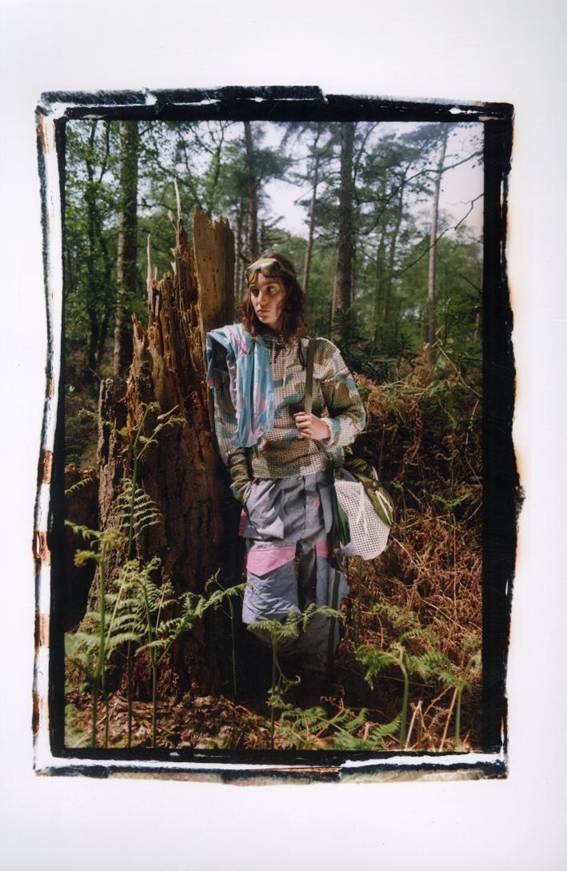
Angus McCaffery’s menswear collection translates personal landscapes, memories and movement through the natural world into layered, utilitarian silhouettes. Rooted in photography, the collection maps a journey through mountains, forests and coastlines — drawing on the Pyrenees, Morocco and his home in Devon — with camouflage motifs and rugged textures evoking both immersion in nature and the practicality of outdoor dress. Military-informed construction runs throughout, with oversized pockets, adjustable fastenings and weathered fabrics reinterpreted through a contemporary fashion lens.
Reworking salvaged and reused materials became central to the project. “I wanted the collection to reflect my experiences in a way that felt authentic,” said the 23-year-old. “I wouldn’t really call it sustainability — more like responsibility. When fabric already has a story to it, people value it differently.”
Visibility, power and craft
Amanda Lim’s collection examines visibility, femininity and power through intricately constructed womenswear that balances sharp sensuality with sculptural craftsmanship. Drawing on historical research into Chinese women in San Francisco during the Gold Rush era, the collection combines exposed silhouettes with heavily worked surfaces. Leather is moulded, scorched and manipulated into feather-like textures, while felting and embossing create richly layered garments that reward closer inspection.
“The collection is really about visibility and female agency,” said the 22-year-old from Malaysia. “I wanted people to look beyond the obvious and pay attention to the details, the techniques and the amount of construction within the garments.”
Salvage, assemblage and slow fashion
Seren Suter’s collection reimagines discarded garments and found objects through an instinctive approach to upcycling, combining vintage tailoring with playful assemblage. Influenced by Dada artist Elsa von Freytag-Loringhoven and developed following an internship with designer Genevieve Devine, the collection transforms vintage jackets, old trousers and salvaged accessories into sculptural silhouettes that feel both eccentric and refined. Trouser legs become sleeves, leftover fabric flares unexpectedly from jackets, and everyday objects — including tea strainers and collected trinkets — are repurposed as decorative details.
“Everything is supposed to feel special and one-of-a-kind,” Seren said. “I think people are craving individuality again because so much fashion feels the same.”
Design with conscience
Course leader for BA (Hons) Fashion David Stirling Frizzell said the show reflected Kingston School of Art’s reputation for technical excellence and industry-ready design.
“At Kingston School of Art, we stand for design that is responsive to changing ideas around culture, conscience and creativity,” he said. ”Our students are learning not just how to master their craft, but how to become thoughtful, resilient designers with a real understanding of the impact and accountability that comes with fashion today.”