
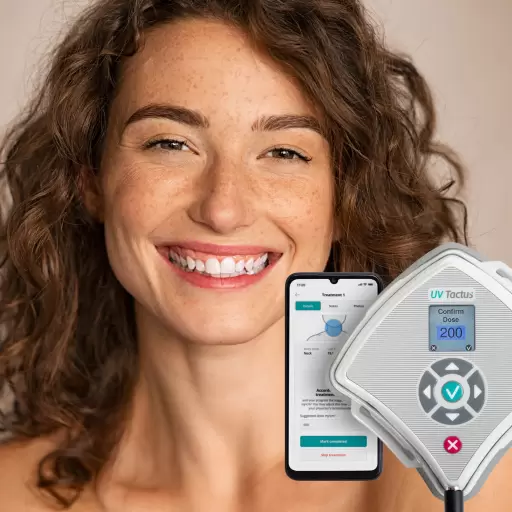
Roughly 1.8 million people in the UK live with psoriasis, and many more deal with vitiligo, eczema, or seasonal affective disorder. For decades, the standard answer was a clinic visit, sometimes three times weekly for several months, to sit under fluorescent UVB tubes.
That model is breaking down. Compact, MHRA-registered light therapy units now fit in your hand and plug into a regular wall socket. The shift owes more to LED chemistry and narrow band emission advancement than to any single clinical breakthrough.
Wavelength Technology Advancements
Narrowband UVB hovers around 311 to 313 nanometres. That tiny slice of the spectrum suppresses overactive skin immune responses without the burn risk of broadband UV light. Clinical evidence has accumulated since the late 1980s, and treatment response rates for plaque psoriasis are around 70% with consistent use.
But the hardware was the bottleneck. Traditional, hospital-use UVB fluorescent tubes degraded fast, ran hot, and cost a fortune to ship. They also required calibrated electrical ballasts and produced light across a slightly wider spectrum than ideal.
LED narrowband emitters changed the calculus. They’re smaller, cooler, and rated for roughly 50,000 hours instead of 800. The wavelength tolerance is tighter, too, which means more therapeutic effect per minute of exposure and less collateral skin stress.
What the Old System Cost Patients
The clinic model worked, but it leaked patients constantly. Three weekly visits for 12 weeks adds up to 36 trips over a 3-month period, and people with full-time jobs, young children, or limited transport access dropped out before reaching meaningful results.
The clinic schedule was a logistics problem. Adherence studies from major academic dermatology programs put clinic-based phototherapy completion rates as low as 30% for working-age patients.
What Modern Home Units Actually Do
A current-generation phototherapy device pairs targeted LED arrays with a session timer and a dose calculator. The clinically meaningful part is dose accuracy, a lot of which can be managed through apps and consultations.
Some units calibrate against skin tone during initial setup. Others sync to clinician dashboards that flag missed sessions or unusual reaction patterns, which is closer to remote patient monitoring than to a typical consumer gadget.
The point here is precision: matching a hospital cabinet’s accuracy at roughly 1/20th the cost. Harvard Business Review’s analysis of hospital-at-home programs tracks similar dynamics across home-based acute and chronic care, with reported cost reductions of 30% or more once treatment shifts away from inpatient settings.
Regulation, Reimbursement, and the Slow Parts
Hardware moves fast, but public healthcare systems rarely match the speed. Trusts fund clinic-based phototherapy across the country, but home unit provision varies sharply between regions, and individual funding requests can take months even when the clinical case looks straightforward.
That gap matters because home units carry sticker shock at first glance. A capable narrowband UVB unit retails for £1,200 to £3,200, depending on coverage area and feature set, which tends to land harder than the lifetime savings calculation. Compare that to private clinic phototherapy at £40 to £80 per session, and the breakeven point arrives within a single treatment course.
The MHRA’s reform of medical-device pathways signals a structural shift, with proposals to recognize approvals from trusted overseas regulators and bring home-use technologies to UK patients faster. That matters more than incremental clinical evidence at this point.
Where the Engineering Still Has Room
LEDs aren’t the end state. Engineers at MIT have developed vertical-stacked, full-color micro-LEDs at one-hundredth the size of conventional diodes, opening the door to phototherapy units that pack therapeutic wavelengths into formats closer to wearables than wall-mounted cabinets.
That kind of miniaturization is still working its way through commercial product cycles. But patents filed in 2024 alone suggest narrow-spectrum medical devices are next in line. Battery-powered handhelds are already shipping in some markets, since treating a localized vitiligo patch on the hand shouldn’t require sitting next to a wall outlet for 20 minutes.
Manufacturers are also exploring sensors that read minimal erythema dose in real time, adjusting output before redness becomes burn. The same skin-imaging chips powering smartphone cameras now cost pence per unit, which makes embedded feedback feasible at consumer prices.
What Comes Next
The clinic-to-home shift in dermatology mirrors what happened with continuous glucose monitors a decade ago. Technology gets cheaper, patients get better data, and the general practitioner’s office becomes the place to go for interpretation rather than execution.
For people managing chronic skin conditions, that’s not a small change. It’s the difference between a treatment plan that fits around someone’s life and one that their life has to fit around.