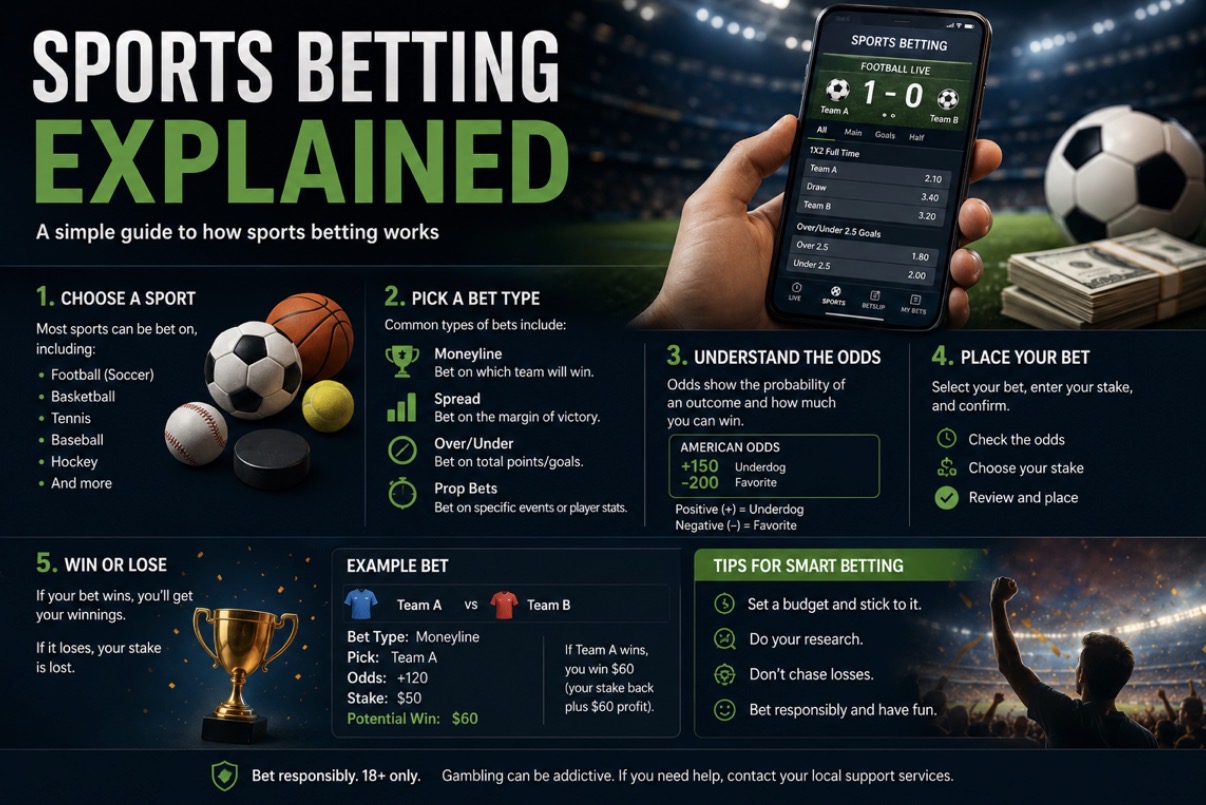
Why Understanding Sports Betting Terminology Matters
Walk into any betting chat and the words fly past as if everyone was born fluent. Vig, chalk, cover, juice. For a newcomer it’s the vocabulary, not the math, that stings. Learn to read a betslip like a regular and a wager stops being a guess.
The fix is learning the words where you can see them work. The sports betting section at 1Red labels every market, odds format and bet type on screen, so each term here has a button to attach to. Match the words to the layout and it stops looking like code.
The Basic Concepts Every Beginner Should Know
Three ideas carry the rest: the bet, the odds, the payout.
What Is a Sports Bet?
A sports bet is money staked on a specific outcome at an agreed price. Back a team to win, or a total to go over a number, and the book sets your odds. Outcome lands, you collect. It doesn’t, the stake’s gone.
Odds and Potential Payouts
Odds pull double duty. They flag how likely a result is and how much it pays, so shorter odds mean a likelier outcome and a smaller reward while longer odds flip both — and your payout is just stake times odds, with €10 at 2.00 returning €20.
Stake and Return
Beginners blur these two. Your stake is what you risk; your return is everything handed back on a win, stake included — so profit is that return minus the stake, which is why €20 back on a €10 bet leaves only €10 in pocket.
Common Types of Sports Bets
Most beginner markets come in four shapes.
Moneyline Bets
The simplest bet on the board. You pick the winner — no margins, no conditions. American odds show the favorite as a minus (-150), the underdog as a plus (+130).
Point Spread Bets
Here the book handicaps the game. The favorite gives points; the underdog gets them. At -6.5, a team must win by seven to “cover” — back the +6.5 dog and a six-point loss still pays.
Over/Under Bets
Forget who wins. An over/under — or totals — bet is the combined score versus a posted line. The book sets 47.5; you call over or under.
Parlay Bets
A parlay ties several picks into one ticket. Every leg must win to cash. The payout swells as the odds compound — but one wrong leg sinks it all. Tempting on paper, brutal in practice.
Essential Betting Terms Explained
A few terms surface constantly. Keep this shortlist close:
- Vig (or juice) — the book’s built-in margin; why fair-looking odds still favor the house.
- Chalk — the heavy favorite; backing the obvious result for a thin return.
- Push — a tie against the line; stake refunded.
- Hedge — betting the other side to lock profit or cut a loss.
- Value — odds longer than the outcome’s true chance. What sharp bettors hunt.
Understanding Sports Betting Odds
Every sports betting price wears one of three outfits. The numbers are identical odds — only the convention differs.
| Format | Looks like | Means |
| American | +200 | Stake €100 to win €200 |
| Decimal | 3.00 | €10 returns €30, stake included |
| Fractional | 2/1 | Win €2 for every €1 staked |
Each format also hides a probability. Decimal odds of 3.00 imply about 33% (1 ÷ 3.00), so price-to-percentage flags a generous line fast. That habit beats any tipster.
Bankroll Management Terms
Knowing the bets means nothing if the cash runs out by Sunday.
Bankroll
Your bankroll is the pot set aside for betting and nothing else — not rent, not bills. Ring-fence it. Its only job is to soak up the swings, not bleed into your life.
Unit Size
A unit is your standard stake, usually 1–2% of the bankroll. Betting in units, not random amounts, stops one bad night wiping you out. On €500, a unit is €5–€10.
Risk and Reward
Every bet trades one for the other; the odds set the rate. Chase long shots, variance grinds you down. Lean only on favorites, the returns barely move. A 1red bet casino bonus can pad your starting bankroll — handy, but check the rollover first.
Live Betting and In-Play Terminology
Not every bet is placed before kickoff. With live betting — in-play — you wager as the action runs and the odds shift by the second, and cash out becomes the headline feature: take a guaranteed sum mid-game instead of riding the result all the way to the whistle.
Common Beginner Mistakes When Learning Sports Betting Terms
Most early stumbles trace back to a misread term, not bad luck:
- Confusing return with profit, then wondering why the win feels thin.
- Treating the favorite as a lock — chalk loses all the time.
- Stacking long parlays and ignoring how fast the odds turn against you.
- Forgetting the vig, so “even” bets quietly cost more.
- Betting random amounts instead of units, then emptying the bankroll on tilt.
Building Confidence Before Placing Your First Bet
Confidence comes from reps, not from memorizing a glossary. Start small. A 1red bet account opens in a minute. After the 1red bet casino login, stake one unit on a moneyline you understand and watch the betslip behave. 1Red keeps sport betting and casino online play on one balance — a match wager and a slot spin share the same funds. Build from there: small stakes, clear bets, a bankroll you respect.
Frequently Asked Questions
What is the most important sports betting term to understand?
Odds. Payouts, value, bankroll math — it all runs off the price. Read odds as a payout and an implied probability, and the rest follows.
What does a favorite mean in sports betting?
The favorite is the side rated more likely to win, shown by shorter odds like -200. Favorites win often but pay little — safer on the slip, lighter on the payout.
How do betting odds work?
Odds price likelihood and set the payout in one number. In decimal form, multiply stake by the figure: €10 at 1.80 returns €18.
Is sports betting the same as casino betting?
Not quite. Sports betting rides on real-world events; casino games run on fixed probabilities. Plenty do both, which is why platforms now bundle sport betting and casino online gaming under one account.
How much of my bankroll should I bet as a beginner?
A common rule is 1–2% per bet — one or two units. On a €200 bankroll, that’s €2–€4 a wager — small on purpose.