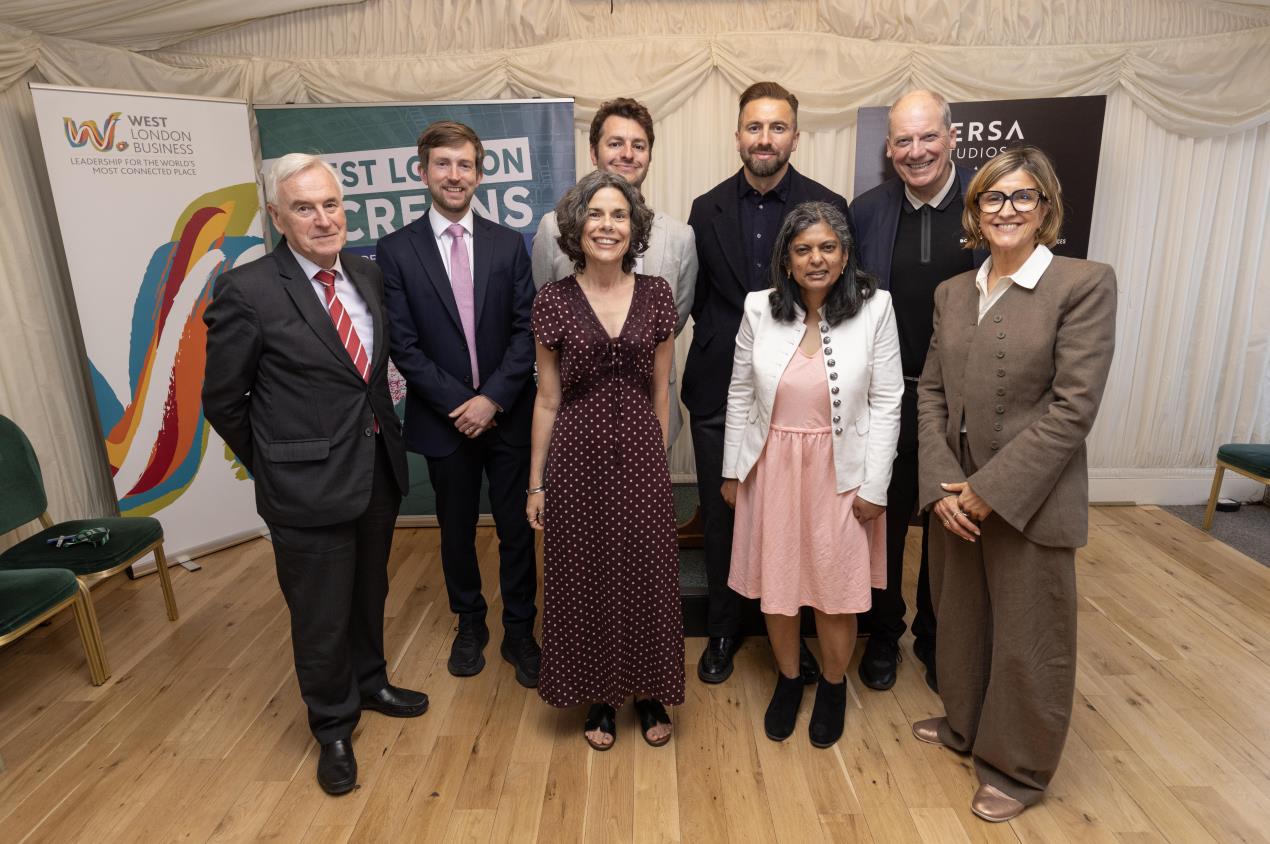
On the evening of 1 June, the University of West London (UWL) was represented by Professor Emily Caston, Director of PRISM (the Public Research Institute of Screen Media), as she led the parliamentary launch of her landmark report ‘West London Screens: The Hidden Engine of the UK’s Convergent Screen Industries’.
The event, held at the House of Commons and hosted by Dr Rupa Huq MP for Ealing Central and Acton – herself a member of the Culture, Media and Sport Select Committee – brought together Ministers, Members of Parliament, and senior figures from across the UK screen industries to discuss the findings of UWL’s most ambitious screen industries research project to date.
125-year-old industrial cluster
The ‘West London Screens’ report, commissioned by West London Business and nine West London local authorities, is the first comprehensive mapping of the sub-region’s screen industries ecosystem. Drawing on data from 6,842 companies with a combined turnover of £74.5 billion and encompassing 82 studios, the research reveals West London as the strategic heart of Britain’s convergent screen industries – spanning film, television, advertising, games, post-production, VFX, and immersive content – and argues that its 125-year-old industrial cluster is the hidden engine driving screen production across the country.
Speaking at the launch, Professor Caston highlighted the methodological innovation that made the research possible, explaining that the team had moved beyond standard ONS statistical methods by deploying The Data City’s industry classification engine, enabling a far more accurate picture of the sector’s true scale. She said:
“We found just shy of 7,000 companies with a turnover last year of £74.5 billion and a growth rate of 3.3% – and if you mine into parts of the sector, you’ll see growth rates as high as 17%.”
Sustained government backing
Jack Abbott MP, Parliamentary Private Secretary in the Department for Culture, Media and Sport, was emphatic about the sector’s economic and social importance. He told the room:
“This is thousands of jobs, this is billions of pounds of investment.”
He pointed to the government’s Creative Industries Sector Plan – a ten-year roadmap – and a screen growth package worth £75 million, along with business rates relief of up to 40% for the next decade, as evidence of serious, sustained government backing. He said:
“This isn’t just warm words. This is specific backing being delivered by this government.”
Dan Tomlinson MP, Exchequer Secretary to the Treasury, reinforced the government’s commitment from a Treasury perspective. As the minister responsible for business rates and tax credits, he confirmed that the Chancellor is closely engaged with the sector’s needs.
“Screen and film – I back it. I know the Chancellor backs it. And we’re always interested in looking at ideas about what more we can do.”
As the MP for Barnet, one of the nine West London boroughs represented in the report, he also pointed to the human dimension behind the data:
“I knock on doors in Barnet and I’ll meet young couples working in the studios, wanting to live in North London – we’ve got to do more to help make it more affordable for people.”
Global and practitioner perspectives
Adrian Wootton OBE, Chief Executive of the British Film Commission and Film London, offered a global perspective, having returned from the Cannes Film Festival the previous week. He said:
“Right now, we have more film, television and advertising – and certainly games – going on in this city and in the UK nations and regions than anywhere else in the world. There are more stars making films here than in Los Angeles right now.”
He praised the “brilliant” report as a model for the whole country:
“This report needs to be mirrored and done in other parts of the UK, because it’s really showing the wealth and fantastic interconnections between businesses and this area. That has a massive impact on London – and a massive impact on the UK as a whole.”
Charlie Ingall, Co-Founder of VERSA Studios – whose 600,000 square feet of studio facilities span London, Manchester and Leeds – offered a practitioner’s perspective. He said:
“I think everyone probably knows how impactful this industry is, but this report is showing it is even more impactful.”
He drew on VERSA’s own experience to illustrate how West London anchors the national screen ecosystem: productions initiated from the company’s Acton base had generated £45 million of spend and thousands of jobs in Leeds alone. He concluded:
“A strong West London is actually a strong UK, and it’s so important that we stay ahead of that.”
Senior figures from across the industry
Attendees included John McDonnell MP; Krishnan Guru-Murthy, Main Anchor of Channel 4 News and Unreported World; Hasan Bakhshi MBE, CEO of the Creative PEC; Marcus Ryder MBE, CEO of the Film and TV Charity; Neil Hatton MBE, CEO of UK Screen Alliance; Rishi Coupland, Executive Director of Industry Development and Innovation at the British Film Institute; Elizabeth Diaferia, Head of the Creative Industries Trade and Investment Board; and Steve Davies, CEO of the Advertising Producers’ Association.
The House of Commons event marks a significant moment for UWL’s growing profile in policy-facing research. The university’s investment in PRISM and in Professor Caston’s programme of work on the UK’s hidden screen industries is now directly informing national creative industries strategy at the highest level.