Desk drawers rarely start out messy. They usually begin with a bit of structure. Pens in one section, sticky notes in another, maybe a few spare cables tucked away. Over time, though, things get added without much thought.
A few extra office supplies here, a handful of loose items there, and gradually the drawer stops working as intended.
It is not usually a lack of storage that causes the problem. It is the absence of any clear system once new items start building up.
Why desk drawers become difficult to manage
Most desk drawers end up acting as catch-all storage.
Items that do not have an obvious home tend to land there first. Binder clips, spare stationery, tech accessories, even paperwork that has not been filed yet. Without any structure, those items shift around every time the drawer is opened or closed.
Over time, that movement creates friction. Things get buried, duplicates build up, and it becomes harder to find what you need, especially when you are trying to grab something quickly before a meeting or end up replacing items you already own but cannot locate.
Starting with a clean base
The most effective way to reset a drawer is to take everything out and group it properly.
This does not need to be overly detailed. A few simple categories are usually enough:
- writing tools
- small office supplies such as sticky notes and binder clips
- documents or file folders that are still in use
- cables or small tech accessories
Seeing everything laid out makes it easier to decide what actually needs to go back into the drawer and what does not.
Using drawer organisers to create structure
Once items are grouped, the next step is to introduce some form of structure so everything stays in place.
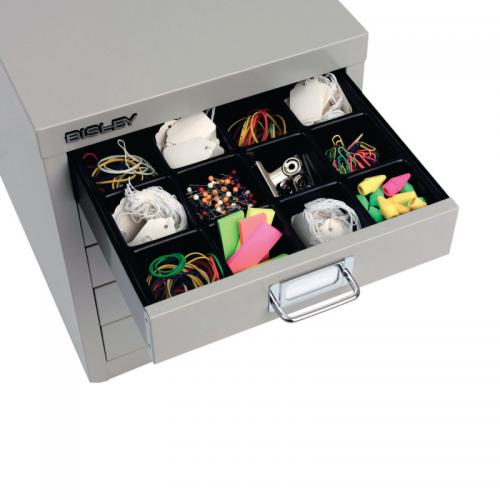
This is where a drawer organiser starts to make a real difference, particularly in a desk drawer organiser setup where different categories need to stay visible and easy to access throughout the day. Rather than relying on a single open space, organisers divide the drawer into smaller sections, making it easier to assign a place for each item.
Drawer dividers, stacking trays, or compartment-based storage solutions all achieve the same goal. They reduce movement, improve visibility, and make it easier to return items to the same place after use. In practice, this tends to save time during the day, as items can be found quickly without disrupting the rest of the drawer.
In deeper desk drawers, combining organisers with stackable bins or layered trays creates a more flexible drawer organisation system that can handle both small and bulkier items without becoming overcrowded.
Making better use of space
One of the more common issues with desk drawers is that horizontal space gets filled quickly, while vertical space is left underused.
Using vertical storage, even in small ways, can make a noticeable difference. Stacking trays or using slightly deeper compartments allows you to separate items without spreading them across the entire drawer.
This is particularly useful for drawers that hold a mix of office supplies and bulkier desk accessories, with retailers such as Office Stationery supplying a wide range of storage solutions where a flat layout quickly becomes inefficient.
Choosing materials that hold up
Not all organisers behave the same over time.
Acrylic inserts tend to work well for visibility, especially when you want to see contents at a glance. Bamboo organisers offer a more solid structure and are often better suited to heavier use. Plastic drawer organisers are typically the most flexible option, particularly when you need to adjust layouts over time.
The right choice usually depends on how often the drawer is used and how varied the contents are.
Keeping the system consistent
Even a well-organised drawer will drift if it is not maintained.
A simple routine helps. A quick weekly reset, where items are put back in place and anything unnecessary is removed, is often enough to keep things under control. Some people also follow a one in, one out policy, where adding a new item means removing something else.
Labelling can also help, particularly in shared environments. Using a label maker or simple visual cues makes it easier to maintain consistency without overthinking it.
A more practical way to think about it
Desk organisation is less about finding the perfect setup and more about creating something that is easy to maintain.
Drawer organisers do not solve the problem on their own, but they make it easier to keep things in order once a basic structure is in place. They give items a defined space, reduce unnecessary movement, and make everyday use more efficient.
When that happens, staying organised becomes less of an effort and more of a habit.