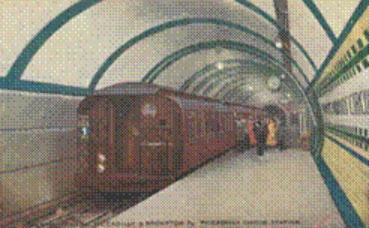
London Transport Museum is marking 120 years of the Piccadilly line with a season of special events celebrating the history, design and cultural impact of one of London’s most iconic Underground lines.
A brief history of the Piccadilly line
The Piccadilly line opened in December 1906 as the Great Northern, Piccadilly and Brompton Railway. Running between Finsbury Park and Hammersmith, it was the longest deep-level Tube railway in the world at the time, stretching 14.5 kilometres (9 miles).
Over the last 120 years, the line has expanded to connect more people and places across the capital, evolving with new engineering innovations.
The line was built using an engineering device called the Greathead Shield and cast-iron tunnel linings. This engineering breakthrough allowed railways to be constructed deep beneath the capital’s built-up city streets from 1890 onwards. In 1911, it became the first Underground line to introduce an electric escalator at Earl’s Court. In the early 1930s the line was extended at both ends to Cockfosters, Hounslow West and Uxbridge.
The Piccadilly line has played a vital role during key moments in national history
During the Second World War, deep-level Piccadilly line stations became places of refuge for Londoners sheltering during air raids. Stations including Aldwych and Piccadilly Circus also safeguarded national treasures from The National Gallery and British Museum.
In 1939, Down Street – a now disused station between Green Park and Hyde Park Corner – was transformed into a secret wartime bunker. It became a command centre used by the Railway Executive Committee to keep Britain’s mainline railways running and even protected Prime Minister Winston Churchill during the Blitz.
The Piccadilly line today
Today, the Piccadilly line is the capital’s second longest Underground line.
It stretches 71 kilometres (44 miles) and serves 53 stations, linking Londoners and visitors with the West End, Hyde Park and some of the city’s most loved museums and cultural destinations, including London Transport Museum in Covent Garden and the Natural History Museum and V&A in South Kensington. It is also the only Tube line to boast a station named after a football team, Arsenal FC.
Transport for London (TfL) has been working with Siemens Mobility on a new fleet of state-of-the-art Piccadilly line trains featuring walk-through carriages, air conditioning, CCTV and improved access. The new trains are forecast to start entering service between December 2026 and June 2027.
Matt Brosnan, Head Curator at London Transport Museum, said: ‘The opening of the Piccadilly line in 1906 marked an era of engineering ambition and rapid transport expansion that shaped the growth of London and the way people lived, worked and explored the city.
‘Our line-up of events will delve into these stories, giving people the chance to discover more about London while enjoying unique experiences at the Museum in Covent Garden and at our Museum Depot in Acton.’
Andy Lord, London’s Transport Commissioner, said: ‘Running through the heart of the capital, the Piccadilly line has a distinctive and much-loved heritage, connecting everything from world-famous museums to theatres to airports. Millions of people use the line every year and as we prepare to introduce our new state-of-the-art trains along the line, it’s the perfect moment for people to reflect on its past and celebrate its future with London Transport Museum.’
Piccadilly line themed events at London Transport Museum, Covent Garden and the Museum’s Depot, west London in 2026
Workshop: Make a textile artwork inspired by the Piccadilly line, Saturday 13 June
Join artists Hâf Weighton and Sophie Levi-Kallin for a hands-on textile adult half-day workshop inspired by the 120th anniversary of the Piccadilly line. Ticketholders will explore the Museum’s latest exhibition, Art deco: the golden age of poster design before creating their own textile artworks inspired by Piccadilly line stations, using transport-inspired fabrics, moquette offcuts, hand-stitching and embellishment techniques.
Book now: www.ltmuseum.co.uk/whats-on/make-a-textile-artwork-piccadilly-line
Talk: 120 years of the Piccadilly line with Tim Dunn, Saturday 22 August
Celebrate 120 years of the Piccadilly line in an expert talk with railway historian and broadcaster Tim Dunn.
Join Tim as he explores stories of the Piccadilly line’s construction, operation, architecture, trains and more! Discover modernist gems and abandoned stations, while digging out surprising engineering and technology from this remarkable railway.
From Cockfosters to Heathrow, guests will leave this talk with fascinating heritage elements to spot, enjoy and explore along the Piccadilly line.
Book now: www.ltmuseum.co.uk/whats-on/talks/120years-piccadilly-line-tim-dunn
Museum Depot open days: design classics, 25 – 27 September 2026
London transport’s design heritage is world-famous – but what about the people and stories behind those iconic creations? From Charles Holden’s architectural vision for Piccadilly line stations to Harry Beck’s revolutionary Tube map and Enid Marx’s bold Tube seating fabric or ‘moquette’ patterns, discover the names that shaped the look and feel of London.
Book now www.ltmuseum.co.uk/whats-on/depot-open-days/design-classics
October half term: along the Piccadilly line, 24 October – 1 November
Families can have fun during October half term as they celebrate the 120th anniversary of London’s Piccadilly line at London Transport Museum. Families can learn about this historic Underground line and the people and places it connects us to.
More information here: www.ltmuseum.co.uk/whats-on/october-half-term-along-piccadilly-line
Exclusive Hidden London tours on the Piccadilly line, Wednesdays to Sundays in 2026
Additionally, visitors will be able to explore the secret parts of the Piccadilly line by joining one of the Museum’s exclusive Hidden London guided tours, including:
Aldwych: the end of the line, which explores a disused station and former branch terminus of the line which closed in 1994
Dover Street: alight here for Green Park, which explores secret parts of Green Park station
Holborn: the secret platforms, which takes visitors into the third of the station that is not open to the public
Piccadilly Circus: the heart of London, which explores the closed-off remnants of the original Edwardian station
Tickets can be booked at www.ltmuseum.co.uk/hidden-london